Wastewater
Digital Parameter Logging Wastewater: What the Switch from Paper Logbooks Actually Looks Like
Most small wastewater plants switch from paper logbooks to digital parameter logging not because paper is broken - but because re-entering the same numbers twice every day finally stops being worth it.
October 8, 2026 · 4 min read
TL;DR
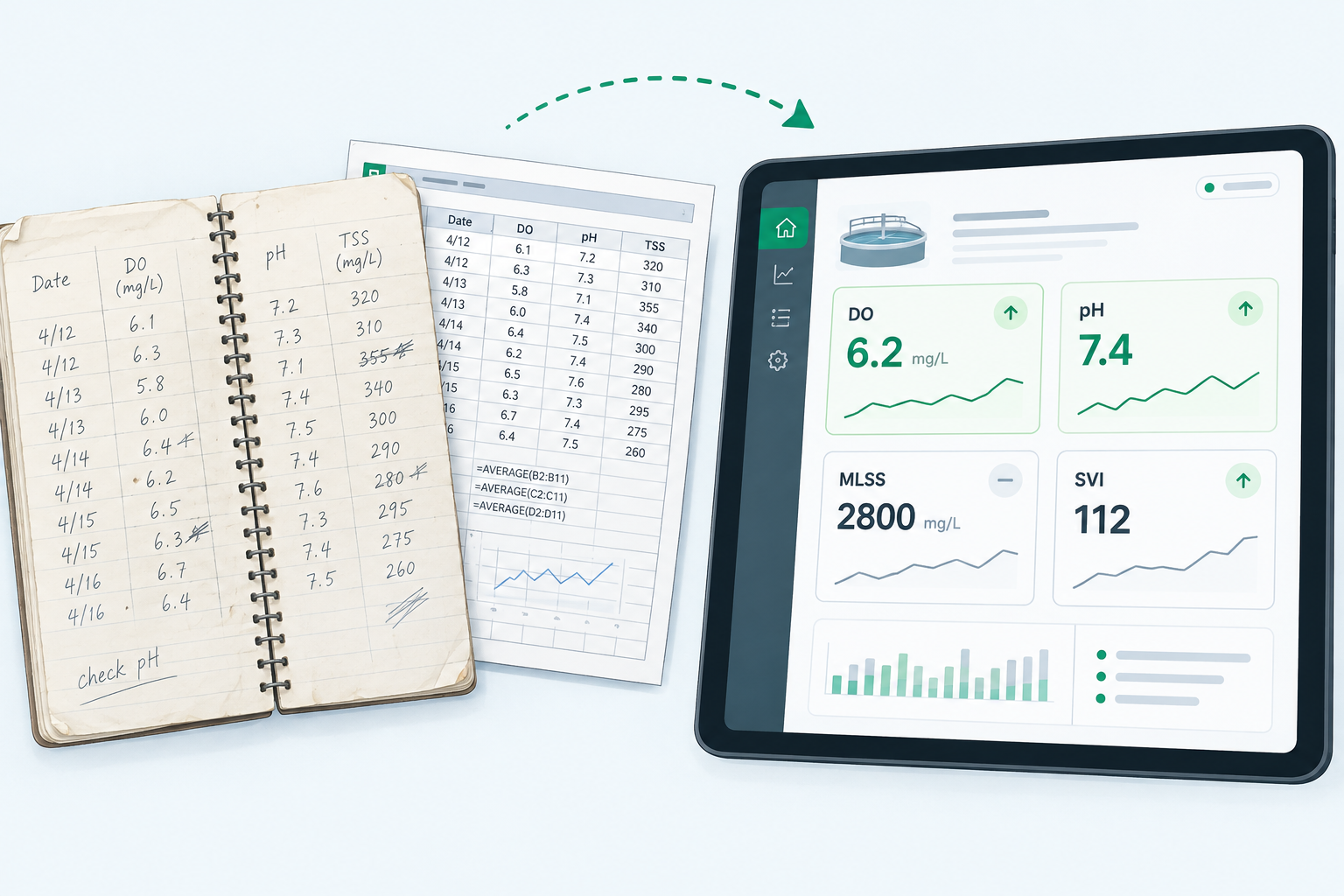
Most small wastewater plants switch from paper logbooks to digital parameter logging not because paper is broken - but because re-entering the same numbers twice, every day, finally stops being worth it. The transition itself is less dramatic than operators expect: start logging digitally, run the existing and digital workflows in parallel for an initial validation period, and move to digital-primary once the team confirms record completeness, calculations, exports, and backup procedures. The biggest change isn't the interface - it's not having to compile a monthly report from four different spreadsheets under deadline pressure.
Why do most small plants still use paper logbooks?
Paper logbooks aren't wrong. They have worked for decades, and operators who learned on paper know exactly how to use them. A well-kept logbook is auditable, portable, and doesn't require a login.
The problem isn't the paper. The problem is everything that happens after you close the logbook.
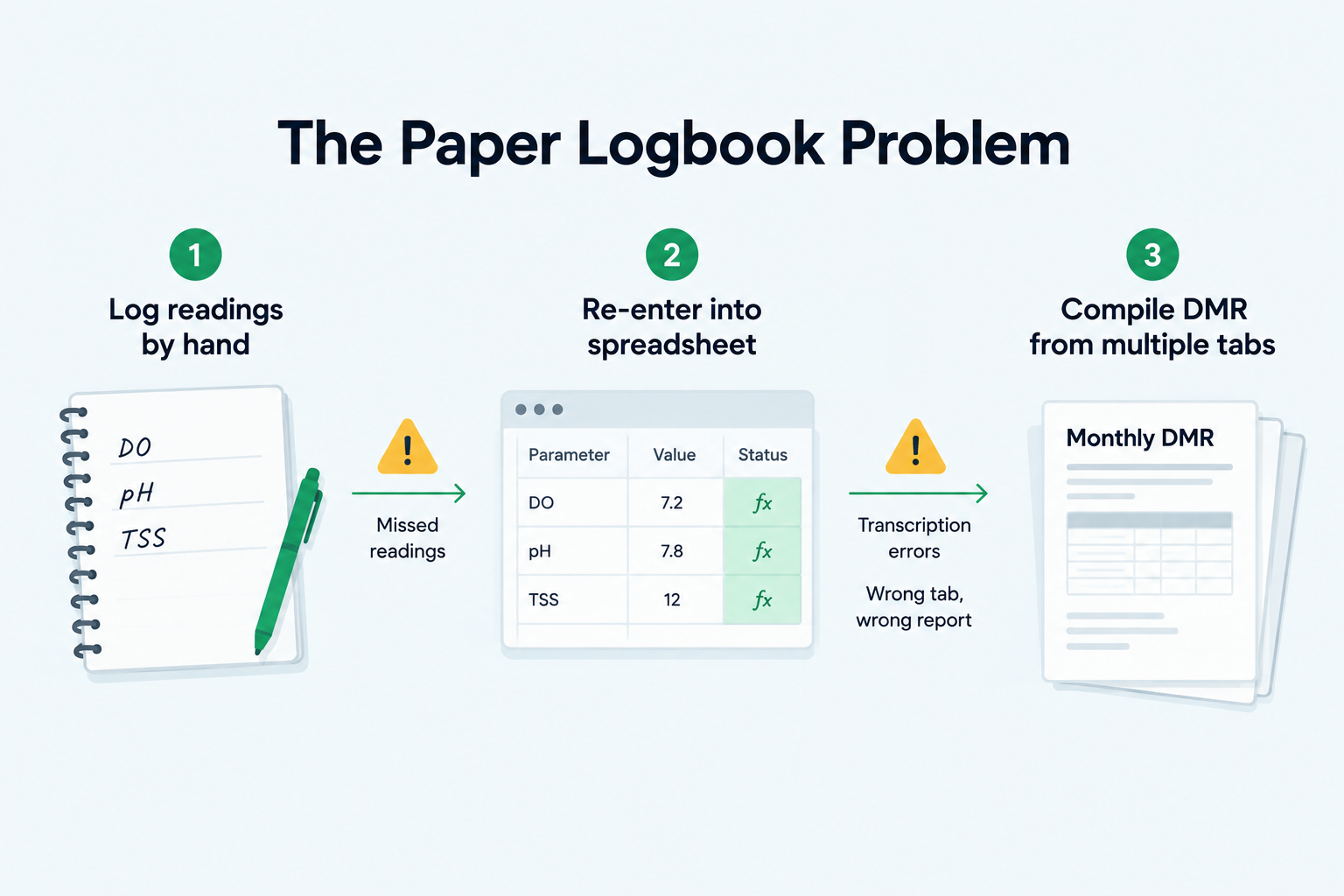
DO, pH, MLSS - you log them by hand on the walkthrough. Then later, someone re-enters the same numbers into a spreadsheet. Then at the end of the month, that spreadsheet feeds into the DMR. If anything in that chain is off - a transposed value, a formula someone overwrote - the error shows up in the submission.
At plants that use paper-to-spreadsheet workflows, it's familiar. It also means every reading gets entered twice.
What does the breaking point actually look like?
It's usually not one thing. It's the compounding weight of small friction over years.
Consider a familiar scenario: it's Friday afternoon before a holiday weekend, and the monthly DMR is due Tuesday. Staff must reconcile three spreadsheets, six tabs, and two operators' handwritten records. The report gets done - it always gets done - but the process itself is the problem.
Common breaking points operators describe:
Logging pH and DO at 6 a.m. on paper, re-entering them into the spreadsheet at 4 p.m. - and sometimes delaying or missing the spreadsheet transcription
SVI calculations done on a calculator, written in the logbook, never checked against the actual formula
A TCEQ inspector asking for readings from 60 days ago, and spending 45 minutes paging through a spiral notebook to find them
A process upset that, in retrospect, showed up in the trend three days before - but the trend was invisible because the data was in a logbook
The wastewater daily log digital question isn't really about the log itself. It's about the re-entry, the calculation errors, and the monthly compile.
How does the transition actually happen?
Most operators expect this to be harder than it is.
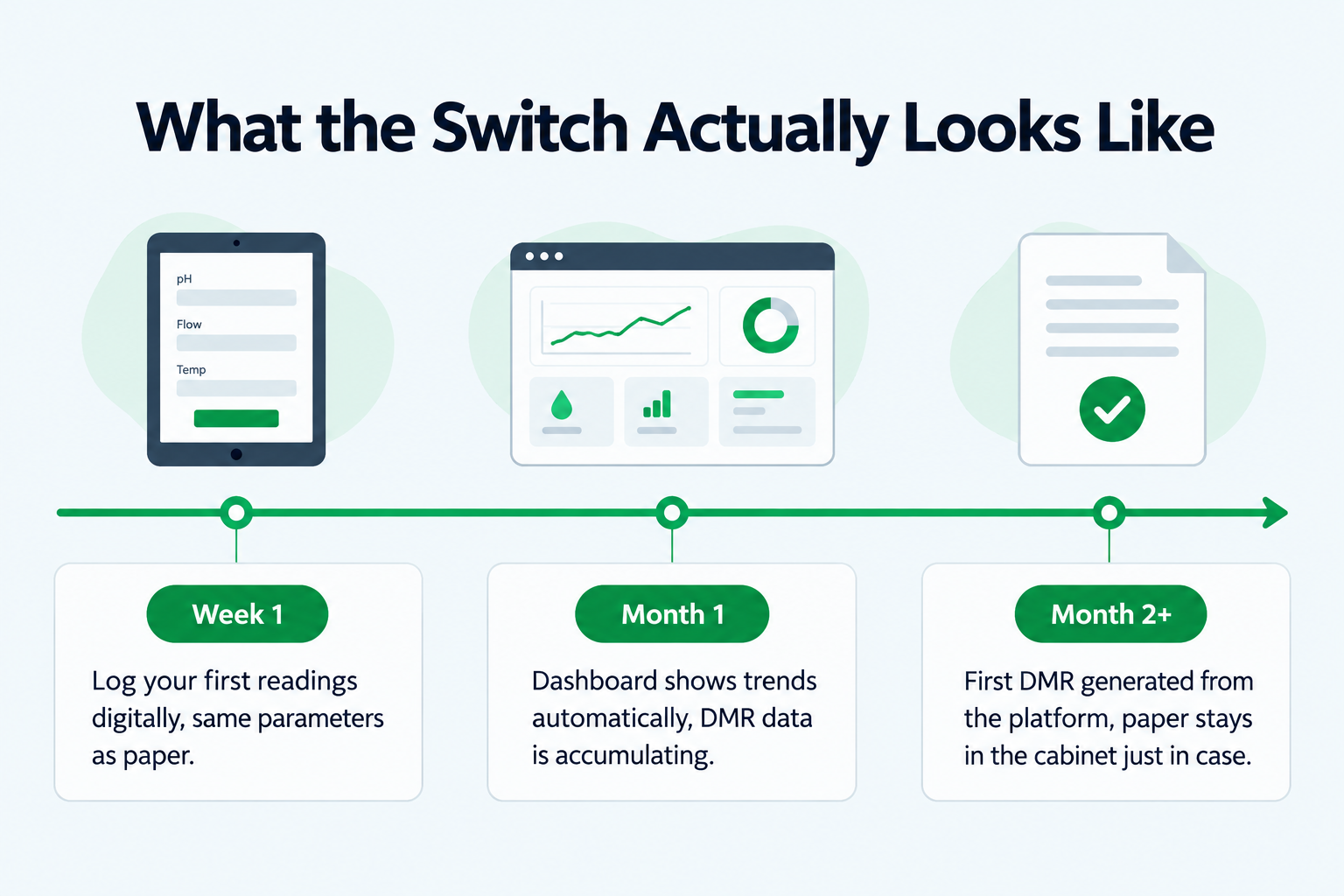
A small plant typically starts by logging one shift digitally - just the regular parameters they already track. DO, pH, temperature, MLSS, chlorine residual. Same readings, different medium.
ComplyFlo, which builds wastewater operator logbook software specifically for Texas plants, is designed around exactly this workflow. Operators log from a phone or tablet. Each entry records who entered it and when. Operators also record the actual measurement or sample date, time, and location, along with the sampler and applicable laboratory information - entry timestamps do not replace the original sampling or measurement details. When the required readings and plant configuration are available, ComplyFlo calculates supported process-control metrics and updates their trends automatically.
Most plants run the existing and digital workflows in parallel for at least one reporting cycle. The paper stays in the cabinet. Staff reconcile the two records, confirm that calculations match expectations, and verify that exports and backup procedures work before making digital the primary system.
Paper vs. digital: what the same tasks look like
Task | Paper workflow | Digital workflow |
|---|---|---|
Log DO reading | Write in logbook | Enter on phone, auto-timestamped |
Calculate SVI | Calculator, write in logbook | Auto-calculated when both SV30 and MLSS readings are available |
Find a reading from 60 days ago | Page through spiral notebook | Search by date in seconds |
Compile monthly DMR | Pull from multiple spreadsheet tabs | Configured permit data can populate a draft DMR preparation package; staff verify before submission |
Track SSO event | Notepad + calendar reminder | Record the awareness timestamp; track applicable reporting deadlines and exceptions |
Review permit milestones | Personal calendar | Dashboard tile with lead-time alerts |
What's different six months after the switch?
The work is the same. The operator still walks the plant, checks equipment, makes decisions. That doesn't change.
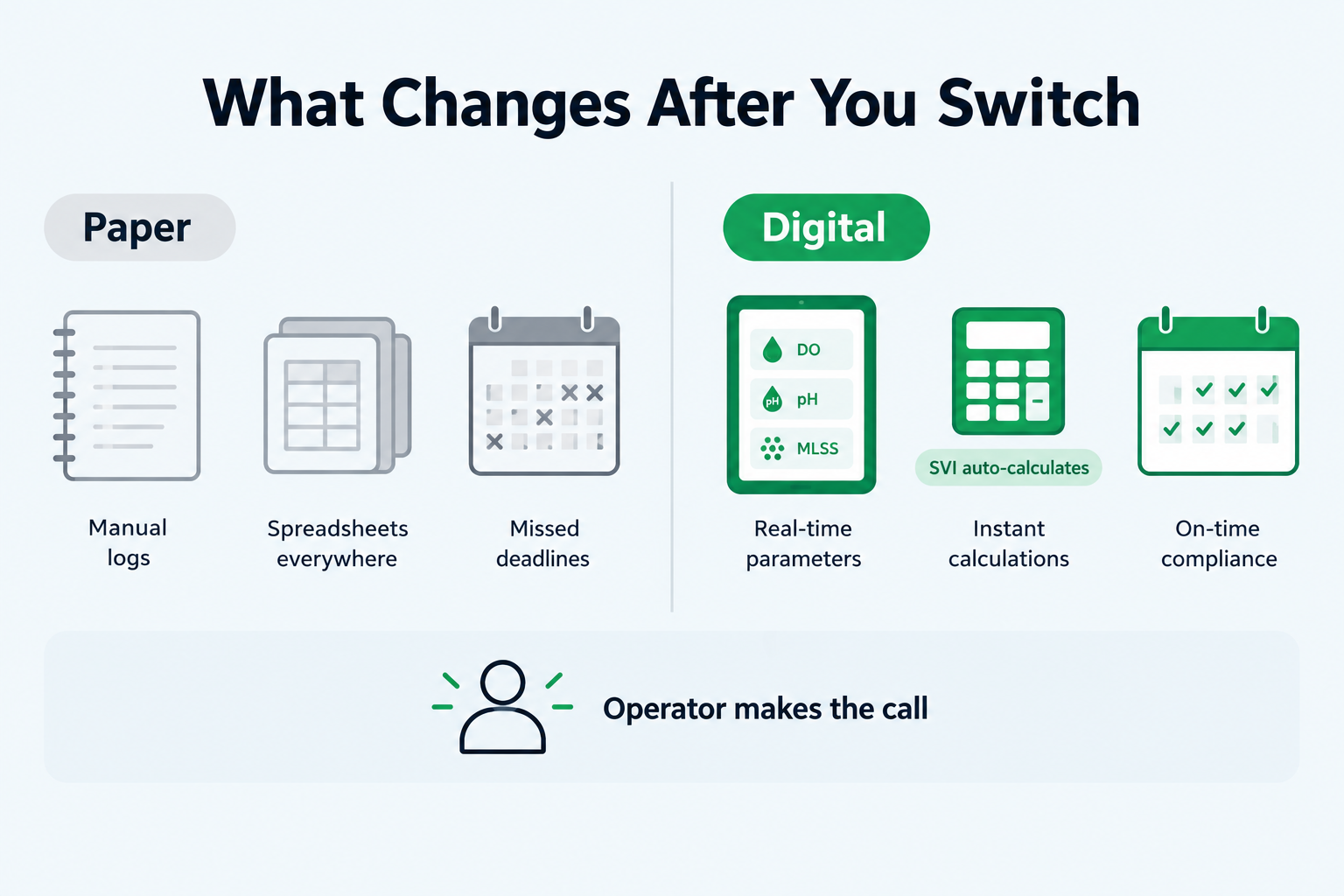
What changes is the overhead.
Readings don't get re-entered twice. Process calculations don't live in isolated spreadsheets with formula drift risk. Configured permit-reporting data can populate a draft DMR preparation package throughout the monitoring period - staff still verify required samples, laboratory results, units, calculations, and reporting statistics before an authorized signatory certifies and submits the report, but they're not starting from scratch at the end of the month.
Some operators describe a subtler change: they can actually see what's been happening. When SVI starts trending up, they notice it before it becomes a problem. When flow spikes after a storm event, the dashboard shows exactly what happened to every other parameter at the same time.
In a 2016 Hydromantis blog describing feedback from wastewater operators, about 55% of respondents said their first instinct when something goes wrong is to troubleshoot it themselves. The post does not report a sample size, so the result is illustrative rather than an industry-wide estimate. The broader point holds either way: digital parameter logging doesn't change an operator's troubleshooting instinct - it just gives them better information to work with when they do.
Is digital parameter logging worth it for a small plant?
Yes - but the right question is whether the timing is right for yours.
If your plant is running on one operator and a paper logbook, and the system is working, there's no emergency. The case for switching is the overhead that compounds over time: the re-entry, the spreadsheet maintenance, the monthly compile. Those hours add up across a year.
The case is stronger if you're also trying to get your TCEQ compliance documentation in order, if permit sampling schedules are easy to miss, or if you're heading into a TPDES renewal window. A well-managed digital system can make records easier to retrieve; completeness and reliability matter more than format alone.
Moving to digital logging does not mean discarding historical records. Preserve original records for their applicable retention periods - EPA's standard NPDES conditions generally require at least three years of monitoring records, with longer requirements for sewage-sludge use and disposal records and possible extensions. Maintain secure backups, verify that records remain readable and exportable, and establish access controls and a documented correction history so staff can distinguish original entries from later changes.
Try ComplyFlo
ComplyFlo is built for Texas wastewater plants making exactly this transition - package plants with lean staffing, not large utilities with dedicated IT departments. Operators log readings from a phone or tablet. When the required readings and plant configuration are available, supported process calculators - SVI, F/M, SRT, BOD removal efficiency - calculate and update their trends automatically. Configured permit-reporting data can populate a reviewable DMR preparation package throughout the monitoring period, which staff verify and certify before submission.
You don't need a SCADA integration to start. File imports and manual entry work on day one, and you move up the automation curve at your own pace.
Book a demo or learn more at complyflowaste.com.
Frequently Asked Questions
What is a digital wastewater daily log?
A digital wastewater daily log is software that replaces paper logbooks for recording plant parameters like DO, pH, TSS, MLSS, and temperature. Readings are entered on a phone or tablet, stored in a searchable database, and attributed to the person who entered them. When the required inputs and plant configuration are available, the platform can auto-calculate supported process-control values like SVI and F/M, and configured permit data can populate a reviewable DMR preparation package throughout the monitoring period. Platforms like ComplyFlo are built specifically for Texas wastewater treatment plants and package plants.
Can I switch to digital parameter logging without disconnecting my SCADA system?
Yes. Most plants start with manual entry or file imports - no SCADA integration required on day one. Wastewater operator logbook software like ComplyFlo supports manual entry, CSV uploads, and scheduled file imports before any live SCADA connection is set up. You can add a SCADA integration later, subject to integration planning and validation, without rebuilding records already entered.
How long does the transition from paper to digital logbooks take?
A phased rollout over one or two reporting cycles can be a practical starting plan, but the timing depends on staffing, connectivity, permit complexity, historical-data needs, and validation. A common approach: start with selected parameters, run existing and digital workflows in parallel, compare records and calculations, and expand once staff confirm that the workflow is reliable. TPDES permit compliance documentation is often one of the clearest areas where digital records reduce end-of-month workload.
Does TCEQ require wastewater operator logbook software?
TCEQ does not require a specific software platform for daily parameter logging. What TCEQ requires is accurate, complete records that support your monthly Discharge Monitoring Report and your TPDES permit conditions. Digital logbooks make that documentation easier to maintain, search, and export - but the underlying compliance obligation is the same whether your records are on paper or in software.
What parameters can I track in digital logbook software?
Most wastewater operator logbook software tracks permit-monitoring and operational parameters, depending on the facility - commonly dissolved oxygen (DO), pH, temperature, TSS, MLSS, ammonia (NH3-N), chlorine residual, and turbidity. ComplyFlo also calculates supported process-control values - SVI, F/M ratio, SRT, BOD removal efficiency, and HRT - when the required inputs and plant configuration are available, without requiring a separate spreadsheet.
Free checklist
TPDES Permit Compliance Checklist
Review permit-specific DMR submissions, sampling, SSO reporting, renewal milestones, and applicable pretreatment responsibilities.
Ready to move your plant logs and reports off paper?
Book a free 1-hour demo with a ComplyFlo team member and see it running on your own workflow.
Book a free demoGet TCEQ compliance updates
Deadline reminders, rule changes, and practical guides for Texas waste operators. No spam — unsubscribe anytime.
By subscribing you agree to receive emails from ComplyFlo. See our privacy policy.