Wastewater
TPDES Permit Compliance Checklist Texas: DMR Deadlines, SSO Reporting, and Permit Milestones
A practical TPDES permit compliance checklist for Texas wastewater plant operators covering DMR due dates, sampling requirements, SSO obligations, permit milestones, and pretreatment basics.
October 8, 2026 · 11 min read
TL;DR
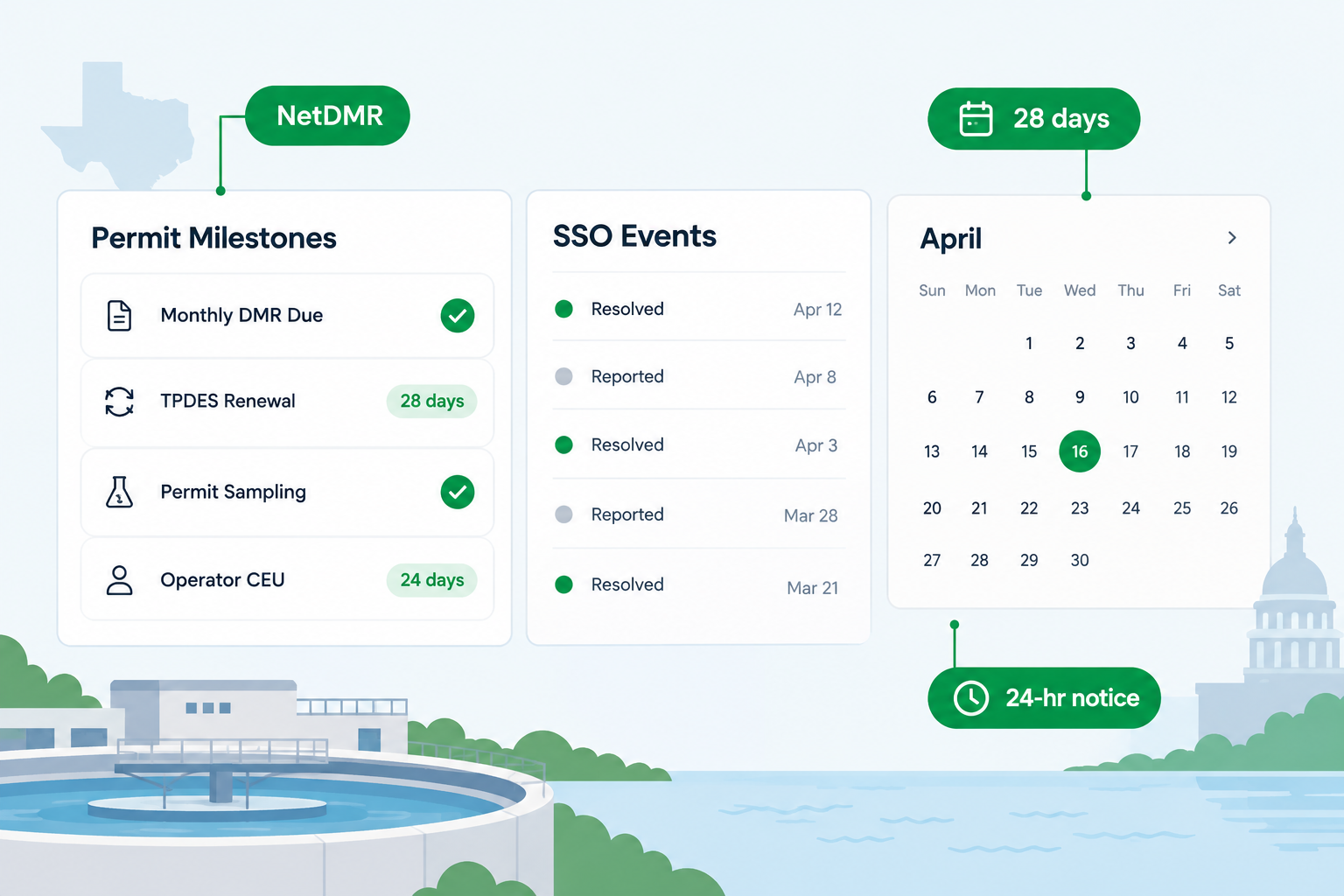
Texas wastewater facilities should build their compliance calendar from their actual TPDES permit and other applicable requirements. Monthly wastewater DMRs are commonly due by the 20th of the following month and generally must be submitted through NetDMR unless an approved electronic-reporting waiver applies. Sampling parameters, frequencies, methods, units, and calculations are permit-specific. Unauthorized discharges and SSOs generally require notification within 24 hours of awareness and a written report within five working days after awareness, unless all monthly-summary eligibility conditions are met. Public notification under 30 TAC 319.301-319.303 may also be required. Track permit renewal, monitoring, operator licensing, and pretreatment obligations where applicable. ComplyFlo helps organize records, calculations, reminders, and reporting workflows; it does not replace permit review, authorized certification, or qualified operator judgment.
What does a TPDES permit actually require you to track?
Your TPDES permit is the legal document that authorizes your discharge and sets the rules for everything your plant puts into Texas surface waters. The permit spells out which pollutants you must monitor, how often you must sample, what your effluent limits are, when you report, and what special conditions apply.
TPDES stands for Texas Pollutant Discharge Elimination System. It is Texas's version of the federal NPDES program administered under the Clean Water Act. The EPA delegated NPDES oversight to the Texas Commission on Environmental Quality (TCEQ) in 1998. Since then, TCEQ sets the effluent limits in every Texas permit to protect Texas Surface Water Quality Standards.
Every permit is different, but the compliance obligations typically fall into five categories for Texas municipal plants:
DMR submissions (monthly in most cases)
Parameter sampling (per your permit's monitoring schedule)
Permit milestone tracking (renewals, audits, sampling windows)
SSO event reporting (immediate, with specific deadlines running from awareness)
Pretreatment program management (where required by your permit)
The rest of this checklist walks through each one. Treat every item as a starting point - your actual permit, not this article, controls your obligations.
When are Texas DMRs due, and what happens if you miss the deadline?
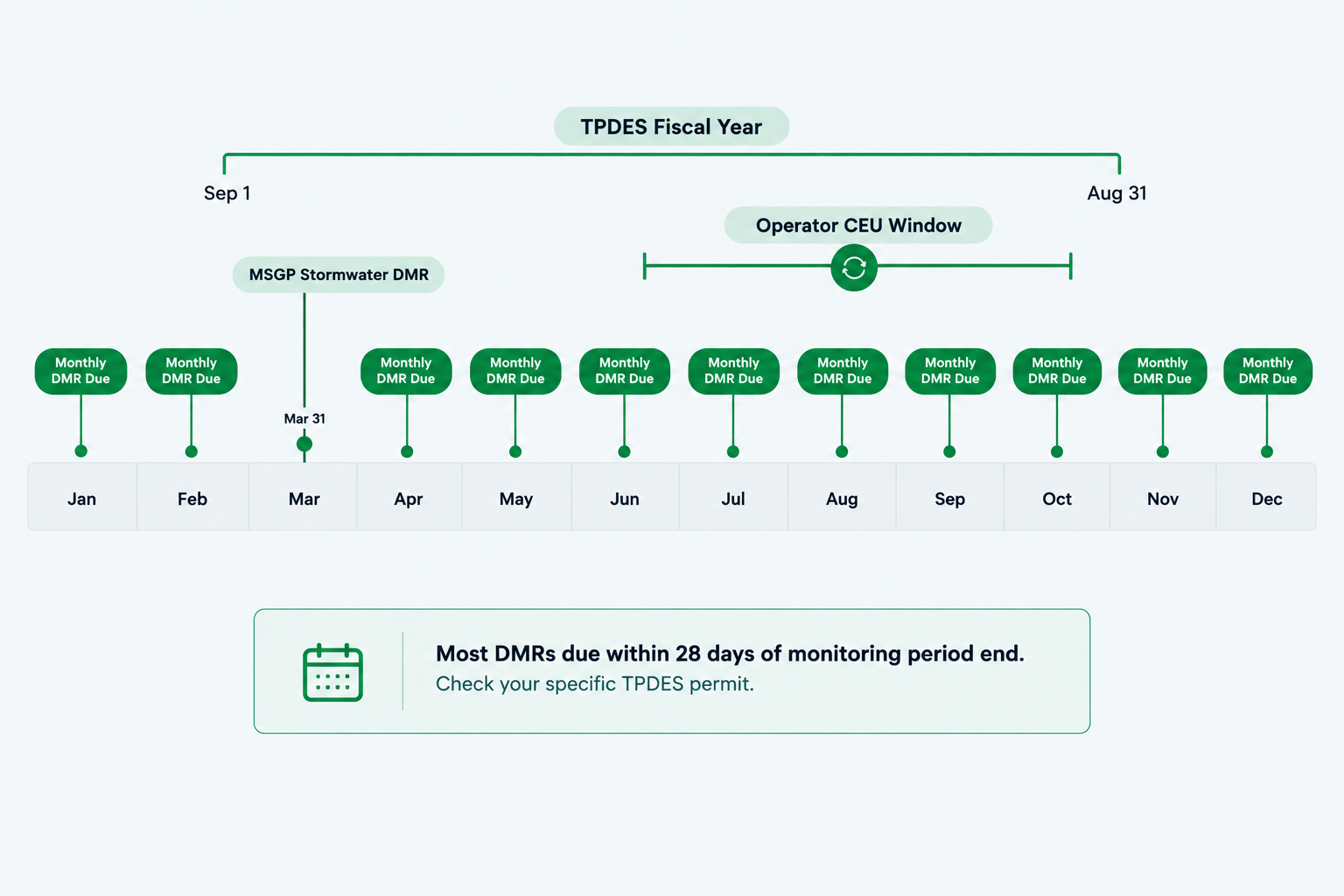
Monthly wastewater DMRs are commonly due to TCEQ by the 20th day of the following month. For example, January monitoring results are commonly due February 20. Always confirm the reporting frequency and exact due date in your facility's permit - different obligations may use different periods and deadlines.
Facilities required to submit DMRs generally must report electronically through NetDMR, the EPA's Central Data Exchange portal. TCEQ provides a Request for Electronic Reporting Waiver (Form TCEQ-20754) for facilities unable to report electronically. A facility should not switch to paper reporting without confirming that an approved waiver or other applicable authorization permits it. Industrial stormwater facilities covered under the Multi-Sector General Permit (MSGP) face a different deadline: DMRs are due March 31 annually.
Missing the DMR deadline is a permit violation. TCEQ can issue a Notice of Violation. Consequences depend on the applicable law, permit conditions, violation, and circumstances.
A few things to know about NetDMR before month-end:
You need an active CDX account and the NetDMR Program Service added to it
Assign access according to the user's duties. Only an appropriately authorized signatory can electronically sign and certify the DMR. Entering or saving data is not the same as completing submission
The DMR is not submitted until it is electronically signed. A saved draft is not a submission
NetDMR performs automatic validation and flags hard errors (must fix before submission) and soft errors (warnings you can submit with explanation)
Different obligations may use calendar-year, monthly, permit-specific, or other reporting periods. Configure each deadline from the applicable permit or reporting instruction.
What does your TPDES permit require you to sample?
Your permit's Monitoring and Reporting section defines the exact parameters you must test. It also sets the sampling frequency, analytical methods, and whether you report a daily average, daily maximum, monthly average, or geometric mean. The precise parameter, sample type, frequency, units, and calculation required by your permit control - the list below is illustrative, not universal.
Common parameters in Texas municipal wastewater treatment plant permits include:
BOD₅ or CBOD₅ (Biochemical Oxygen Demand, 5-day, or carbonaceous variant) - use the exact form your permit specifies
TSS (Total Suspended Solids) - measures particulate matter
NH₃-N (Ammonia as Nitrogen) - measures nitrogenous pollutants
DO (Dissolved Oxygen) - measures oxygenation
pH - must stay within permit range (SU)
Flow - report the statistics and units required by the permit. Average or maximum flow may be expressed in million gallons per day (MGD); total volume for a month is expressed in volume units such as million gallons (MG) where required
Temperature - in degrees Celsius or Fahrenheit as specified
Fecal coliform or E. coli - geometric mean calculation required; use the parameter your permit specifies
Chlorine residual - where disinfection is applied
Percent removal - treatment efficiency calculations where required
Industrial dischargers may also need to monitor for heavy metals (cadmium, chromium, lead, mercury, zinc), oil and grease, COD, TOC, and industry-specific compounds.
A few sampling errors that create problems at NetDMR submission:
Wrong calculation type: Using a simple average for E. coli instead of geometric mean, or reporting a monthly average when the permit also requires a daily maximum
Non-approved analytical methods: Your permit specifies which EPA methods are acceptable. Using a different method is a compliance violation, not just a data quality issue
Biomonitoring gaps: If your permit requires quarterly toxicity testing, missing a quarter is a monitoring violation. These tests require advance scheduling with a certified lab
The samples you collect during the month become the DMR you submit at month-end. Every missed sample is a gap you have to explain in NetDMR before you can submit.
What TPDES permit milestones should you be tracking?
Build the compliance calendar from the facility's actual permit, operator-licensing requirements, approved pretreatment program, enforcement orders, and other applicable obligations. The items below are common examples - not a universal list, and not all automatically constitute permit violations when missed.
TPDES permit renewal: Individual municipal domestic wastewater permits have fixed terms. TCEQ directs applicants to submit renewal applications 180 days before permit expiration. Track that application deadline—not just the expiration date—and confirm the requirements applicable to your specific permit. See TCEQ’s Municipal Domestic Wastewater: The Permitting Process
Permit-specific sampling schedules: Beyond routine DMR parameters, some permits include episodic sampling windows, seasonal monitoring, biomonitoring, or special studies with their own calendars
Pretreatment program reporting: Where a facility has an approved pretreatment program, periodic reports to TCEQ may be required under that program's terms
Collection-system obligations: Where required by a permit, enforcement order, or participation agreement, capacity management and operations and maintenance (CMOM) commitments may carry their own reporting deadlines
Operator license renewals: TCEQ issues wastewater treatment operator licenses in Classes A, B, C, and D (plus provisional Class D). Collection-system operator licenses are Classes I, II, and III. Each license has an expiration date and renewal requirements
Continuing education (CEU) requirements: TCEQ generally requires 30 continuing-education hours for wastewater-license renewal, completed before the license expiration date. Requirements vary by license class - verify the specific renewal path for each license held
Most plants track these in a calendar or not at all. A milestone that gets missed typically shows up for the first time during a TCEQ inspection, when the enforcement clock has already started.
What are your SSO reporting obligations under TCEQ rules?
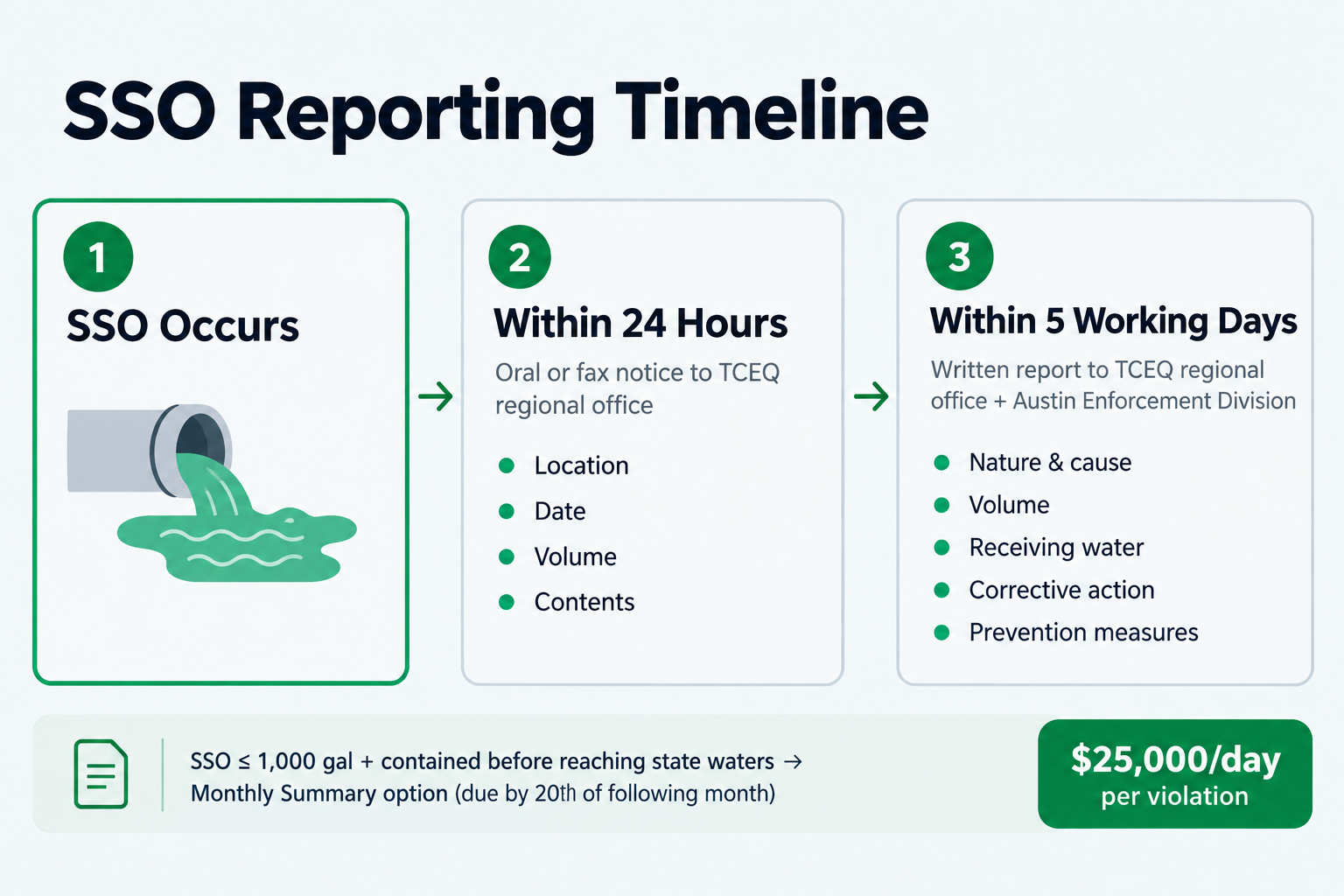
When personnel become aware of a sanitary sewer overflow anywhere in your collection system, notify your TCEQ regional office as soon as possible - and no later than 24 hours after becoming aware of the event. The clock runs from awareness, not from the event's estimated start time. There is no minimum volume threshold. The rule applies to permitted facilities and to subscribers - meaning any city, apartment complex, school, or business with a lift station or force main connected to a permitted facility's collection system.
Texas Water Code Section 26.121 and your TPDES permit conditions govern SSO reporting. Missed reporting or monitoring obligations can result in enforcement action. Consequences depend on the applicable law, permit conditions, violation, and circumstances.
Record both the event's estimated start time and the date and time personnel became aware of it. Notify TCEQ as soon as possible, but no later than 24 hours after awareness. Submit the written report within five working days after awareness, unless the event qualifies for the monthly-summary alternative.
Within 24 hours of awareness - oral or fax notice to your TCEQ regional office. TCEQ requires four pieces of information at this stage: the date, the location, the estimated volume, and the contents of the overflow.
Within 5 working days of awareness - written report. Per TCEQ RG-395 and TCEQ's UD/SSO requirements page, the written report must include all of the following:
Nature of the discharge or overflow: source, location, route, volume, and specific cause
Potential danger to human health, safety, or the environment, including any monitoring data collected
Duration, with exact dates and times
Estimated continuation if unresolved, and actions taken to mitigate adverse effects
Steps taken to reduce, eliminate, and prevent recurrence
Include the facility's TPDES permit number. Subscriber notifications must include the collection system's Regulated Entity Number. Use TCEQ Form 00501 or submit a letter covering all required elements. Permitted facilities send the 5-day report to their TCEQ regional office and to TCEQ's Enforcement Division in Austin. Subscribers send only to the regional office. Keep a copy at the facility - TCEQ inspectors can request records for the prior three years.
The monthly summary option requires that all six of the following conditions are met:
The event occurs at a facility or collection system owned or operated by a local government
The overflow is 1,000 gallons or less
The event is not associated with another simultaneous unauthorized discharge or SSO
The overflow is controlled or removed before entering water in the state or adversely affecting a drinking-water source
The event does not endanger human health, safety, or the environment
The event is not otherwise subject to local regulatory control and reporting
When all six conditions are met, you may submit TCEQ Form 20756 by the 20th of the following month instead of the 24-hour and 5-day reports. If even one condition is not met, the 24-hour and 5-day deadlines apply.
Evaluate public-notification requirements separately under 30 TAC 319.301-319.303. Completing an agency report does not necessarily satisfy public-notice obligations.
When in doubt, call your regional office. A proactive conversation is far better than a retroactive compliance finding.
What does a pretreatment program require?
Determine the facility's pretreatment responsibilities from its TPDES permit, applicable pretreatment regulations, and approved program documents. Requirements differ between plants with approved local pretreatment programs and facilities whose industrial users are overseen through other regulatory arrangements.
Where an approved pretreatment program applies, common obligations include:
Industrial user identification and permitting: Identify industrial users using the applicable regulatory definitions - not just volume or concentration thresholds - and track applicable permits or control mechanisms
Sampling and analysis: Collect samples at permit-specified intervals, analyze against applicable limits, and document results. Exceedances must be documented and may require a response
Inspection records: Conduct periodic inspections and maintain records that TCEQ can review during audits
NOV (Notice of Violation) tracking: Issue and document enforcement responses when industrial users violate applicable conditions
Reporting to TCEQ: Periodic pretreatment program reports may be required under the approved program's terms
Hauled-waste acceptance and grease trap manifesting is a related but separate workflow. Each accepted load needs documentation of generator, waste type, volume, and manifesting. Confirm with your permit and applicable ordinances whether hauled-waste loads fall under your pretreatment program or are tracked separately.
The practical challenge is that this data lives in multiple places - a binder of lab results here, a spreadsheet of permits there, phone notes from the last inspection. When a TCEQ auditor arrives and asks for three years of inspection records for a specific industrial user, paper-based programs struggle.
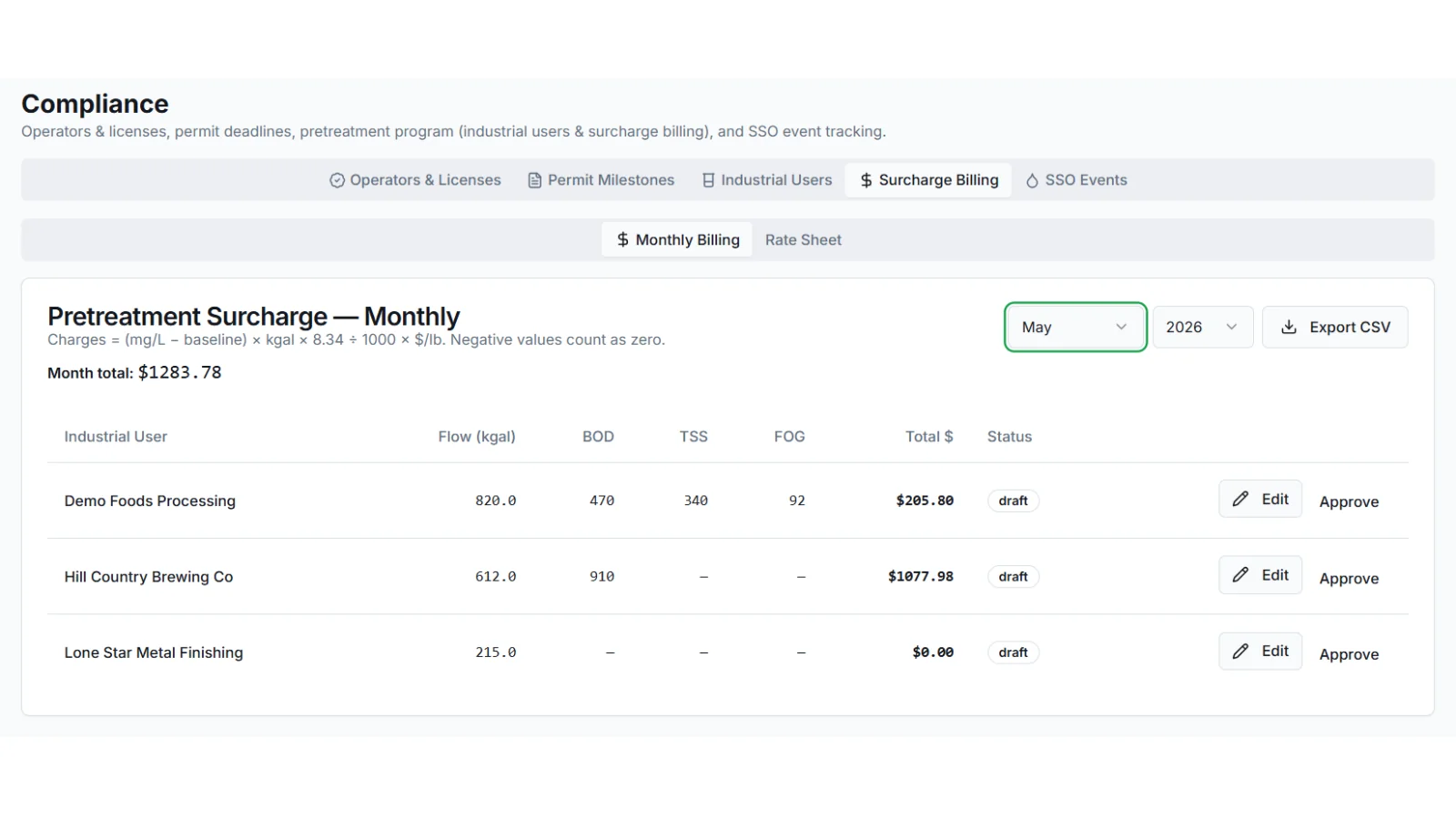
ComplyFlo keeps industrial user records, sample results, inspection notes, and NOVs in one searchable system. Surcharge billing - applying configured per-parameter rates to lab results - runs from entered data, subject to applicable ordinances, validated laboratory results, and user review before invoicing. ComplyFlo can help teams apply configured surcharge schedules consistently and identify potentially unbilled charges.
How does manual TPDES compliance tracking compare to using a digital platform?
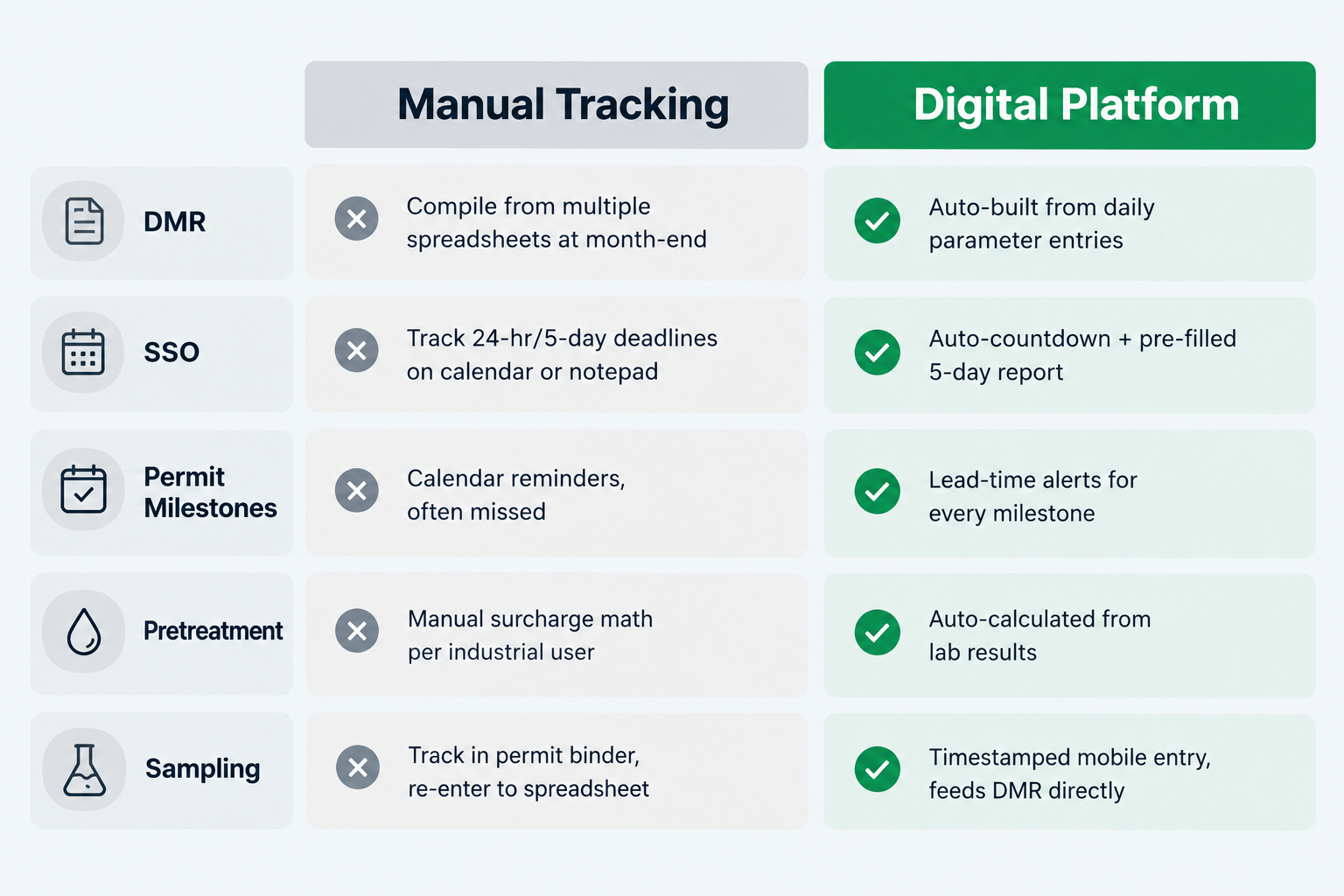
The difference shows up most at month-end DMR time. Manual tracking means pulling data from paper logbooks, re-entering into spreadsheets, running calculations by hand or in formulas that drift, and assembling the DMR from multiple tabs under deadline pressure. One formula error or one missed parameter means one problem to fix in NetDMR before submission.
Compliance task | Manual tracking | Digital platform |
|---|---|---|
Monthly DMR | Compile from multiple spreadsheets at month-end | Built from daily parameter entries; requires operator review before submission |
SSO deadlines | Track 24-hr and 5-day deadlines on a calendar or notepad | Configurable countdown from awareness date; pre-filled written report for review |
Permit milestones | Calendar reminders, often missed | Lead-time alerts for configured milestone types |
Pretreatment surcharges | Manual pound calculations per industrial user per parameter | Calculated from entered lab results per configured rate schedule; requires review |
Sampling entry | Log in permit binder, re-enter to spreadsheet | Timestamped mobile entry feeds parameter records |
Process calculations (SVI, F/M, SRT) | Spreadsheet formulas; formula drift common | Auto-calculated from entered readings, no re-keying |
Operator license/CEU tracking | Checked manually, often before inspection | Expiration alerts and CEU progress per operator |
The manual workflow is not wrong - plants ran it for decades. The problem is that it scales badly with the number of parameters, industrial users, and milestones a real permit carries. And it relies on the person who built the spreadsheet still being around.
Try ComplyFlo for TPDES permit compliance
ComplyFlo is built specifically for Texas wastewater treatment plant operators. It is not a national generalist platform with TCEQ features bolted on. The DMR package, the SSO event tracker, the permit milestones dashboard, the industrial user registry, and the surcharge billing module are all built around how TCEQ-permitted plants actually operate.
ComplyFlo tracks configurable deadlines and generates reports for operator review. SSO event records retain both the event start time and the awareness timestamp so countdowns run from the right clock. The platform supports operator judgment and review - it does not certify or submit on the operator's behalf.
Book a demo to see ComplyFlo running on your actual parameters and permit requirements.
Frequently Asked Questions
When is the TPDES DMR commonly due each month in Texas?
Monthly wastewater DMRs are commonly due to TCEQ by the 20th day of the following month. For example, January monitoring results are commonly due February 20. Always confirm the reporting frequency and exact due date in your facility's permit and NetDMR requirements - your permit controls. ComplyFlo tracks permit-configured deadlines on the milestones dashboard.
Is paper DMR submission still accepted in Texas?
Facilities required to submit DMRs generally must report electronically through NetDMR unless they qualify for and obtain an applicable electronic-reporting waiver from TCEQ. A facility should not switch to paper reporting without confirming that an approved waiver or other applicable authorization permits it.
What are the TCEQ SSO reporting deadlines?
When personnel become aware of a sanitary sewer overflow, notify the TCEQ regional office as soon as possible but no later than 24 hours after awareness - not simply 24 hours after the event's start time. A written report must follow within 5 working days after awareness. Permitted facilities also send the 5-day report to TCEQ's Enforcement Division in Austin. Missing either deadline is a permit violation under Texas Water Code Section 26.121. Consequences depend on the applicable law, permit conditions, violation, and circumstances.
What is a pretreatment program, and does my plant need one?
Determine the facility's pretreatment responsibilities from its TPDES permit, applicable pretreatment regulations, and approved program documents. Requirements differ between plants with approved local pretreatment programs and facilities whose industrial users are overseen through other regulatory arrangements. ComplyFlo provides an industrial user registry where sample results can be reviewed against configured limits and inspection records are stored and searchable.
What TPDES permit milestones do Texas wastewater operators need to track?
Build the compliance calendar from the facility's actual permit, operator-licensing requirements, approved pretreatment program, enforcement orders, and other applicable obligations. Track permit renewal, monitoring schedules, biomonitoring where required, special studies, pretreatment reports where applicable, operator-license expiration, and continuing-education requirements. TCEQ generally requires 30 continuing-education hours for wastewater-license renewal. ComplyFlo tracks configurable milestones with lead-time alerts.
See ComplyFlo in action
Manifests, compliance reporting, and billing in one platform built for waste operations.
Book a demo