Wastewater
TCEQ SSO Reporting Requirements: The 24-Hour Notice and 5-Day Report Checklist for Texas Wastewater Operators
A plain-language guide for Texas wastewater operators on the exact TCEQ timeline after a sanitary sewer overflow: what to report, to whom, and by when.
August 4, 2026 · 10 min read
---
TL;DR
An SSO just happened at your plant or in your collection system. Here is exactly what TCEQ requires:
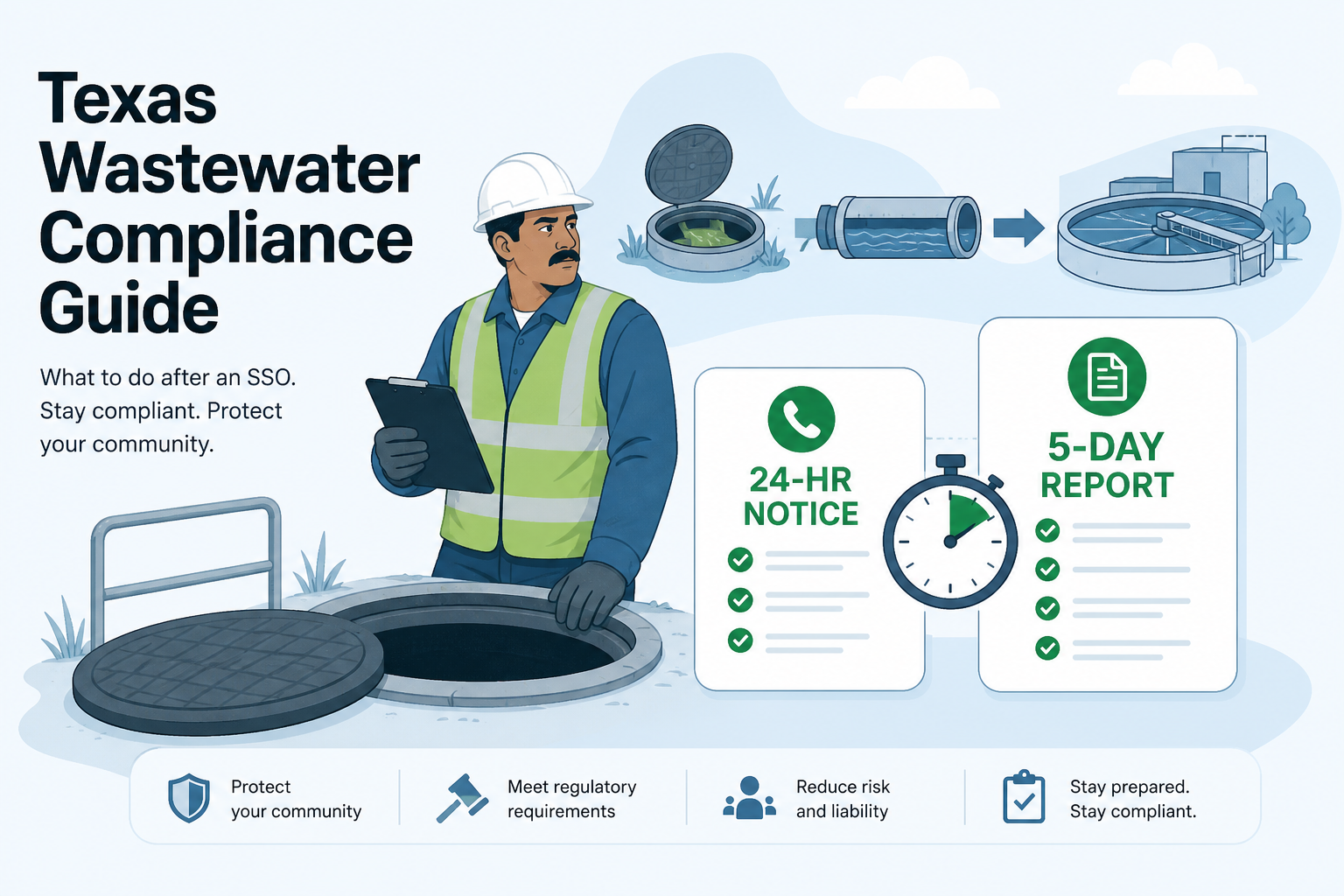
Within 24 hours: Oral or fax notice to your TCEQ regional office - date, location, volume, and contents of the overflow. No minimum volume. No exceptions.
Within 5 working days: Written report to your regional office (and to TCEQ's Enforcement Division in Austin if you're a permitted facility). Use Form TCEQ-00501 or a letter covering all five required elements.
If you miss either deadline: You have a permit violation. TCEQ penalties run up to $25,000 per day per violation.
If the SSO is ≤1,000 gallons and contained before reaching state waters: You may qualify for the monthly summary path instead - due by the 20th of the following month.
ComplyFlo logs SSO events from your phone, runs automatic countdowns for both deadlines, and pre-fills the 5-day report from your event record. But first - the checklist.
---
When the alarm goes off, the clock starts immediately
It doesn't matter whether the overflow was 200 gallons from a blocked manhole or 50,000 gallons from a failed lift station pump. Under 30 TAC Section 327.32 and your TPDES permit, the moment your crew becomes aware of a sanitary sewer overflow, the reporting clock is running.
There is no minimum volume threshold for SSO reporting in Texas. That surprises a lot of operators. The language in TCEQ's official guidance (RG-395) is unambiguous: "Permitted facilities and subscribers must report all UDs and SSOs to the TCEQ regardless of volume, as federal and state regulations do not have a specified minimum reporting volume."
This applies to you whether you're a municipal POTW holding a TPDES permit, a private collection system operator, a water district, or a subscriber - meaning any city, apartment complex, school, or business with a lift station or force main connected to a permitted facility's collection system.
The two deadlines operators most often scramble over:
24-hour oral/fax notice to your TCEQ regional office
5-day written report to your regional office (and Austin Enforcement Division if you're a permitted facility)
Here is what each one requires, precisely.
---
The 24-hour notice: what it is and what it isn't
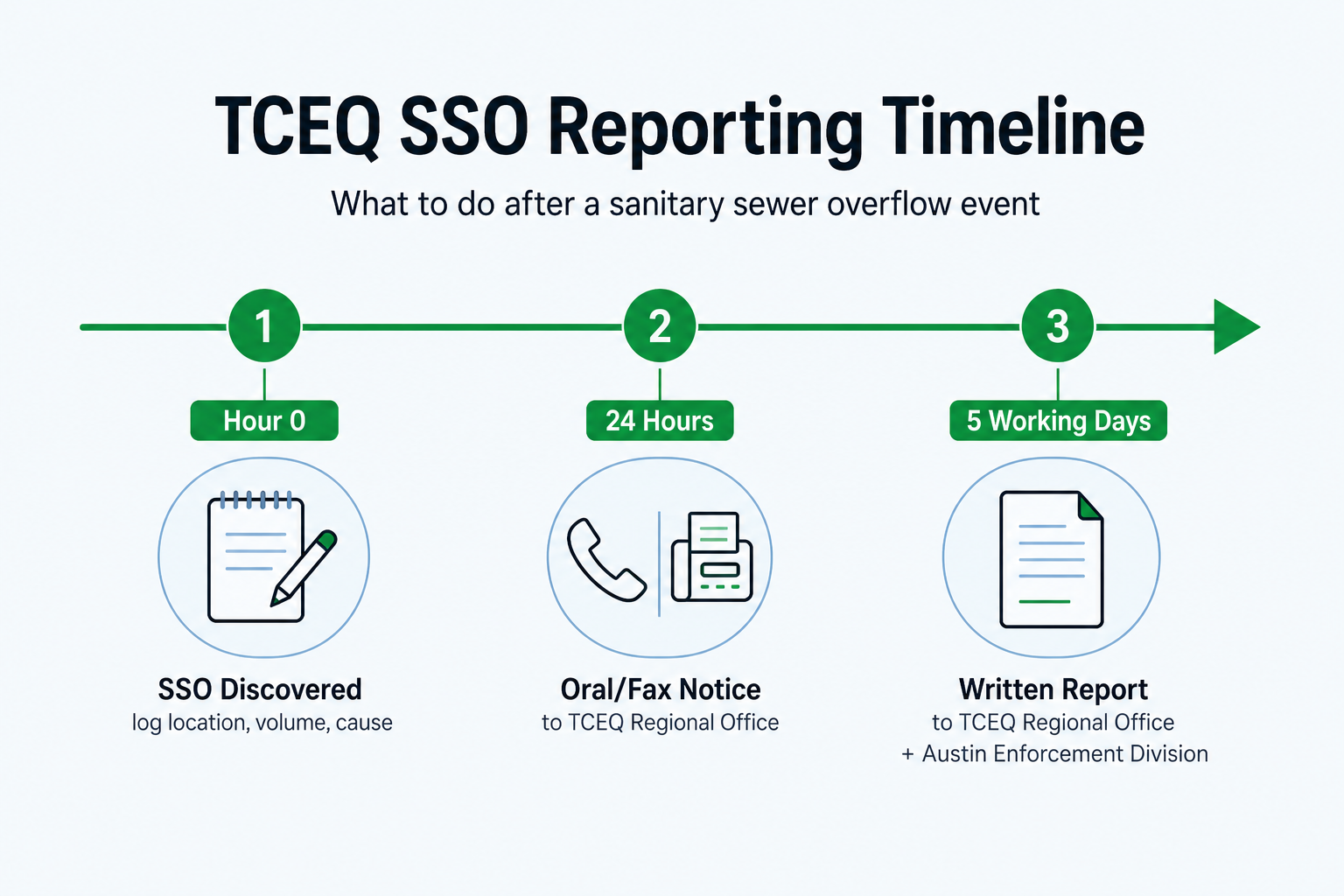
The 24-hour notice is the immediate alarm. It is not a full report. TCEQ only requires four pieces of information at this stage:
Required Element | What it means in practice |
|---|---|
Date of the SSO | When the overflow started |
Location | Address, manhole number, or GPS coordinates |
Volume | Your best estimate - gallons, using visual, measured, or flow-rate method |
Contents | Untreated sewage, partially treated effluent, industrial waste, etc. |
That's it. You don't need the root cause analyzed, the lab results back, or a remediation plan drafted. You need to make the call.
How to make the call - business hours vs. after hours. During normal TCEQ business hours (Monday through Friday, 8 a.m. to 5 p.m.), the 24-hour notice must be given orally by phone or in person, or by fax to your regional office. After business hours, you call the regional office by phone - the recorded message explains the after-hours notification procedure. If you're a local government operator and the SSO is large enough to require public notification (see the size thresholds below), you also call the TCEQ Emergency Response Hotline at 800-832-8224.
Log the call. Write down the date and time you called. You'll need it. If it ever becomes a compliance question, your record of when you notified TCEQ is the first thing an investigator asks for.
When public notification is also required. For SSOs at local-government-owned facilities, a separate 24-hour public media notification is required when:
The discharge will adversely affect a public or private drinking water source, or
The volume is 50,000 gallons or more and occurs within ½ mile of a drinking water source or in an active groundwater-recharge area, or
The volume is 100,000 gallons or more (regardless of location).
Within 48 hours of notifying the public, you also notify your regional office that public notice was given. These public-notification requirements come from 30 TAC Sections 319.301–303.
---
The 5-day written report: exactly what must be in it
The 5-day report is where operators get tripped up - not because it's complicated, but because it has five specific required elements, and submitting an incomplete report creates its own compliance problem.
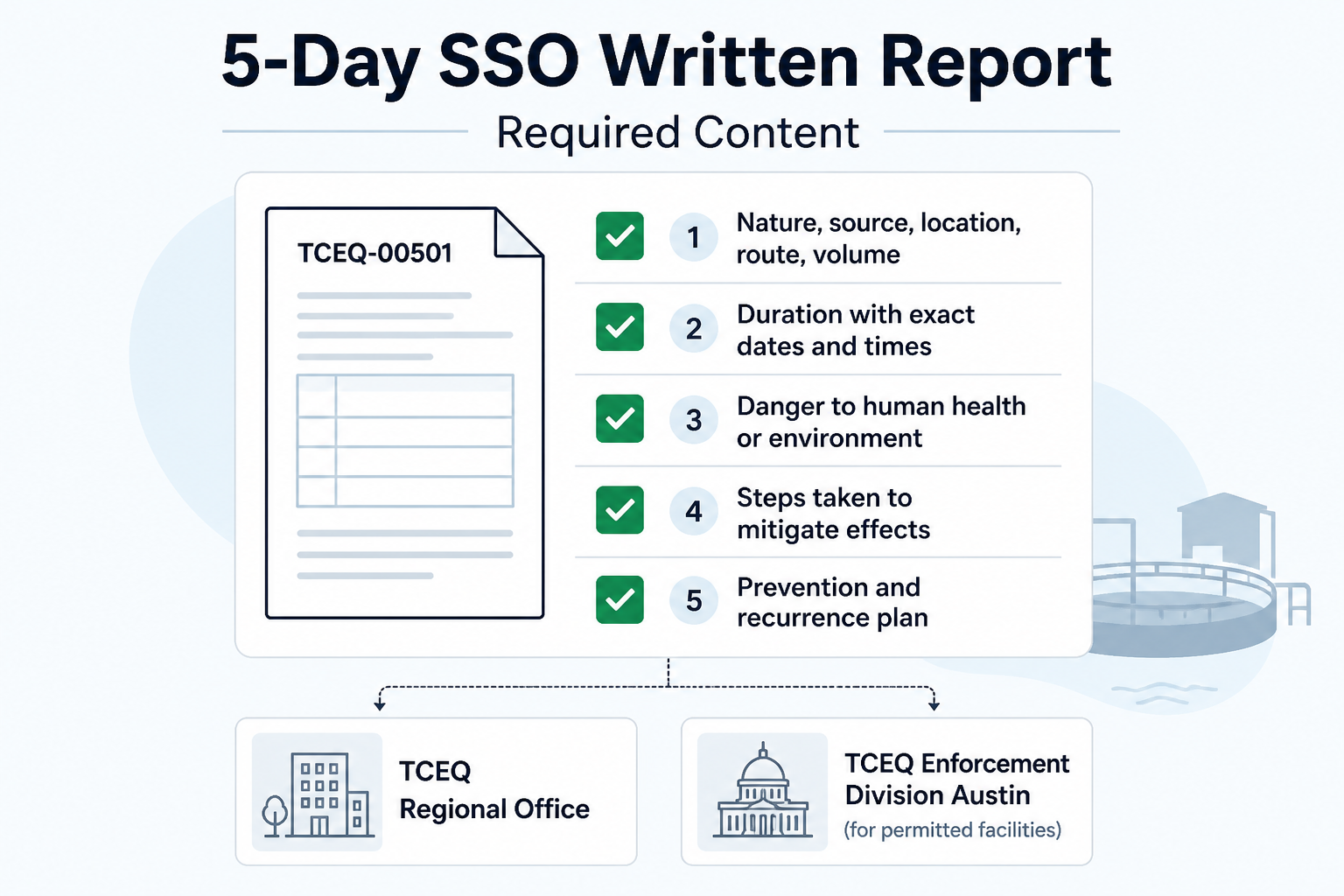
Per TCEQ RG-395 and TCEQ's UD/SSO requirements page, the written report must include all five of the following:
1. Nature of the SSO - source, location, route, and volume - and its specific cause.
Not "pipe blockage." The specific cause: root intrusion in the 12-inch vitrified clay main on Oak Street, grease accumulation at Lift Station 7 wet well, pump failure on the lead pump at the Riverside lift station due to mechanical seal failure. TCEQ investigators read these reports and they notice when causes are vague.
2. Potential danger to human health or safety, or the environment - including monitoring data if collected.
Did the overflow reach a creek, ditch, roadway, or drainage channel? Was a water body affected? If you collected samples, include the results. If you didn't collect samples, state that and explain why. Don't leave this section blank - a blank field looks like the assessment was never done.
3. Duration - exact dates and times.
"Approximately three hours" isn't sufficient. You need the time your crew became aware of the SSO, the time flow was stopped or contained, and the total duration. If the event was still ongoing at the time of the report, note that and estimate how long the noncompliance is expected to continue.
4. Actions taken to mitigate adverse effects.
What did you do to stop it? Contain it? Disinfect the area? Recover discharged wastewater? Return it to the collection system? This is your chance to document the response effort - don't shortchange it.
5. Steps taken to reduce, eliminate, and prevent recurrence.
What changed? Increased FOG cleaning frequency? Pump replaced? Emergency repair scheduled? If the root cause is a capital improvement that will take 18 months, say that - along with the interim mitigation steps in place while you wait.
The form to use. TCEQ has a standardized form, Water Quality Noncompliance Notification (TCEQ-00501), that covers both the 24-hour fax notice and the 5-day written report. You can also submit a letter, but it must contain all five elements and must include your facility's TPDES permit number (or your collection system's Regulated Entity Number if you're a subscriber).
Where to send it. Permitted facilities must send the 5-day report to:
Their TCEQ regional office, and
TCEQ's Enforcement Division in Austin.
Subscribers send only to the regional office.
Recordkeeping. Keep a copy of every written SSO report at the facility site. TCEQ inspectors can ask to review them for the prior three years.
---
The monthly summary option - and when it actually applies
There is a third reporting path that some operators qualify for: the monthly summary. But the criteria are strict, and operators sometimes assume they qualify when they don't.
A monthly summary (submitted using TCEQ Form 20756, due by the 20th of the following month) is only available when all six of these conditions are met:
Condition | What it requires |
|---|---|
Local government ownership | The facility must be owned/operated by a local government - private operators don't qualify |
Volume ≤ 1,000 gallons | Over 1,000 gallons requires the 24-hour + 5-day path |
Not associated with another simultaneous SSO | If two overflows happened at the same time, neither qualifies |
Contained before reaching state waters | No discharge into a creek, river, lake, wetland, or other water of the state |
No threat to drinking water or human health | No impact to public or private water supply |
No local regulatory conflict | Not already subject to a local reporting requirement that supersedes |
If even one condition isn't met, the 24-hour and 5-day deadlines apply. When in doubt, call your regional office - a proactive conversation is far better than a retroactive compliance finding.
---
What happens when you miss the deadline
Missing the 24-hour notice or the 5-day report deadline is a permit violation. TCEQ enforces these violations under Texas Water Code Section 26.121 and your TPDES permit conditions.
The practical consequences:
Administrative penalties up to $25,000 per day. That's per violation, per day of noncompliance. A missed 5-day report that surfaces six months later during a compliance inspection isn't one violation - it can be calculated from the day the report was due. TCEQ's enforcement history includes wastewater operators fined $74,750+ for SSO-related violations. These are real numbers, not theoretical maximums.
Compliance-history rating impact. TCEQ tracks each facility's compliance history. A violation from a late or missing SSO report becomes part of that record. A poor compliance history affects how TCEQ evaluates future permit renewals, variances, and enforcement discretion.
Formal enforcement action. Repeated or serious violations can escalate from administrative penalties to compliance orders, consent agreements, and mandatory corrective action requirements with enforceable milestones.
Criminal liability for knowing violations. If management knowingly disregards a known SSO reporting obligation, Texas Water Code authorizes criminal prosecution.
One more thing worth knowing: if you miss the 24-hour notice, a voluntary early disclosure to your regional office - before TCEQ discovers the violation independently - is viewed more favorably than a violation found during an inspection. It doesn't eliminate the violation, but it affects how it's handled.
---
The dry-weather vs. wet-weather distinction
The reporting requirements above apply the same way regardless of cause. But the cause matters for your prevention and recurrence documentation - and for the TCEQ SSO Initiative.
Dry-weather SSOs are almost always caused by something operationally preventable: root intrusion, grease accumulation, a failed pump, a collapsed pipe, vandalism. The TCEQ reviewer reading your 5-day report will want to see the specific cause, the repair made, and what changed in your maintenance program.
Wet-weather SSOs typically result from infiltration and inflow (I/I) overwhelming system capacity during heavy rain events. Grease blockages can be addressed at the root. I/I is a capital infrastructure problem that takes years to remediate - which is exactly why TCEQ created the SSO Initiative.
The TCEQ SSO Initiative is a voluntary program (launched in 2004) that allows publicly owned collection systems with chronic wet-weather SSO problems to enter into an agreement with TCEQ covering a corrective action plan. Participating systems are protected from formal enforcement for SSOs addressed by that plan - as long as they're still reporting each individual event and working the milestones. It doesn't eliminate reporting requirements; it provides enforcement protection while you're doing the long capital work.
If your system experiences repeated wet-weather SSOs, contact your TCEQ regional office about SSO Initiative eligibility. It's one of the most underused tools available to small and mid-size Texas collection system operators.
---
How most Texas operators handle SSO reporting today - and where it goes wrong
Most plants we talk to track SSO events on a whiteboard, a shared Google Calendar, or a paper logbook. The 24-hour notification gets made - usually - and someone writes down "called regional office, 2:47 pm, spoke with [name]." Then the 5-day window opens.
And this is where it goes sideways.
The five working days feel longer than they are. The SSO response is still wrapping up - contractors on site, post-event sampling still coming back from the lab, shift changes happening. The operator who responded is not the person responsible for writing the report. Nobody has a system that automatically tracks which events need a 5-day report, what day the window closes, or whether the report has been submitted.
Some operators reconstruct the 5-day report from memory days after the event, when details have faded. Exact times get approximated. Volume estimates are rougher. The root cause section is thinner than it should be.
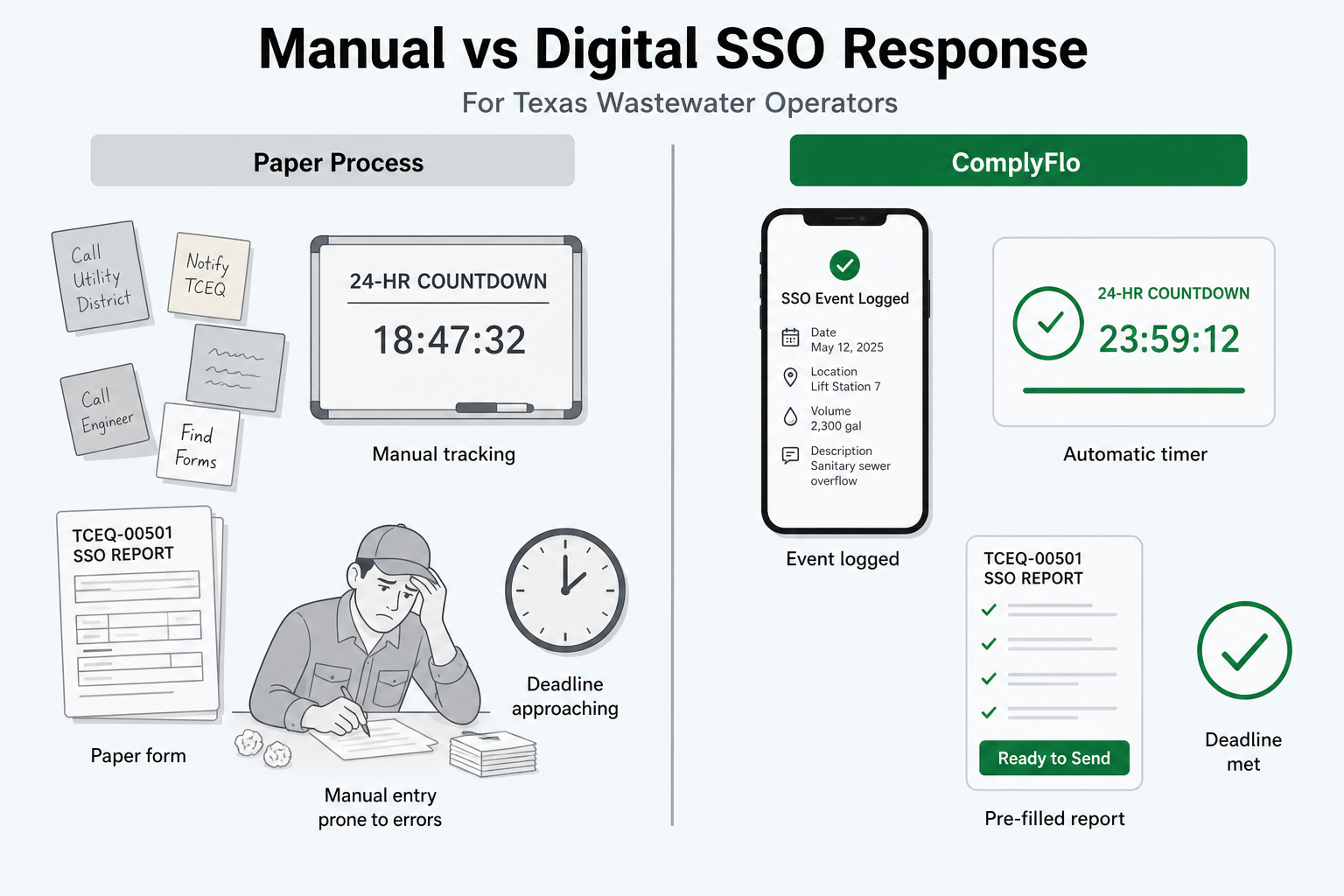
The difference between a plant that consistently meets SSO reporting deadlines and one that occasionally misses them is almost never intent. It's system. The plant that misses deadlines doesn't have a bad operator - it has a process that depends on people remembering things under pressure.
---
What good SSO event management actually looks like
The moment an SSO is discovered, three things need to happen in parallel:
Stop or contain the flow
Log the event - location, volume estimate, time discovered, what's affected
Start the 24-hour clock
That third step is where most manual processes are weakest. The clock starts at the moment of awareness, not when the response is complete, not when the paperwork gets started. If the response takes four hours and the documentation process takes another six, you've used half your 24-hour window before anyone has thought about the notification call.
A solid SSO response protocol looks like this:
Immediate (0–1 hour):
Assign a crew to stop/contain flow
Log the time, location, and initial volume estimate
Assign a specific person to make the 24-hour notification call - don't leave it ambiguous
Note the date and time of that call in the event record
Same day:
Collect photos of the spill area and affected site
Take water quality samples if warranted (nearby receiving water, affected drainage)
Document cleanup actions as they happen - don't reconstruct later
Days 1–4 (5-day window):
Confirm the root cause with maintenance/engineering
Finalize the volume estimate using the most accurate method available
Draft the 5-day report while the event is still fresh
Get lab results back if sampling was done
Identify the specific recurrence prevention steps - not generic, specific
Day 5 (working days from awareness):
Submit to regional office (and Austin Enforcement Division if permitted facility)
Retain a copy at the facility
Log the submission date and method in your event record
---
ComplyFlo
ComplyFlo is built specifically for Texas wastewater operators - and SSO event tracking is one of the platform's core compliance tools. When an SSO occurs, operators log the event from their phone: location, cause, volume, receiving water, containment actions. ComplyFlo starts the 24-hour countdown automatically and surfaces an alert on the plant dashboard. When the 24-hour call is made, the operator logs it and the record is timestamped.
The 5-day report pre-fills from the event record - the details logged during response become the report, not a reconstruction from memory.

The same platform tracks every other TCEQ compliance obligation your plant has: monthly DMR packages generated from parameter readings, TPDES permit renewal windows, operator CEU deadlines, industrial user sample results, and permit milestone alerts - all in one dashboard visible to operators, supervisors, and administrators.
If your SSO compliance process currently lives on a whiteboard or in a shared calendar, complyflowaste.com is worth a look.
---
Frequently Asked Questions
What is the deadline to report an SSO to TCEQ?
Texas operators must notify their TCEQ regional office as soon as possible but no later than 24 hours after becoming aware of the SSO. A second written report must then follow within five working days. Both deadlines apply regardless of the volume of the overflow - there is no minimum reporting volume under Texas or federal regulations.
What information is required in the TCEQ 5-day SSO report?
The written report must include: (1) the nature of the SSO - source, location, route, and volume; (2) the specific cause; (3) potential danger to human health or safety, or the environment, including any monitoring data collected; (4) exact dates and times of the event and how long the noncompliance is expected to continue; and (5) steps taken to mitigate adverse effects and prevent recurrence. Use TCEQ Form 00501 or submit a letter that covers all five elements.
Do I have to report every SSO even if it's a small spill?
Yes. TCEQ requires all SSOs to be reported regardless of volume. There is no minimum gallonage threshold. However, SSOs of 1,000 gallons or less that meet specific criteria - controlled before entering state waters, no threat to drinking water or human health, and owned by a local government - may qualify for the monthly summary reporting path instead of the 24-hour and 5-day notifications.
What are the penalties for missing the TCEQ SSO reporting deadline?
Missing or late SSO notifications violate your TPDES permit and Texas Water Code Section 26.121. TCEQ can issue administrative penalties up to $25,000 per day per violation, pursue formal enforcement actions, and the violation affects your facility's compliance-history rating. Repeated or serious violations can escalate to civil penalties and, in cases of knowing disregard, criminal prosecution.
Where exactly do I send the 5-day SSO written report in Texas?
Permitted facilities must send the 5-day written report to two places: (1) their TCEQ regional office, and (2) TCEQ's Enforcement Division in Austin. Subscribers (cities, lift station operators, satellite collection system owners) send only to their regional office. Reports can be submitted using TCEQ Form 00501 or in a letter format that covers all required elements.
See ComplyFlo in action
Manifests, compliance reporting, and billing in one platform built for waste operations.
Book a demo