Wastewater
Hydraulic Retention Time Wastewater: How to Calculate HRT and What It Means for Your Treatment
Learn the hydraulic retention time wastewater formula, how to define the volume and flow basis, and what a decrease in nominal HRT warrants reviewing at your plant.
October 16 2026 · 5 min read
TL;DR
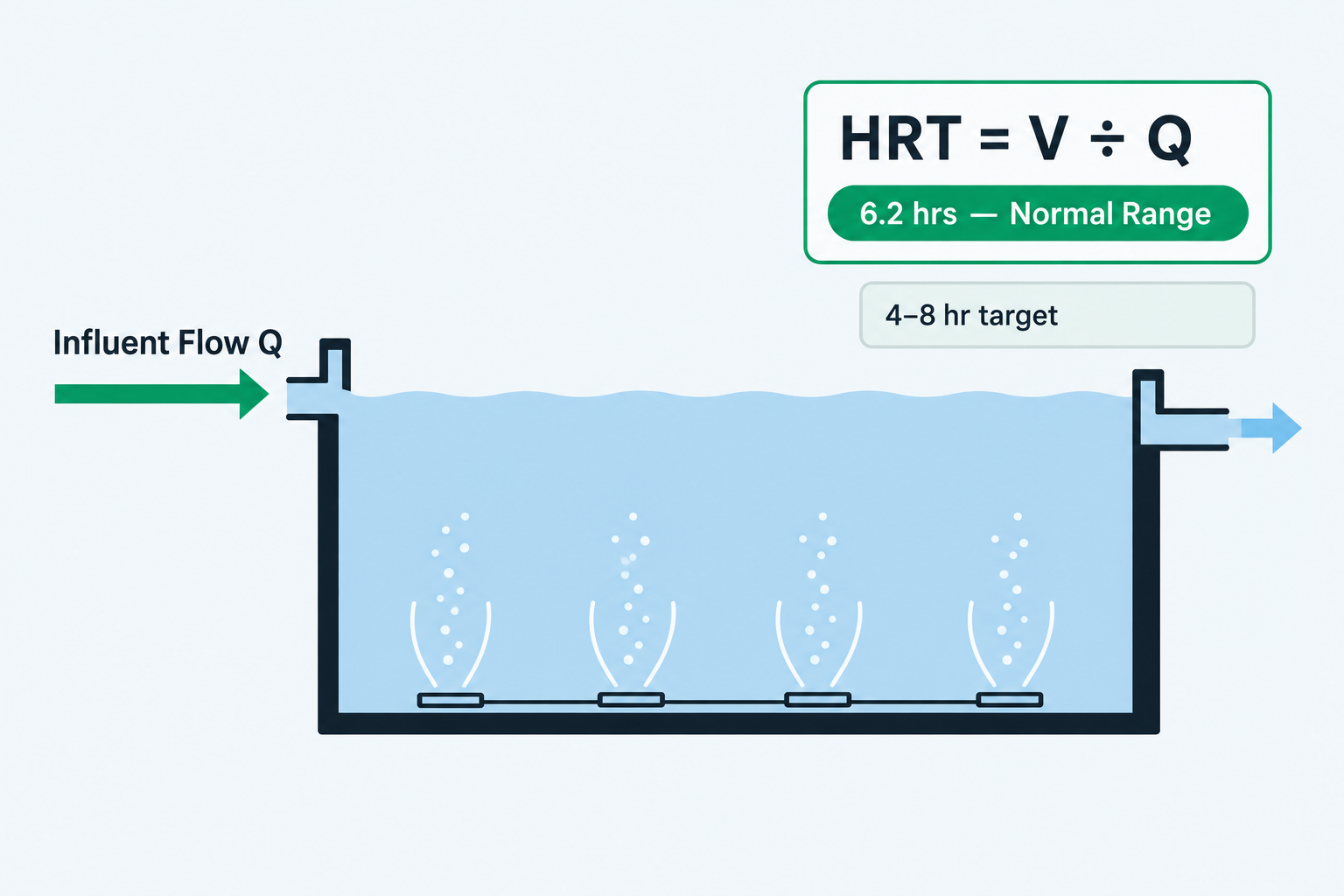
Hydraulic retention time (HRT) is a nominal estimate of liquid retention within a defined treatment volume. Calculate nominal HRT in hours as V / Q, where V is the active treatment volume in gallons and Q is the flow in gallons per hour. To convert MGD to gallons per hour, multiply by 1,000,000 and divide by 24. Reference ranges vary by treatment configuration and are not universal safety limits. Review HRT alongside loading, DO, SRT, settling, clarifier conditions, and effluent results. ComplyFlo can calculate and trend nominal HRT when the required inputs are available and flag facility-configured thresholds; operating decisions remain with qualified personnel.
What does hydraulic retention time measure at a wastewater plant?
Nominal HRT characterizes how long wastewater spends within a defined treatment volume, based on volumetric flow rate and active volume. It is not a permit limit - it is a process control reference number. It tells you how much nominal contact time is available for biological treatment, how the hydraulic load compares to basin capacity, and where to start when investigating a process change.
Hydraulic retention time is one of the standard operational parameters tracked in activated sludge process control. Most Texas TPDES permits do not specify an HRT limit. But the effluent limits they do specify - CBOD, TSS, ammonia - depend on the plant operating within its design parameters, of which HRT is one.
How do you calculate HRT from aeration volume and influent flow?
The nominal HRT formula is: divide the active treatment volume by the flow rate, expressed in consistent units per hour.
HRT = V / Q
V = active treatment volume, in gallons (define which zones are included - see below)
Q = flow rate, in gallons per hour (to convert MGD to gallons per hour, multiply by 1,000,000 and divide by 24)
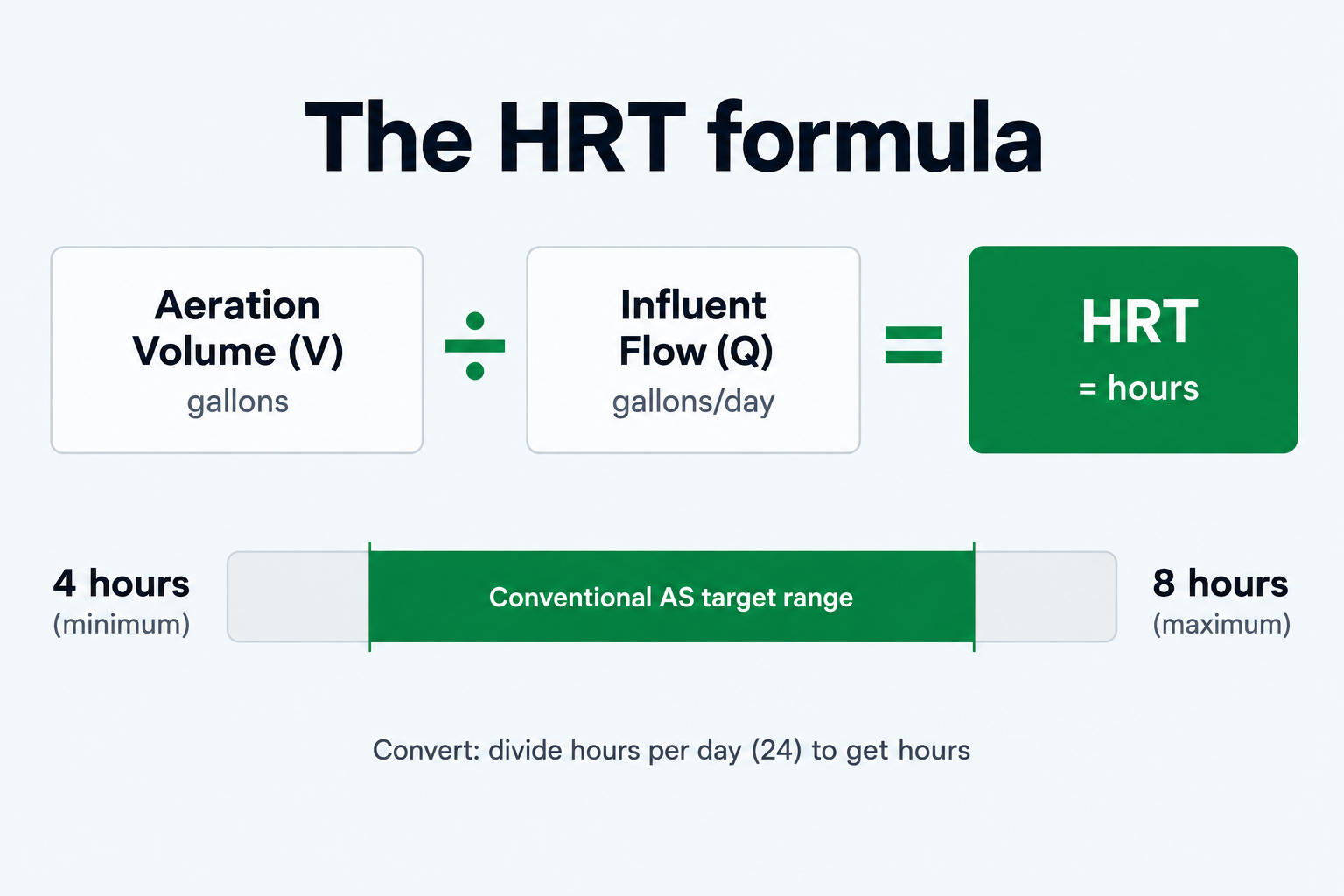
Worked example: A plant has a 400,000-gallon aeration basin receiving 1.2 MGD. Convert to gallons per hour: 1,200,000 x 1 / 24 = 50,000 gallons per hour. Nominal HRT = 400,000 / 50,000 = 8.0 hours. Under the same basin volume, a wet-weather flow of 2.0 MGD gives a nominal HRT of 4.8 hours. Whether that is acceptable depends on the facility's design, loading, treatment objectives, and current operating conditions.
Define the calculation boundary first. For aerobic-zone HRT, use the active aerobic volume. For total biological-reactor HRT, include the relevant active treatment zones. Exclude inactive or out-of-service volume, and identify exactly which zones are included. Baffles alone do not establish that a zone should be excluded; the appropriate boundary depends on what you are calculating.
The V / Q formula gives a nominal or theoretical HRT. It does not measure the actual residence-time distribution or account for short-circuiting and dead zones.
Use the flow basis appropriate to the question. Average-flow HRT provides a baseline. Peak-flow HRT can show conditions during hydraulic loading events. Label the flow period and compare values calculated on consistent bases. Conventional influent-based HRT and a calculation using influent plus internal recycle flow describe different hydraulic quantities.
What does the 4–8 hour reference range mean for conventional activated sludge?
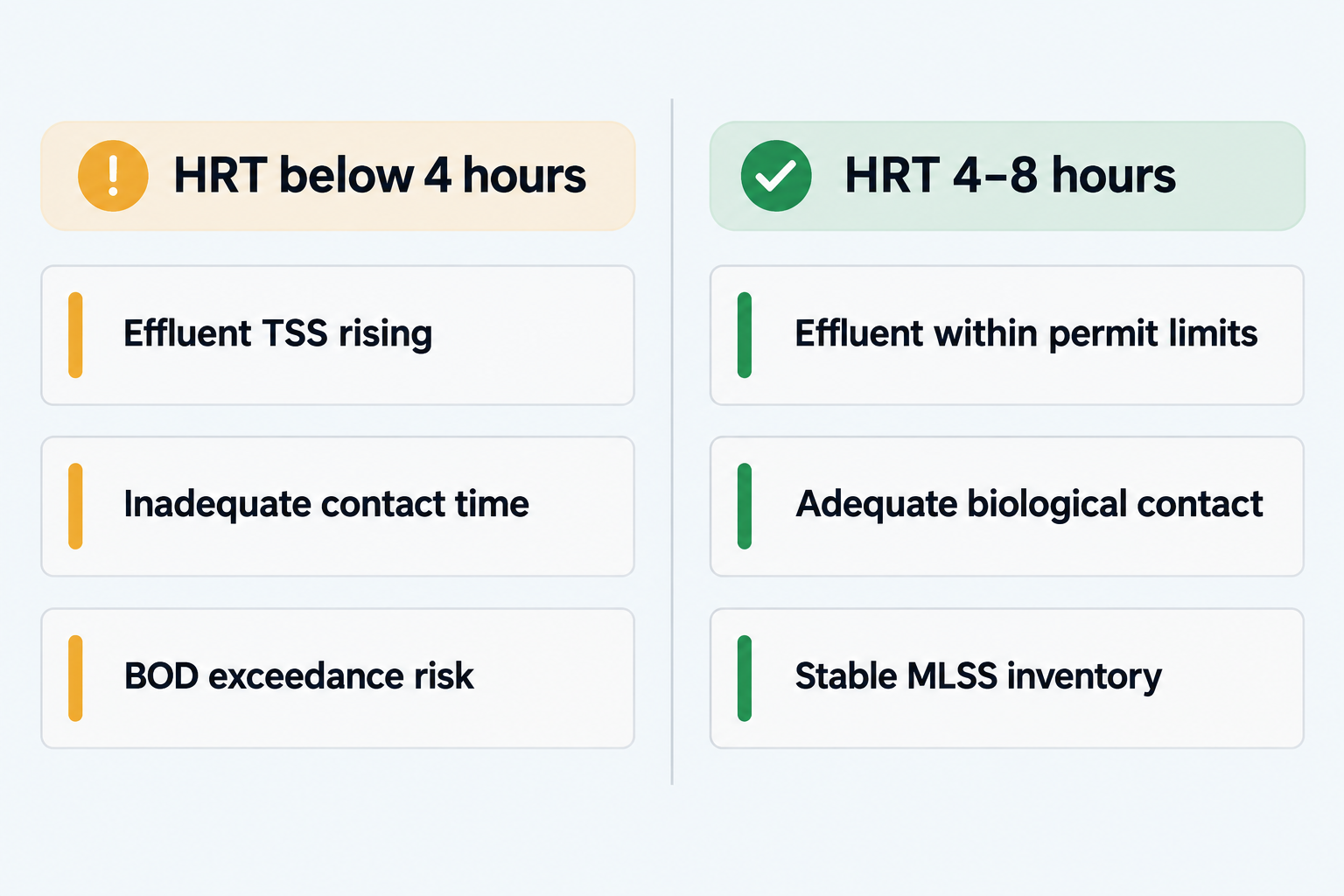
Four to eight hours is a commonly cited reference range for some conventional activated-sludge configurations. Neither endpoint is a universal performance threshold, and values outside that range must be evaluated against the facility's design and operating conditions.
The EPA secondary treatment standard establishes effluent concentration and removal requirements for CBOD and TSS - it does not set a universal four-hour HRT minimum.
EPA operator-training material distinguishes detention time based on influent flow from detention time based on total flow, including return sludge. Identify the flow basis before comparing the result with a design reference.
Extended aeration systems typically operate at much longer detention times. Contact stabilization and step-feed systems have different targets. Establish the appropriate operating reference from the facility's design basis, treatment objectives, validated operating history, and approved procedures. Check the permit for any specific hydraulic, capacity, or operating requirements.
What does a decrease in nominal HRT warrant reviewing?
A decrease in nominal HRT should prompt review of the plant's hydraulic and biological conditions. Determine whether the change reflects increased flow, reduced active volume, or a calculation or input change. Review influent loading, DO, solids inventory, SRT, settling performance, clarifier blanket depth, and effluent results. Higher flow can increase hydraulic stress, but the effect on treatment performance is facility-specific.
HRT and SRT describe different things: HRT characterizes liquid throughput relative to volume, while SRT characterizes solids retention. Increased flow may stress clarification and cause solids losses at some plants, which can reduce SRT. However, shorter nominal HRT does not by itself prove nitrifier washout or nitrification failure - activated sludge retains and returns biomass, and solids retention depends on wasting, solids losses, and inventory. Nitrification assessment should include the plant's SRT, ammonia results, temperature, DO, pH, alkalinity, and treatment configuration.
Higher flow can increase surface overflow rates and clarifier hydraulic loading. Whether effluent quality is affected depends on clarifier design, current loading, solids inventory, and plant-specific operating conditions. The appropriate response is to review all of these factors and follow the facility's approved operating procedures.
Tracking HRT manually versus with a digital platform
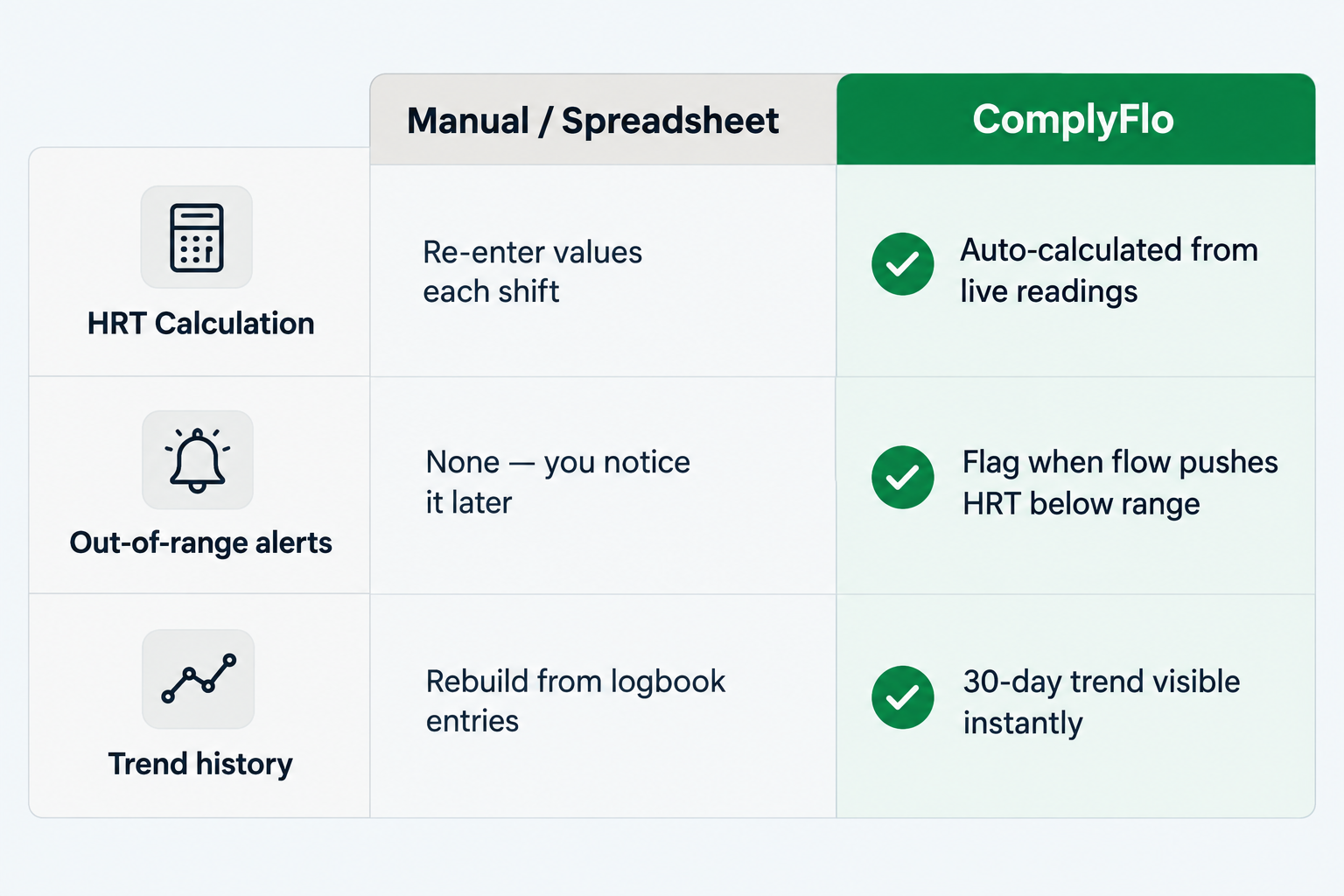
Manual calculation is not wrong. The question is whether it happens often enough to catch changes in hydraulic conditions as they occur.
Approach | Typical workflow | What determines reliability |
|---|---|---|
Manual / spreadsheet | Staff enter or link volume and flow data and review the calculation | Input quality, unit validation, formula protection, and review frequency |
Paper records | Staff record measurements and calculate HRT according to facility procedures | Consistent calculation, trend review, and record availability |
Nominal HRT calculated from configured volume and entered or imported flow data | Accurate configuration, timely inputs, and appropriate threshold settings |
How does HRT connect to SRT, F/M, and SVI?
HRT is most useful when read alongside three other process control numbers.
SRT. HRT tracks liquid; SRT tracks solids. Increased flow may stress clarification and affect solids retention, but HRT and SRT can be varied independently. Nitrification assessment should focus on SRT, ammonia results, temperature, and DO rather than HRT alone. ComplyFlo calculates SRT when the separate inputs required are available.
F/M ratio. If influent BOD concentration and MLVSS remain unchanged, increasing flow or reducing active volume increases calculated F/M. In actual operation, review mass loading and biomass concentration, because those inputs may change at the same time.
SVI. A rising SVI alongside falling nominal HRT warrants investigation, including confirmation of sampling, calculation inputs, and process conditions. Multiple factors affect settleability; do not assign a cause before checking the data.
Track these numbers together. One number out of range is worth investigating. Two or three moving together is a pattern that warrants a systematic review.
Try ComplyFlo
ComplyFlo is built for Texas WWTP operators who need to track process control numbers without managing multiple spreadsheets. HRT is one of eight calculators ComplyFlo runs from entered or imported data - alongside SVI, F/M, SRT, BOD removal efficiency, RAS rate, sludge wasting, and chlorine dose. ComplyFlo can flag nominal HRT against facility-configured thresholds and trend it alongside related process indicators. Alerts support operator review; operating decisions remain with qualified personnel.
Book a demo to see how ComplyFlo works for your plant.
Frequently Asked Questions
What is hydraulic retention time in wastewater treatment?
Hydraulic retention time (HRT) is a nominal estimate of liquid retention within a defined treatment volume. It is calculated as V / Q, where V is the active volume and Q is the flow rate in consistent units. For some conventional activated-sludge configurations, a commonly cited reference range is roughly 4-8 hours, though the appropriate value depends on process design, loading, and treatment objectives. ComplyFlo can calculate and trend nominal HRT from entered or imported data.
What is the formula for calculating HRT at a wastewater plant?
The nominal HRT formula is HRT = V / Q, where V is the active aeration basin volume in gallons and Q is the flow in gallons per hour. To convert MGD to gallons per hour, multiply by 1,000,000 and divide by 24. For example, a 400,000-gallon basin receiving 1.2 MGD: Q = 1,200,000 / 24 = 50,000 gal/hr. HRT = 400,000 / 50,000 = 8.0 hours.
What is the normal HRT range for conventional activated sludge?
A commonly cited reference range for some conventional activated-sludge configurations is roughly 4-8 hours. This is not a universal operating limit or regulatory minimum. The appropriate range depends on process design, loading, temperature, treatment objectives, and operating history. Establish the appropriate operating reference from the facility's design basis, treatment objectives, validated operating history, and approved procedures. Check the permit for any specific hydraulic, capacity, or operating requirements.
What does a decrease in nominal HRT warrant reviewing?
A decrease in nominal HRT warrants review of hydraulic and biological conditions including influent loading, DO, solids inventory, SRT, settling performance, clarifier blanket depth, and effluent results. Higher flow can increase hydraulic stress, but the effect on treatment performance is facility-specific. For nitrification assessment, focus on SRT, ammonia results, temperature, and DO rather than HRT alone.
How does ComplyFlo help operators track hydraulic retention time?
ComplyFlo can calculate and trend nominal HRT from entered or imported flow and volume data. It can flag values against facility-configured thresholds and display HRT alongside F/M, SVI, SRT, and BOD removal. Alerts support operator review; they do not establish compliance or guarantee advance warning of an effluent exceedance.
Free checklist
TPDES Permit Compliance Checklist
Review permit-specific DMR submissions, sampling, SSO reporting, renewal milestones, and applicable pretreatment responsibilities.
Ready to move your plant logs and reports off paper?
Book a free 1-hour demo with a ComplyFlo team member and see it running on your own workflow.
Book a free demoGet TCEQ compliance updates
Deadline reminders, rule changes, and practical guides for Texas waste operators. No spam — unsubscribe anytime.
By subscribing you agree to receive emails from ComplyFlo. See our privacy policy.