MSW Disposal
How to Fill Out the TCEQ MSW Annual Report: A Plain-Language Walkthrough of Form TCEQ-20011a
ComplyFlo · October 22, 2026 · 8 min read
A plain-language guide for Texas MSW disposal site operators: what the November 10 report covers, who files it, how to handle your volumes, and where the registered sludge transporter and compost deadlines fall.
TL;DR
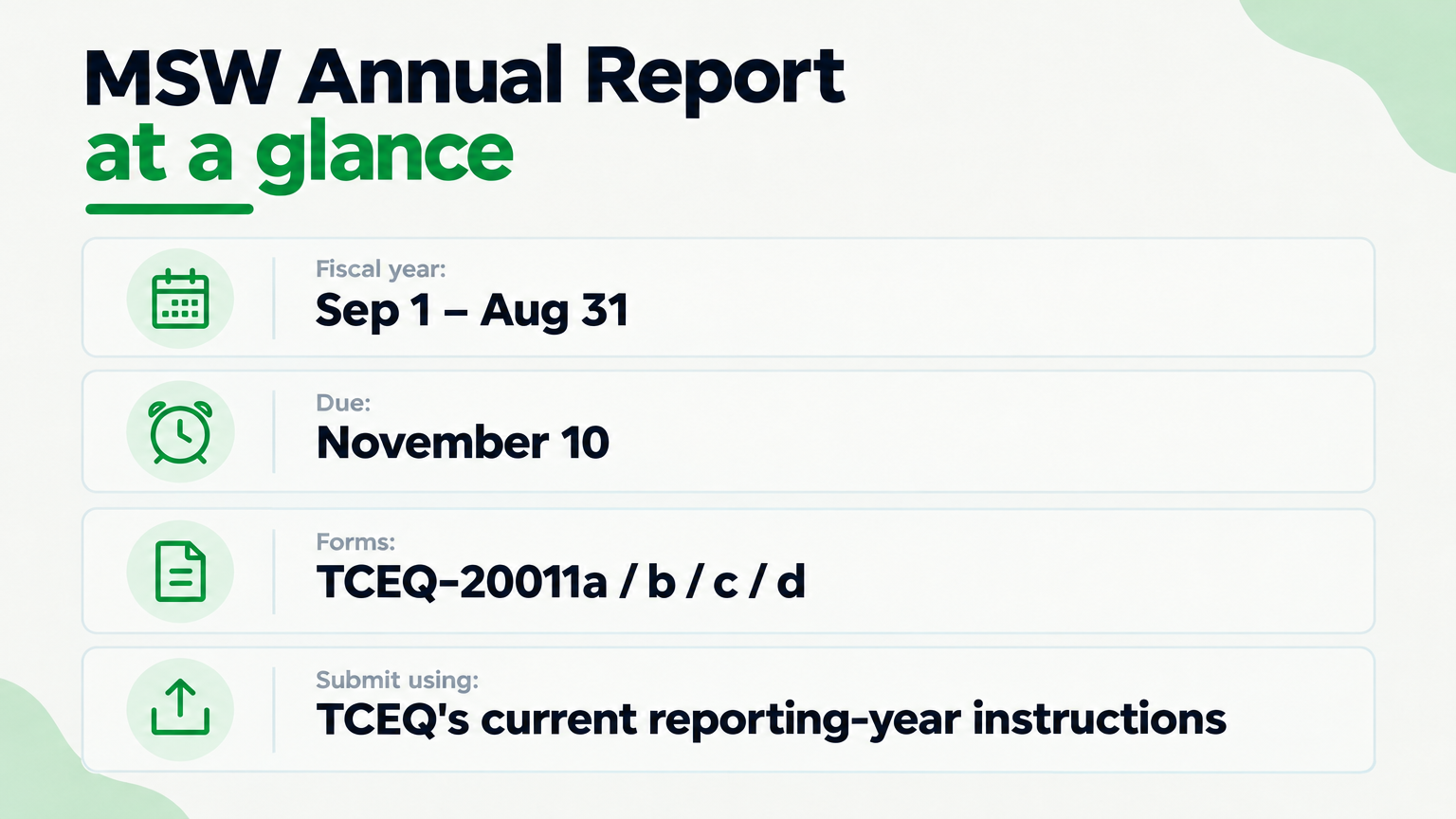
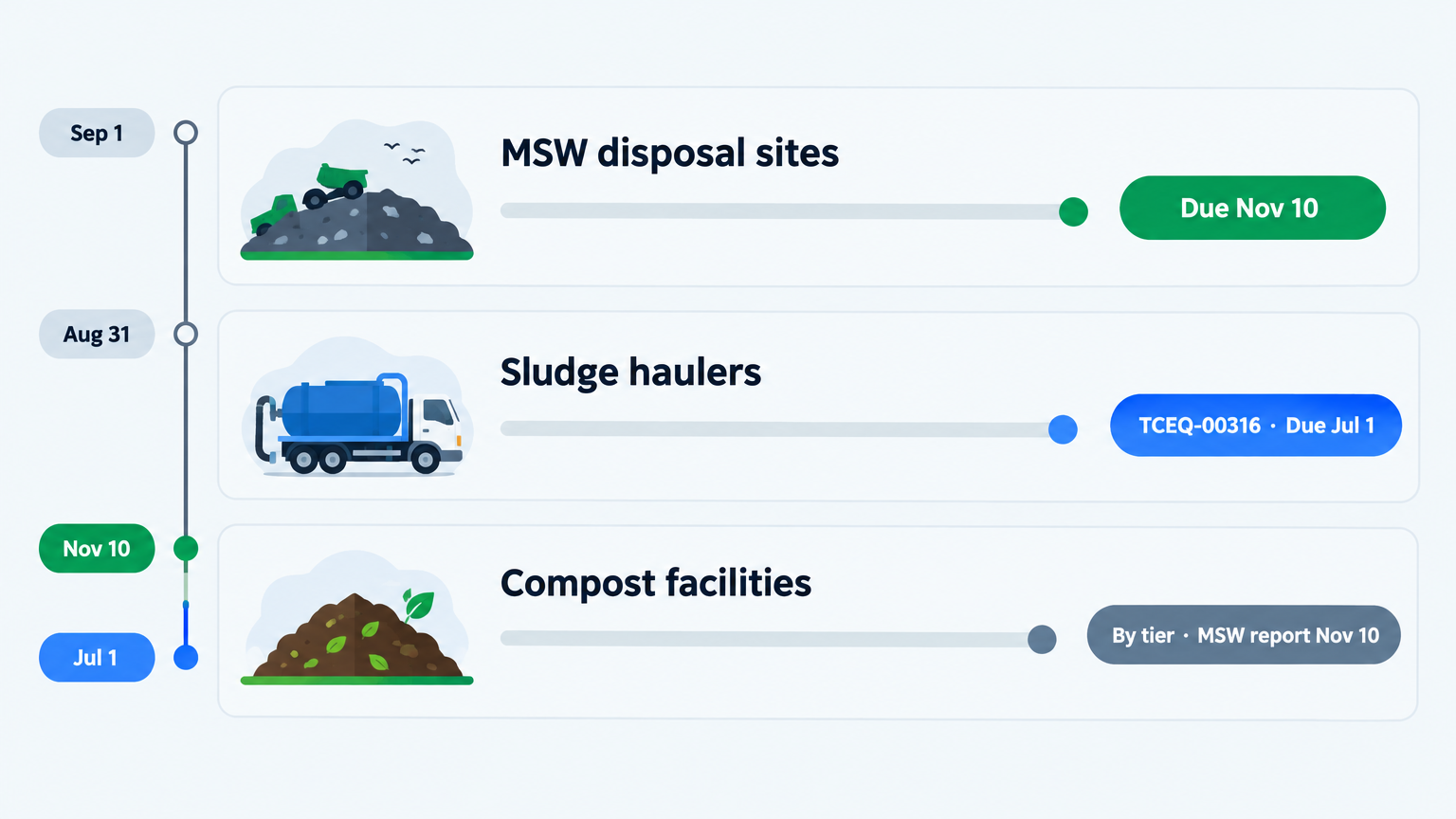
Texas disposal sites file one annual TCEQ report covering the fiscal year from September 1 to August 31, and it is due by November 10.
Who files: permitted and registered MSW facilities, one report per unique authorization number (TCEQ).
What it asks: the types and amounts of waste processed or disposed, and remaining disposal capacity (TCEQ).
Volume to tons: 1 gallon of grease trap waste = 7.5 lb; sludge or septage = 8.5 lb; grit trap waste = 9.0 lb (30 TAC §330.675).
Registered sludge transporters: a separate report, form TCEQ-00316, covering June 1 to May 31, due July 1 (TCEQ).
Compost: registered and permitted facilities also file the MSW Annual Report due November 10 (TCEQ).
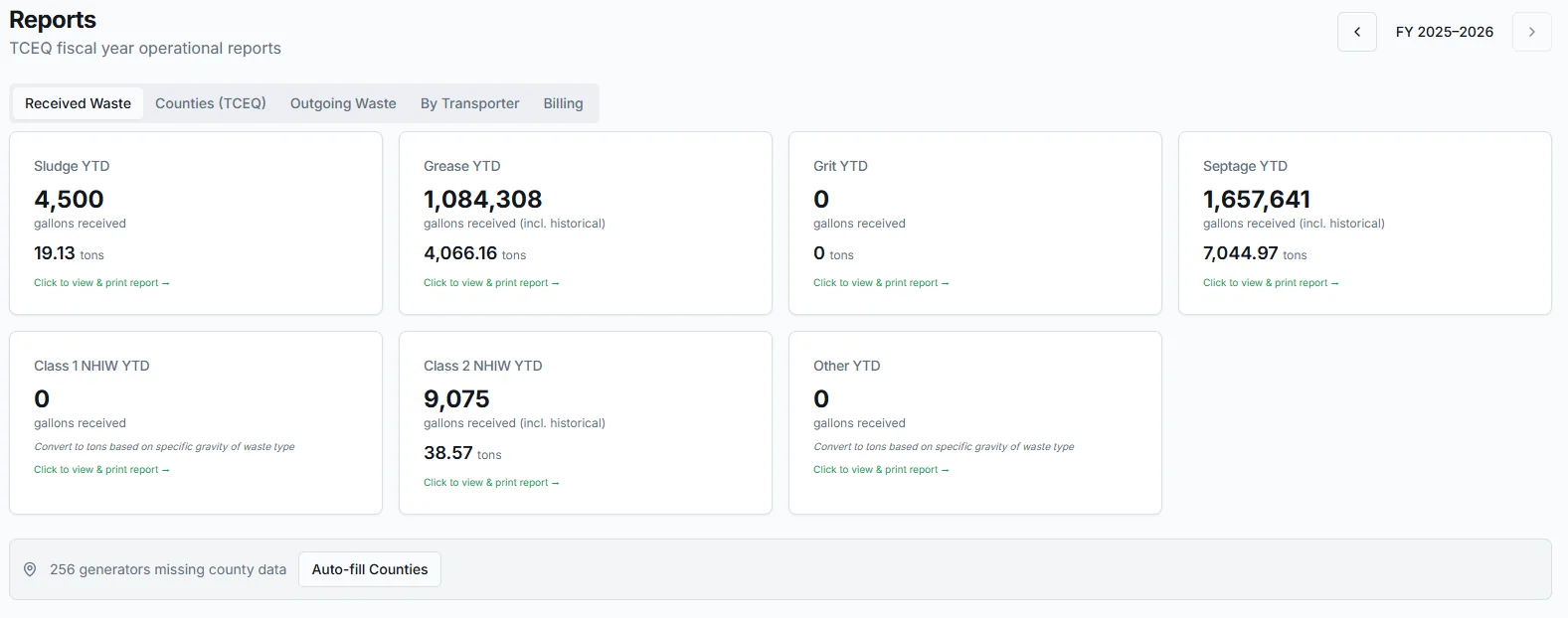
ComplyFlo helps organize approved manifest data and prepare draft reporting totals from that live data. But first - the checklist.
What is the TCEQ MSW Annual Report, and why is November 10 the deadline?
The MSW Annual Report is TCEQ's yearly tally of the waste your site processed or disposed, covering the Texas state fiscal year from September 1 through August 31. TCEQ states that "Reports for each fiscal year (September 1 through August 31) are due by November 10 following the end of the fiscal year" (TCEQ). The fiscal year 2026 report (September 1, 2025 through August 31, 2026) is due November 10, 2026.
Who has to file, and how many reports do you file?
Permitted and registered MSW facilities file, and you file a separate report for each unique authorization number. Under 30 TAC §330.675, "An operator shall file a separate report for each facility that has a unique permit, permit application number, or registration number" (30 TAC §330.675). TCEQ gives each facility type its own hard-copy form (TCEQ):
Landfills: form TCEQ-20011a
Processing facilities (transfer stations, liquid waste processing, composting, medical waste processing): form TCEQ-20011b
Landfill gas recovery and monofills: forms TCEQ-20011c and TCEQ-20011d
What does the report actually ask for?
It asks for the types and amounts of waste you processed or disposed, plus how much disposal capacity remains (TCEQ). If scales are not used, preserve the recorded volume, waste type, and compaction condition. Use the reporting units and conversion method required or permitted by the current facility-specific form.
How do you convert gallons and cubic yards to tons?
You convert with the fixed factors TCEQ publishes, and ComplyFlo applies the outgoing-waste formula for you. Section 330.675 sets these factors (30 TAC §330.675):
Waste or vehicle | Conversion factor |
|---|---|
One gallon, grease trap waste | 7.5 pounds |
One gallon, wastewater treatment plant sludge or septage | 8.5 pounds |
One gallon, grit trap waste | 9.0 pounds |
One drum | 55 gallons |
One cubic yard, no compaction | 400 pounds |
One cubic yard, medium compaction | 666.66 pounds |
One cubic yard, heavy compaction | 800 pounds |
One ton | 2,000 pounds |
For outgoing waste, TCEQ requires reporting in tons. ComplyFlo converts each outgoing load using the conversion factor that matches its waste type, and uses those tons in your report.
What is the November 10 filing checklist?
Here is the checklist most disposal sites work through to close out the fiscal year without a scramble:
Confirm your authorization numbers. Each unique permit, permit application, or registration number needs its own report.
Pull the whole year. Gather every manifest and daily log entry from September 1 through August 31.
Total received waste by type. Sludge, grease, grit, septage, and every other category you accept.
Apply the appropriate documented conversion only where needed for the applicable report.
Account for outgoing waste, using the categories and units the current form requires.
Reconcile quantities. Reconcile received, processed, disposed, transferred, recovered, and stored quantities using the applicable form's definitions. Account for inventory changes and avoid double-counting.
Fill the right form. Landfills use TCEQ-20011a; processors use TCEQ-20011b.
Submit the way TCEQ says. Submit using the method specified in TCEQ's current reporting-year instructions or the applicable facility-specific form. Keep the completed report and evidence of submission.
What does the deadline look like manual versus digital?
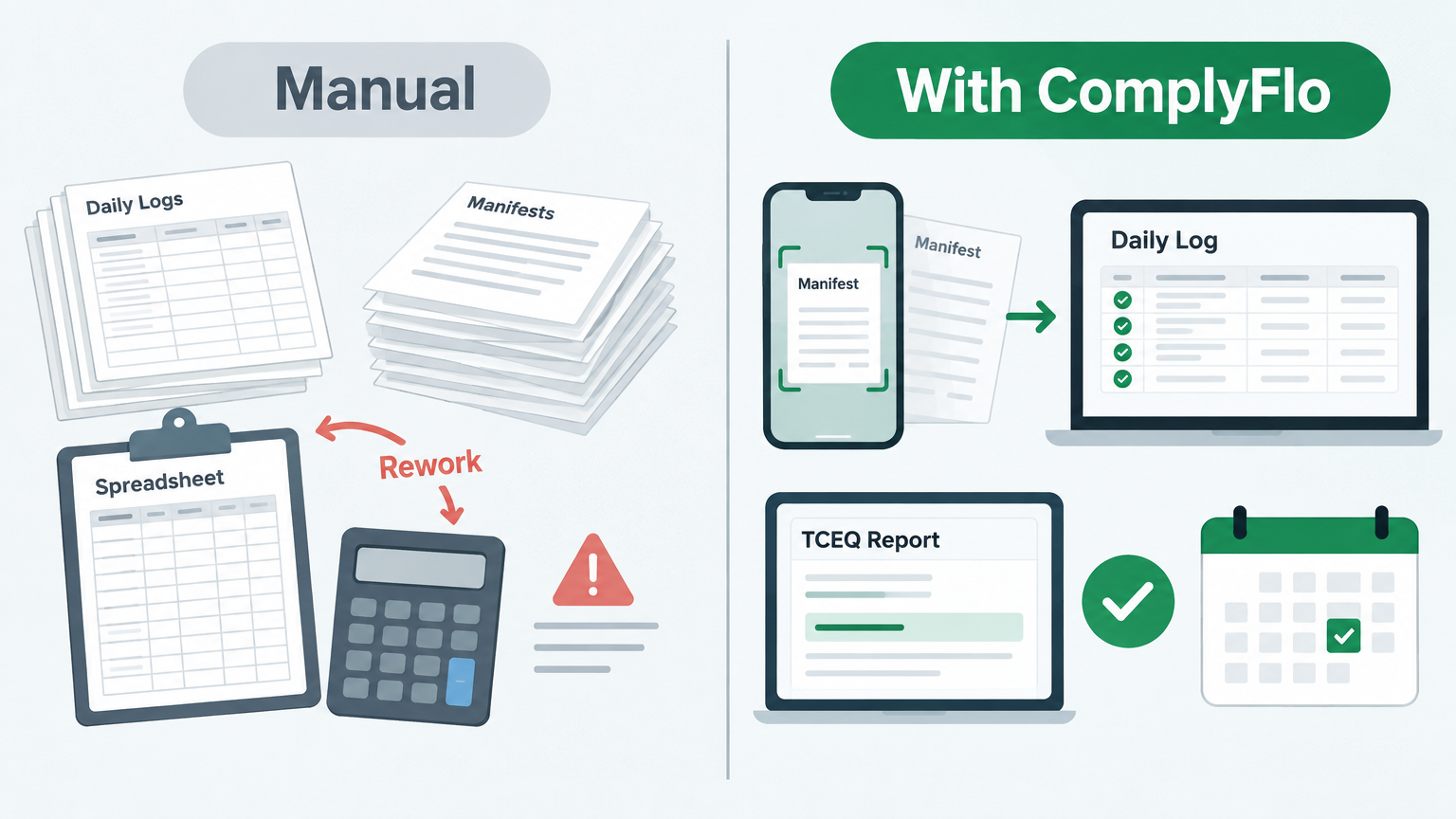
Manual reporting ties the whole year to paper and a spreadsheet; software helps you prepare draft reporting data as the year happens (ComplyFlo):
Step | Manual | With ComplyFlo |
|---|---|---|
Capture manifests | Paper stack, re-keyed later | AI extracts configured fields for user review against the source image |
Daily log | Hand-written, then re-keyed | Auto-populates as manifests are approved |
Review | Cross-checking depends on staff procedures | Supports operator and administrative review checkpoints |
Conversion | Done by hand, error-prone | Applies the TCEQ outgoing-waste formula automatically |
Reporting | Rebuilt from scratch at deadline | Draft reporting data prepared from available approved records for review before filing |
Do registered sludge transporters file the same report?
No. Registered sludge transporters have a separate Annual Summary Report, form TCEQ-00316, covering June 1 through May 31 and due July 1 each year. It summarizes the waste transported and the total of each waste type delivered to a receiver (TCEQ). This applies to registered sludge transporters, not every MSW or UCO hauler. That period matches ComplyFlo's hauler fiscal year, where manifest tracking feeds a one-click TCEQ export.
Do compost facilities file the MSW Annual Report too?
Compost facilities report by their regulatory tier, and the registered and permitted tiers also file the MSW Annual Report due November 10. The tier depends on what you accept, under 30 TAC Chapter 332 (TCEQ):
Tier | What it covers | Reporting |
|---|---|---|
Exempt | Yard trimmings, clean wood, vegetative material, paper, manure; mulching (30 TAC 332.3(d)) | No compost notification, registration, or permit required under Chapter 332; other applicable recycling, air, water, storage, and recordkeeping requirements may still apply |
Notification | Meat, fish, carcasses, dairy, oils and greases (332.3(c)), via form TCEQ-00651 | Operational-status reporting through STEERS where applicable to the facility's authorization |
Registration | Sewage sludge, positively sorted organics, diapers, paper sludges (332.3(b)) | Final product reports; MSW Annual Report due Nov 10 |
Permit | Grease trap waste, mixed MSW not positively sorted (332.3(a)) | Final product reports; MSW Annual Report due Nov 10 |
TCEQ notes that, for facilities subject to §332.71, "Registered compost facilities must submit reports semiannually; permitted compost facilities must submit reports monthly" (TCEQ). Final product derived from municipal sewage sludge at registered facilities is not subject to §332.71 and must instead comply with the applicable Chapter 312 requirements. Confirm which testing, recordkeeping, and reporting framework applies to the facility. ComplyFlo's compost module tracks reporting by tier, uses the built-in TCEQ conversions, and can send deadline reminders 14 and 3 days ahead.
What happens if you miss November 10?
Failure to submit a required report by its due date can provide grounds for enforcement, including potential permit or registration revocation under §330.675. Late payment of applicable fees can separately result in interest charges, and penalties may also apply (30 TAC §330.675).
Frequently Asked Questions
When is the TCEQ MSW annual report due?
It is due by November 10 each year, covering the state fiscal year from September 1 through August 31. The fiscal year 2026 report is due November 10, 2026. TCEQ directs operators to the current reporting-year instructions for the submission method (TCEQ).
Who has to file the TCEQ MSW annual report?
Operators of permitted or registered MSW facilities file it, with a separate report for each unique permit, permit application number, or registration number (30 TAC §330.675). That covers landfills, transfer stations, liquid waste processing, composting, medical waste processing, monofills, and landfill gas recovery facilities.
How do I convert gallons to tons for the TCEQ MSW annual report?
TCEQ publishes fixed factors: one gallon of grease trap waste is 7.5 pounds, one gallon of sludge or septage is 8.5 pounds, and one gallon of grit trap waste is 9.0 pounds. By vehicle volume, one cubic yard is 400 pounds uncompacted, 666.66 pounds at medium compaction, and 800 pounds at heavy compaction (30 TAC §330.675). For outgoing waste, ComplyFlo converts each outgoing load using the conversion factor that matches its waste type, and uses those tons in your report.
What is the TCEQ-00316 hauler annual report?
It is the Annual Summary Report for Transporters of Municipal Sludges and Similar Wastes. A registered sludge transporter files it by July 1 each year, reporting the waste transported from June 1 through May 31 (TCEQ).
Do compost facilities file the TCEQ MSW annual report?
Yes, at the registration and permit tiers. Registered and permitted compost facilities file the MSW Annual Report due November 10; for facilities subject to §332.71, registered facilities submit final product reports semiannually and permitted facilities monthly. Final product derived from municipal sewage sludge at registered facilities is not subject to §332.71 and must instead comply with the applicable Chapter 312 requirements (TCEQ).
See ComplyFlo in action
ComplyFlo applies the TCEQ conversion formula to outgoing loads automatically, so your submission numbers line up with what the regulator expects. Operators remain responsible for verifying conversions, completeness, report requirements, and final submission.
Free checklist
Sludge Transporter Trip Ticket Checklist
Review required fields, signatures, generator copies, five-year retention, annual summaries, and significant-discrepancy procedures.
Ready to replace paper trip tickets and manifests?
Book a free 1-hour demo with a ComplyFlo team member and see it running on your own workflow.
Book a free demoGet TCEQ compliance updates
Deadline reminders, rule changes, and practical guides for Texas waste operators. No spam — unsubscribe anytime.
By subscribing you agree to receive emails from ComplyFlo. See our privacy policy.