Haulers
Grease Trap Pumping Frequency in Texas: How Often Does a Trap Need Cleaning?
ComplyFlo · November 3, 2026 · 5 min read
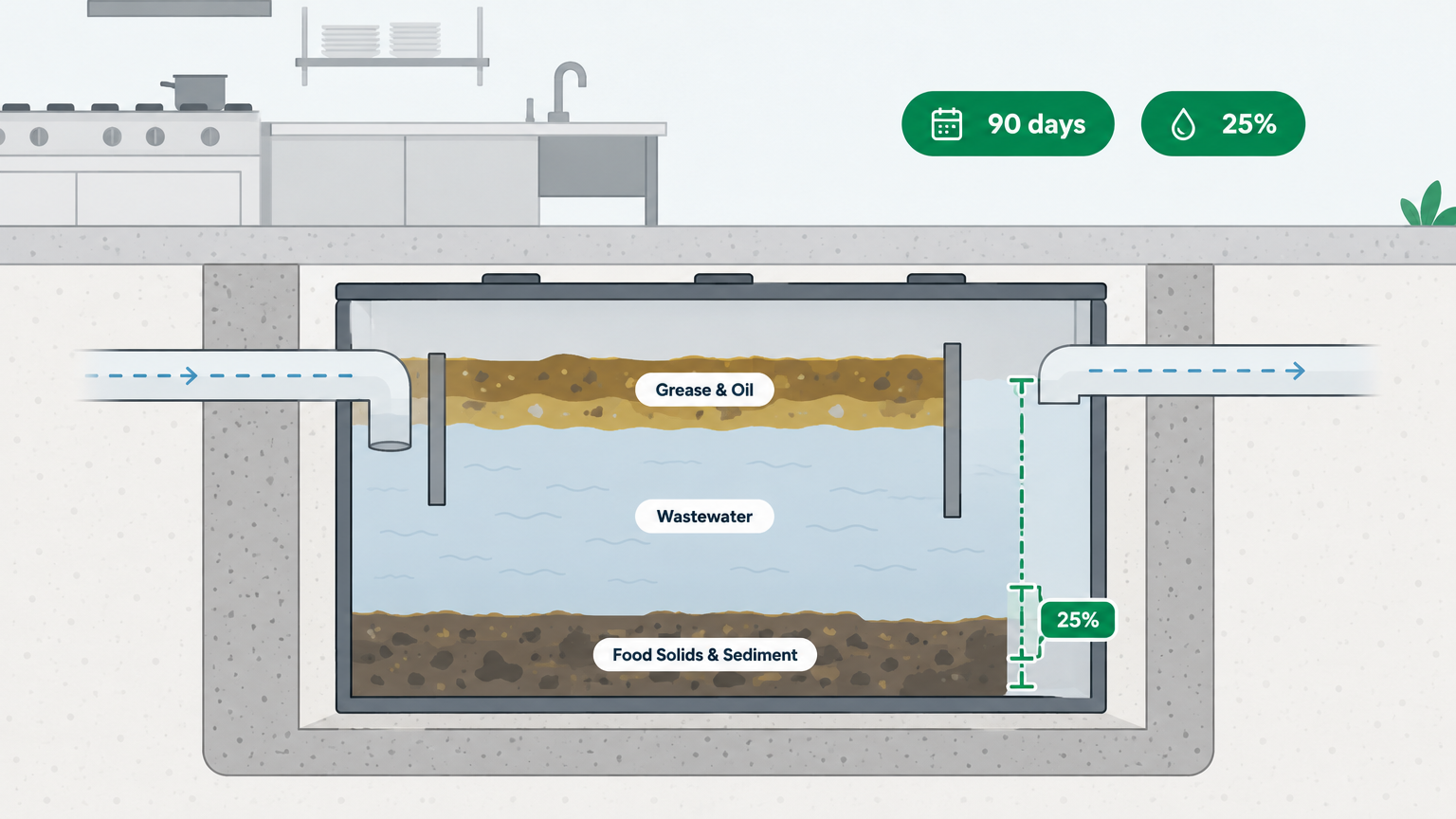
The short version: Your sewer authority's adopted grease ordinance sets your trap's pumping schedule, and TCEQ's model ordinance is the template a city may adopt. Under the model, the trap must be completely pumped out at least every 90 days, sooner if grease and solids fill 25 percent of the device's wetted height (the depth of liquid the trap holds when it's working), and never longer than 180 days. ComplyFlo keeps pump-out dates and manifests (the trip ticket the hauler fills out at each pump-out, showing what was taken and where it went) in one place, so the schedule and the paper trail stay together.
How often does a grease trap need to be pumped in Texas?
Your local grease ordinance sets the exact schedule, not one statewide number. TCEQ publishes a model ordinance a city may adopt, and its numbers are the ones people quote. Two layers govern the job:
Your local ordinance, adopted by your sewer authority (the city-run sewer and wastewater treatment system, called a publicly owned treatment works, or POTW), governs the trap on site.
State rules cover the hauling side. Anyone who hauls grease trap waste must register with TCEQ before they start, and they must notify TCEQ before hauling to a disposal site that isn't listed on their registration (30 TAC §312.142).
Confirm the exact schedule with your sewer authority.
What does the TCEQ model ordinance say about pumping frequency?
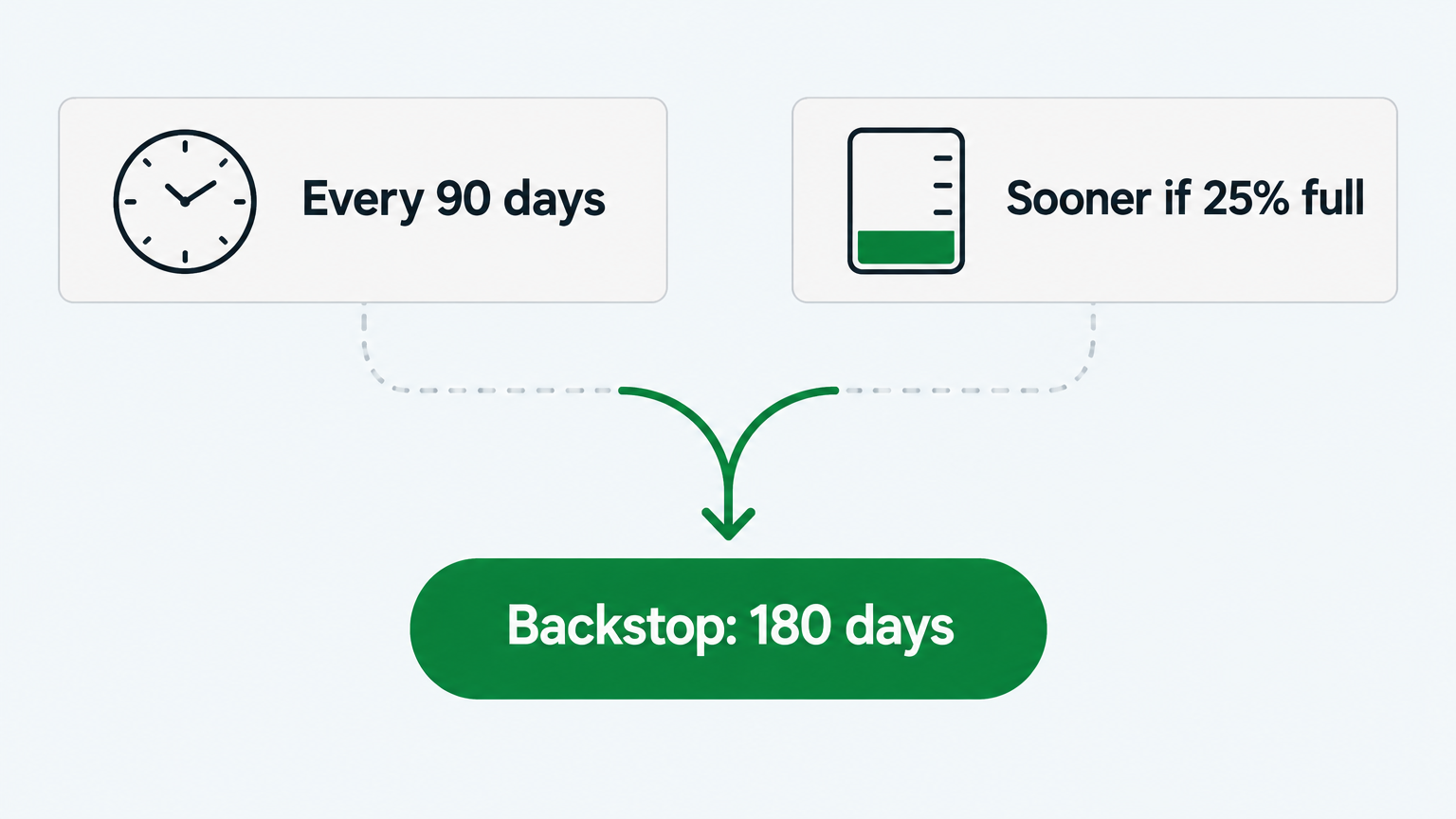
The model sets one fixed interval, one accumulation trigger, and one outer limit.
Completely pumped out at least every 90 days. Traps must be "completely evacuated a minimum of every ninety (90) days" (TCEQ model standards).
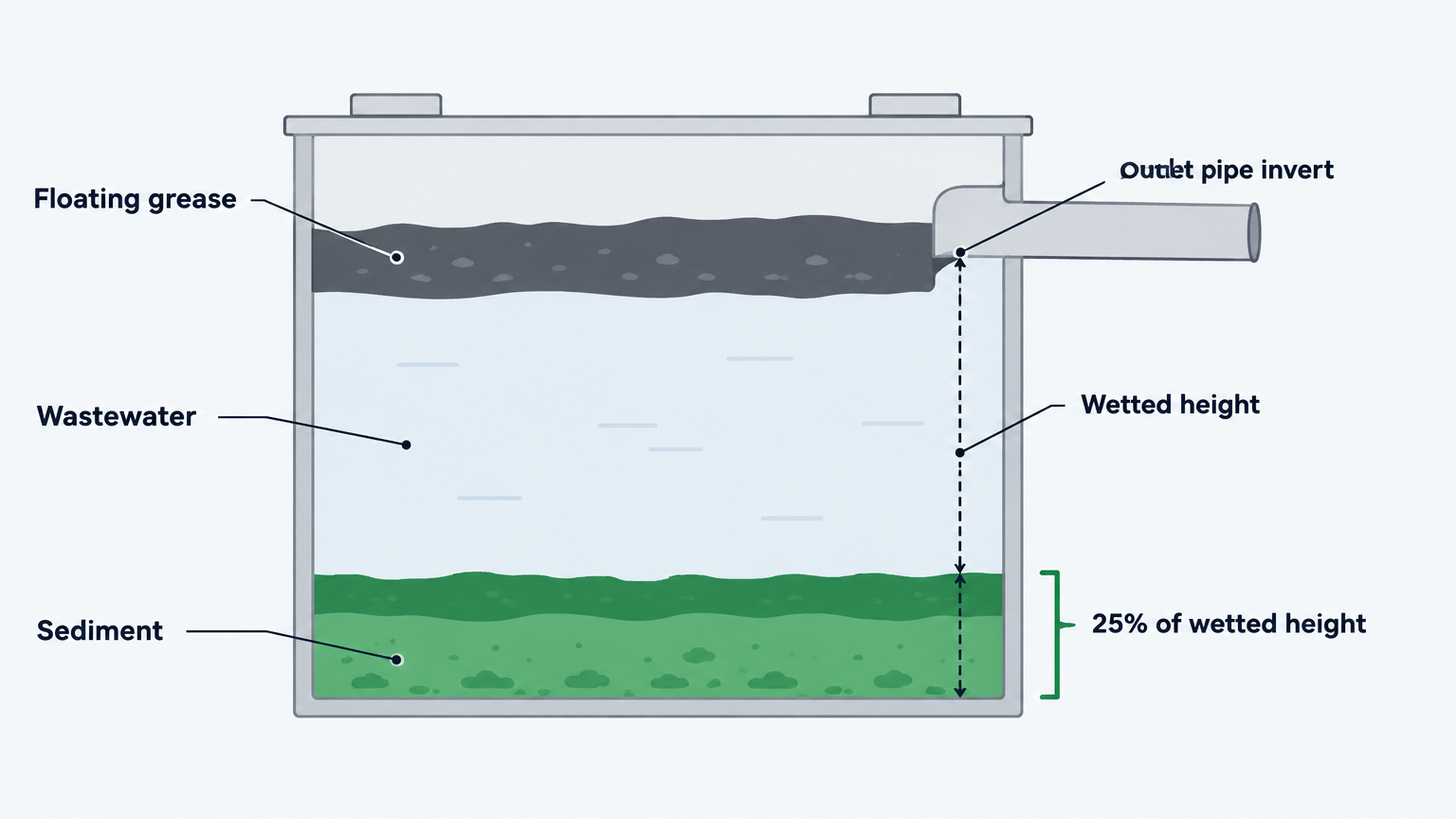
Sooner if the trap fills to 25 percent. It must be cleaned more often when 25 percent or more of the device's wetted height holds floating materials, sediment, oils or greases (TCEQ model standards).
Never longer than 180 days. Even with a written exception to the 90-day rule, a trap shall be "fully evacuated, cleaned, and inspected at least once every 180 days" (TCEQ model standards).
Does the 25 percent rule measure only the grease layer?
No. The 25 percent counts floating fats, oils and greases and settled sediment together, not just the grease cap on top.
What counts toward it: "floating materials, sediment, oils or greases," added together (TCEQ model standards).
Where the measurement runs: from "the bottom of the device to the invert of the outlet pipe" (TCEQ model standards). The invert is the inside bottom edge of the outlet pipe.
So a thick grease cap alone is not the trigger; settled solids count too.
Which comes first, the 90-day clock or the 25 percent fill?
Whichever comes first. Under the model, 90 days is the longest you may wait unless your sewer authority gives you a written exception, and even then you can't go past 180 days. The 25 percent fill is when you must clean early (TCEQ model standards).
Depending on kitchen volume and trap size, a busy kitchen can hit 25 percent well before day 90.
The model adds two more early triggers: a discharge above the POTW's BOD, COD, TSS, FOG, pH or other limits (lab measures of how dirty the wastewater is: BOD and COD measure organic pollution, TSS is tiny solids suspended in the water, FOG is fats, oils, and grease, and pH is how acidic or alkaline it is), and any history of non-compliance (TCEQ model standards).
If the trap holds more than the vacuum truck can take, the transporter must arrange extra capacity so it is fully pumped out within 24 hours (TCEQ model standards).
Do Texas cities set their own grease trap pumping schedules?
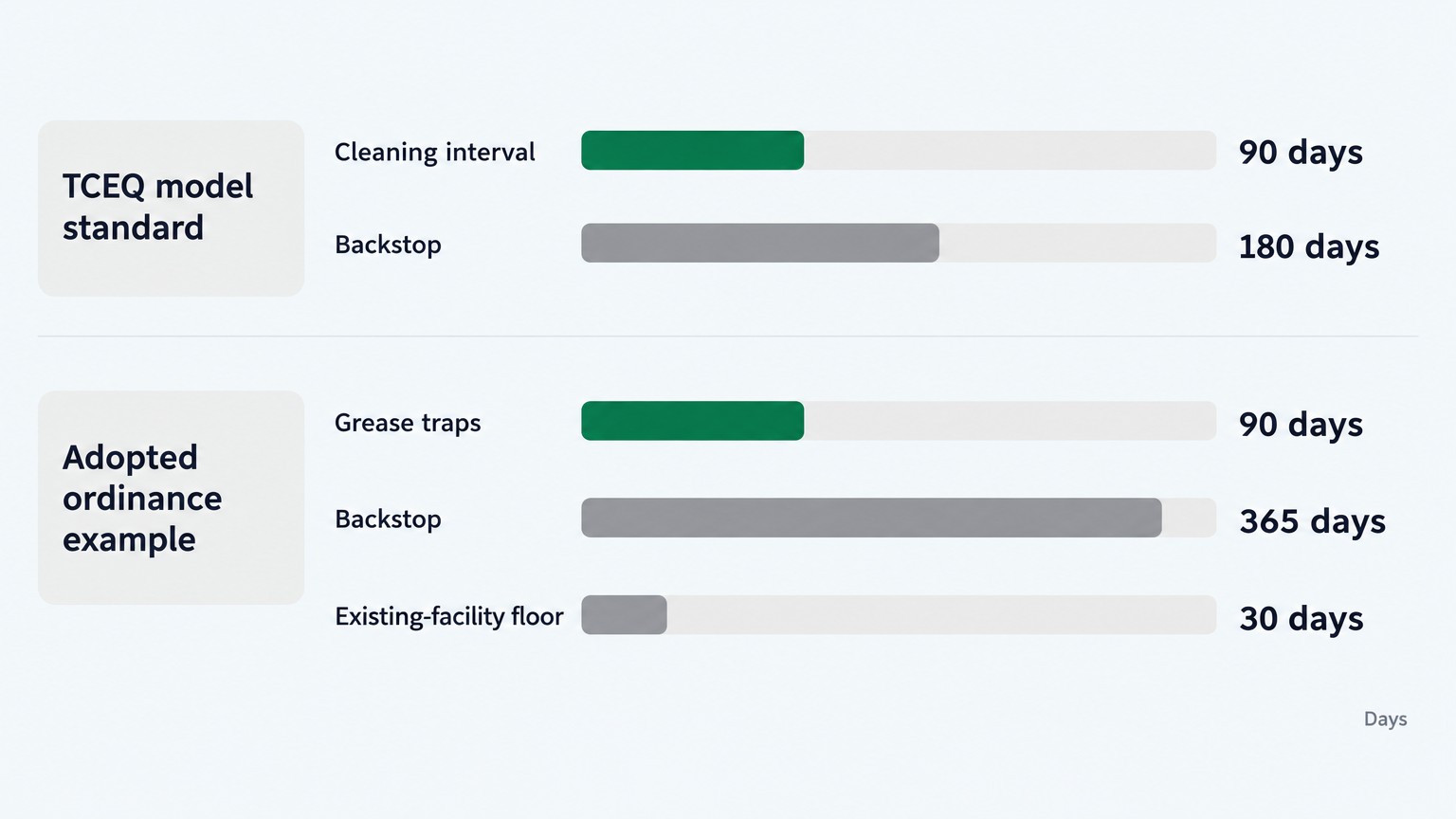
Yes. Cities adopt their own version, and the numbers can differ from the model. The City of Belton's FOG ordinance is one worked example. For the broad overview of state and local rules, see our guide to Texas grease trap regulations.
Requirement | TCEQ model ordinance | City of Belton ordinance (one example) |
|---|---|---|
Grease trap cleaning interval | Every 90 days | Every 90 days |
Accumulation trigger | 25% of wetted height | 25% of wetted height |
Outer limit (even with an exception) | 180 days | 365 days |
Smaller approved pre-existing traps | Not specified | Shortest cycle 30 days |
Belton's Ordinance No. 2017-36 requires grease traps be "completely evacuated a minimum of every ninety (90) days," with an outer limit of "at least once every three hundred sixty-five (365) days" (City of Belton ordinance). Belton also requires a copy of each manifest to be turned in to the city within 10 days of the pump-out, and requires the business to keep manifest copies onsite for three years (City of Belton ordinance). Those are Belton's numbers, not a statewide rule.
How do you prove a Texas grease trap was pumped on schedule?
You prove it with the manifest the hauler completes at each pump-out. If an inspector asks, the manifest is your proof.
Under the model, every pump-out needs a manifest, and the business must keep its returned copy for five years (TCEQ model standards).
Under 30 TAC §312.145, trip-ticket copies are kept five years and made available for TCEQ review, and the hauler must return a completed copy to the business within 15 days after the waste is delivered to the disposal facility.
See our guide to grease trap manifest requirements in Texas.
Grease trap record step | Manual process | With ComplyFlo |
|---|---|---|
Capture the pump-out record | Paper manifest filled in the field | Driver photographs it; fields extracted |
Check it is complete | Noticed later at the office | Driver submits; admin reviews and approves before the record locks (ComplyFlo) |
Store the schedule and records | Filing cabinet or glovebox | Stored in one place with the approved record |
Retrieve it for an inspection | Manual file search | Pulled up from the approved records |
Frequently Asked Questions
How often should a Texas grease trap be pumped?
Your adopted local ordinance sets the interval. The TCEQ model ordinance baseline is every 90 days, sooner at 25 percent of wetted height, and never longer than 180 days.
Is 90 days the law for every grease trap in Texas?
No. TCEQ's model standards are a template a city may adopt, so your adopted local ordinance controls. Your city's numbers can differ from the model's.
Can a restaurant clean its own grease trap in Texas?
It depends on the local ordinance. The model allows self-cleaning only for indoor traps of 50 gallons or less, with approval from the sewer authority every year, and only if the local solid waste authority allows it (TCEQ model standards). Some cities restrict it, so check with your sewer authority.
What happens if a grease trap is not pumped on schedule?
An overdue trap can send grease into the sewer, and the local ordinance sets the penalty. Under one example, a violation is a Class C misdemeanor with fines up to $2,000 and possible termination of water service (City of Belton ordinance). Missing manifests add a separate recordkeeping exposure.
How does ComplyFlo keep grease trap pump-outs on schedule and on record?
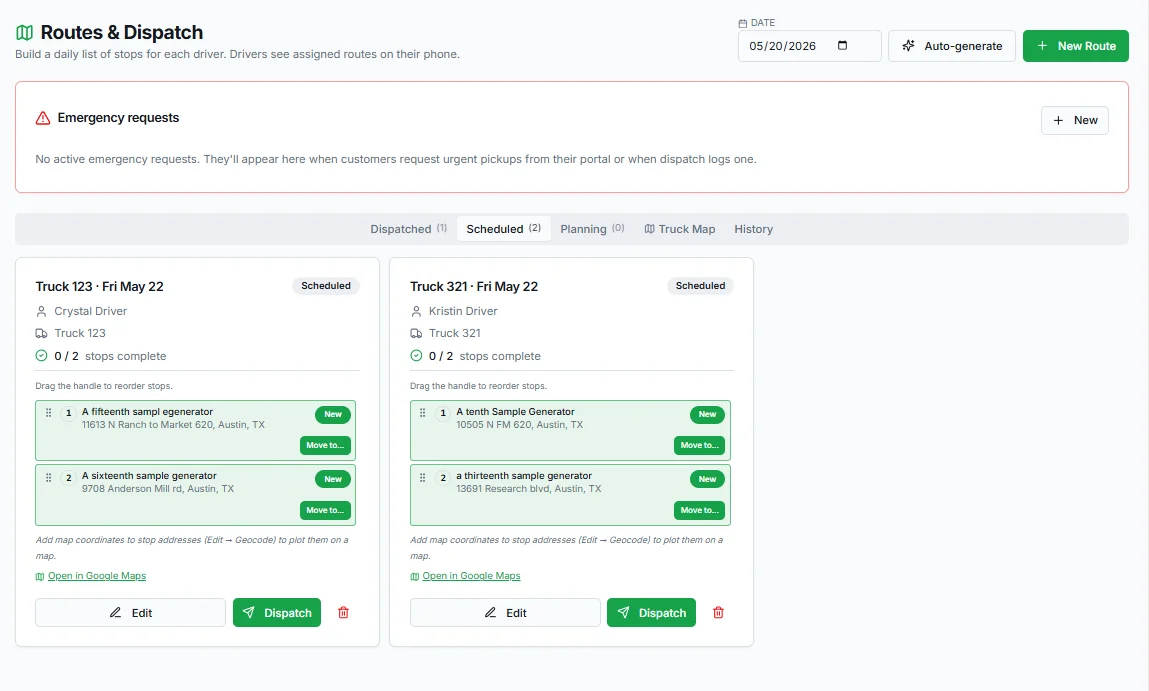
ComplyFlo gives haulers one place to capture, review, and retrieve every pump-out record. A driver photographs the paper manifest, the AI extracts the fields, and the record locks after admin review, so the pump-out date and the manifest stay linked to the generator (the business whose trap it is).
The free printable Texas Grease Trap Manifest Checklist covers transporter registration, manifest fields, authorized disposal, record distribution, and retention requirements that vary by city (ComplyFlo).
For the plant side, ComplyFlo for wastewater tracks permit milestones with lead-time alerts. Book a demo to see the hauler workflow.
ComplyFlo reduces human error in data organization and formatting. Operators and haulers retain responsibility for verifying local requirements and all submissions to environmental agencies.
Free checklist
Texas Grease Trap Manifest Checklist
Check transporter registration, manifest fields, authorized disposal, record distribution, and jurisdiction-specific retention requirements.
Ready to replace paper hauler manifests?
Book a free 1-hour demo with a ComplyFlo team member and see it running on your own workflow.
Book a free demoGet TCEQ compliance updates
Deadline reminders, rule changes, and practical guides for Texas waste operators. No spam — unsubscribe anytime.
By subscribing you agree to receive emails from ComplyFlo. See our privacy policy.