Haulers
Grease Trap Manifest Requirements in Texas: What FOG Haulers Need to Know in 2026
Texas sludge transporters collecting grease-trap waste must complete a trip ticket for each collection and disposal. Here's what TCEQ requires - who must register, what goes on the record, and why documentation gaps create real exposure.
September 24, 2026 · 7 min read
TL;DR
Texas sludge transporters collecting grease-trap waste must complete a trip ticket - also called a waste manifest - for each applicable collection and disposal. The record should identify the generator, transporter, waste type and quantity, and receiving facility, and must be completed and retained in accordance with applicable TCEQ, local, facility, and contract requirements. Under 30 TAC 312.145, electronic signatures and electronic manifest files may be allowed. Confirm the specific requirements for your waste stream, receiving facility, and local jurisdiction. ComplyFlo helps haulers capture, review, organize, and retrieve trip-ticket records in a searchable workflow - reducing dependence on paper files and making records easier to find when customers, disposal facilities, or regulators have questions.
When a registered transporter collects grease-trap waste in Texas, the transporter must complete a trip ticket or waste manifest for each collection and disposal. Most haulers know that much. The part that catches operators off guard is the specifics - which fields belong on the form, what the TCEQ registration requirement actually means, how long records must be kept, and where they can legally go.
A note on terminology. This post uses "FOG haulers" in the title because that's a common search term. The operators it actually covers are more precisely called sludge haulers under TCEQ rules. A TCEQ sludge transporter registration covers grease-trap waste, septic-tank waste, grit-trap waste, and related municipal liquid wastes - all under the same 30 TAC 312 framework. Many of these operators haul both grease-trap waste and septic on their routes, and the manifest requirement applies to those loads too. "FOG" in the pure recycling sense - used cooking oil (UCO) collectors and operators focused on grease-to-fuel or grease-to-feed processing - is a different category with different handling requirements and does not typically use the same manifest system. If you're a pumping operator hauling grease-trap waste, septic, or both, this article is for you.
TCEQ's grease-trap manifest requirements aren't published in one convenient place. They're spread across 30 TAC 312 (sludge transportation) and TCEQ guidance publication RG-389 (grease traps, grit traps, and septic tanks), with additional requirements layered on by local authorities and receiving facilities. This post pulls the core framework into one place.
ComplyFlo helps FOG waste haulers capture, organize, review, and retrieve trip-ticket and manifest records - reducing dependence on paper files and making records easier to find when customers, disposal facilities, or regulators have questions. Records are stored securely for the operator's configured retention period, with retrieval by load, date, driver, generator, or receiving facility.
Why does Texas require a manifest for grease trap waste?
Grease-trap waste, grit-trap waste, septic-tank waste, and related municipal liquid wastes are regulated under Texas sludge-transporter requirements. This article focuses on hauled grease-trap and interceptor waste - not every form of FOG found in a wastewater stream. That waste falls under TCEQ's sludge transportation rules at 30 TAC 312. Three things the trip ticket or manifest does:
Creates a disposal record. Without a completed record, there's no documentation distinguishing a legal pump-out from unauthorized disposal into a storm drain or sewer cleanout.
Documents the generator's waste-management practices. Generators should use registered transporters and retain completed records. Those records help establish what waste-management steps were taken if questions arise about collection or disposal.
Gives TCEQ an audit trail. TCEQ can request manifests during inspections and complaint investigations. No record creates a documentation gap at exactly the moment it matters.
Texas requires a complete trip ticket or waste manifest for each applicable collection and disposal. Under 30 TAC 312.145, electronic signatures and electronic manifest files may be used when the system meets the rule's requirements. Haulers should also confirm any additional local paper-copy, signature, or retention requirements that apply at the generator location or receiving facility. Digital tools like ComplyFlo organize and store manifest data - they help make records traceable, retrievable, and consistent, regardless of whether paper or electronic formats are used.
Who in Texas needs a manifest?
Any registered transporter collecting and transporting grease-trap waste in Texas must complete a trip ticket for each collection and disposal. TCEQ guidance RG-389 states that registered transporters must provide a completed manifest or trip ticket to their customers. The TCEQ sludge transporter registration covers grease-trap waste, septic-tank waste, grit-trap waste, and related municipal liquid wastes - many operators hold one registration covering multiple waste types and haul both grease-trap waste and septic on their routes. A manifest is required for each applicable collection and disposal across those waste streams. That typically covers:
Commercial grease trap pumpers
Interceptor waste haulers
Septic tank waste haulers operating under a TCEQ sludge transporter registration
Industrial grease waste transporters
The generator - the restaurant, commercial kitchen, or food service facility - also has a role. Per TCEQ guidance RG-389, generators should use registered transporters and verify that their hauler holds a valid TCEQ registration before hiring. Retaining completed trip-ticket records documents those waste-management steps if questions arise.
Generators can check hauler registration status using TCEQ's Sludge Query System.
Residential grease is generally exempt from these requirements. Grease-trap and interceptor waste handled by a registered transporter is covered.
What must a Texas FOG waste manifest include?
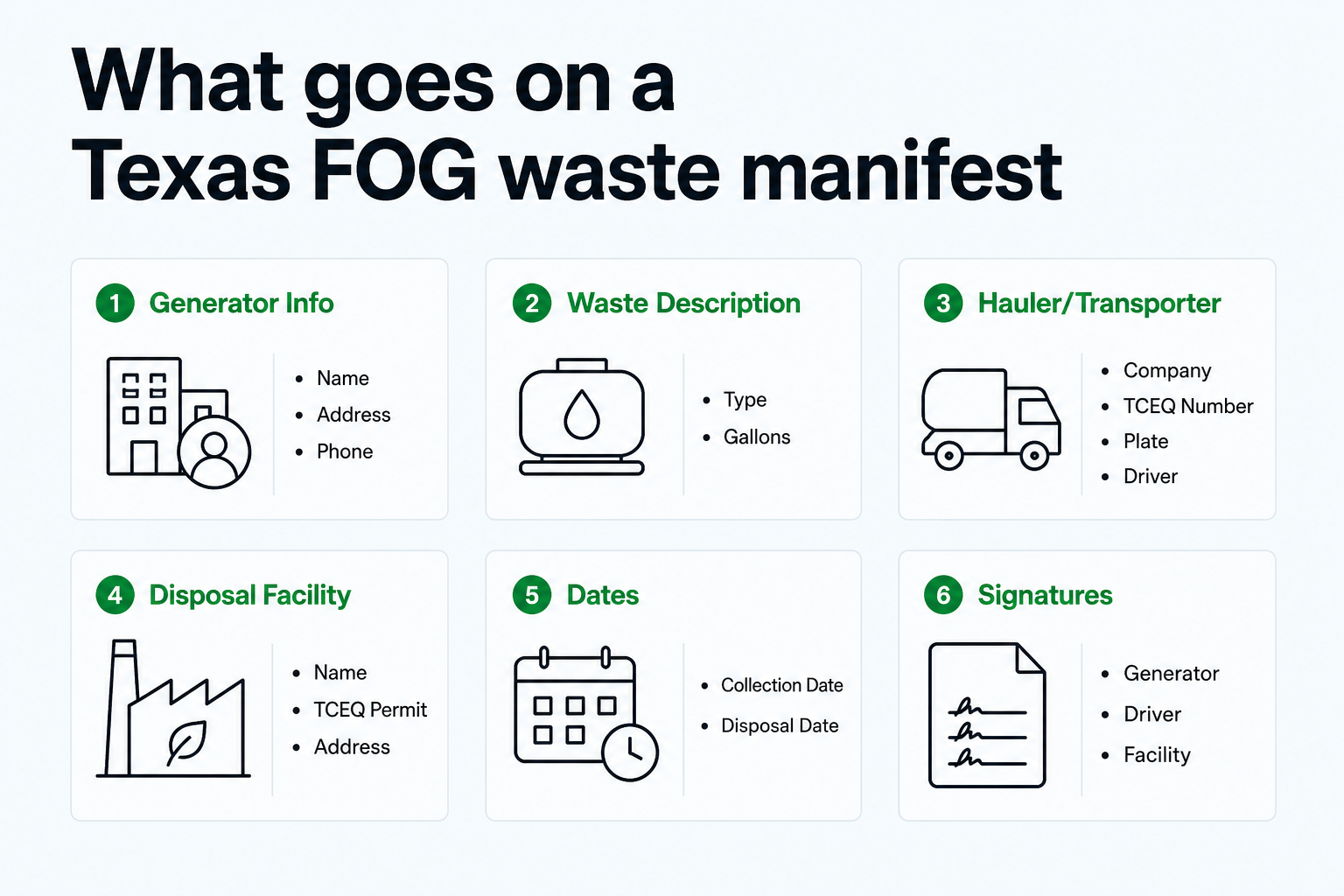
Texas FOG waste manifests must include the fields specified in 30 TAC 312 and TCEQ guidance RG-389. The transporter should complete the generator and collection portions of the trip ticket at the time of service, and the receiving facility should complete its receiving information as required by the applicable rule, local program, and facility procedure. Complete the record promptly and ensure all required information is legible and retrievable.
Generator section:
Business name, address, and phone number
Type of waste (grease trap waste, interceptor waste, grit trap waste, septic tank waste)
Trap or tank capacity
Volume of waste collected (gallons)
Date of service
Generator representative signature
Hauler/transporter section:
Company name, address, and phone number
TCEQ registration number (mandatory - see below)
City or county permit number, if required by local authority
Volume transported (gallons)
Driver name and signature
Receiving facility section:
Authorized facility name
TCEQ permit or registration number
Facility address
A note on the TCEQ registration number: every Texas grease trap hauler must hold a TCEQ sludge transporter registration, obtained using Form TCEQ-00481. Registration costs $10 per vehicle sticker, renews every two years, and each truck must display a dated TCEQ sticker on the door. A transporter must maintain an active TCEQ registration and current vehicle authorization when transporting covered wastes. A complete trip ticket does not cure a registration lapse, so generators should verify both transporter registration and the required vehicle sticker before service begins.
How are grease-trap manifest records distributed and retained?
The transporter, generator, and receiving facility should each receive or be able to retrieve the completed record as required by the applicable state rule, local program, receiving-facility procedure, and contract. Confirm the required record-distribution process with the receiving facility and the local authority having jurisdiction before assuming a standard applies.
Record-retention requirements can come from TCEQ rules, local grease-control or pretreatment programs, receiving-facility procedures, permits, and contracts. The applicable period is not uniform across Texas jurisdictions. Dallas, for example, requires the completed final liquid-waste manifest record to be retained at the generator's facility for three years and kept available for examination. Haulers and generators should confirm the retention period that applies in each operating jurisdiction and build their recordkeeping policy around the longest applicable requirement.
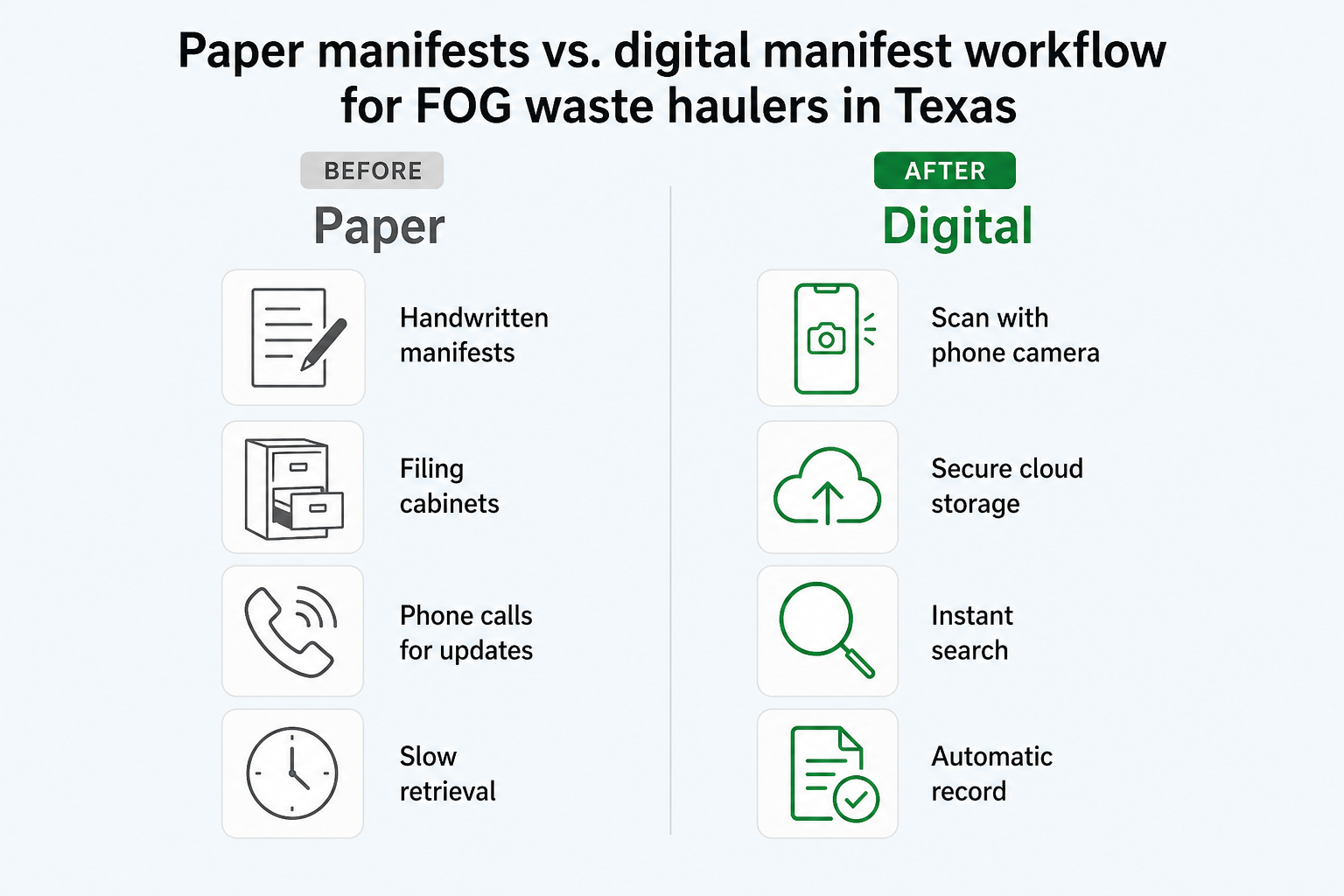
The practical problem: most haulers store paper records in cardboard boxes or filing cabinets. Retrieval during a TCEQ inspection - or a complaint investigation - is slow, stressful, and error-prone. Water damage, office moves, and turnover all put years of required records at risk. A digital system can help preserve and retrieve records, but it should be configured to retain records for the required period under the applicable rules and contracts.
Where can FOG waste go in Texas?
Hauled grease-trap waste should be delivered only to a facility authorized to receive that specific waste stream. Common authorized types include:
Municipal wastewater treatment plants permitted to accept hauled waste
Licensed sanitary landfills accepting sludge waste
Authorized sludge processing or rendering facilities
Haulers should use only facilities authorized to receive the particular waste stream and should maintain current facility-acceptance information. Verify authorization whenever the facility, waste stream, permit status, or acceptance conditions may have changed.
Disposal to unauthorized sites - including grease dumped into sewer cleanouts or storm drains - carries significant civil and criminal penalties under Texas Health and Safety Code Chapter 361.
Also worth noting: wastewater treatment plants that accept FOG loads from haulers have their own manifest obligations on the receiving end. ComplyFlo's wastewater module handles incoming hauled waste manifests for WWTPs.
What happens if a manifest is missing or incomplete?
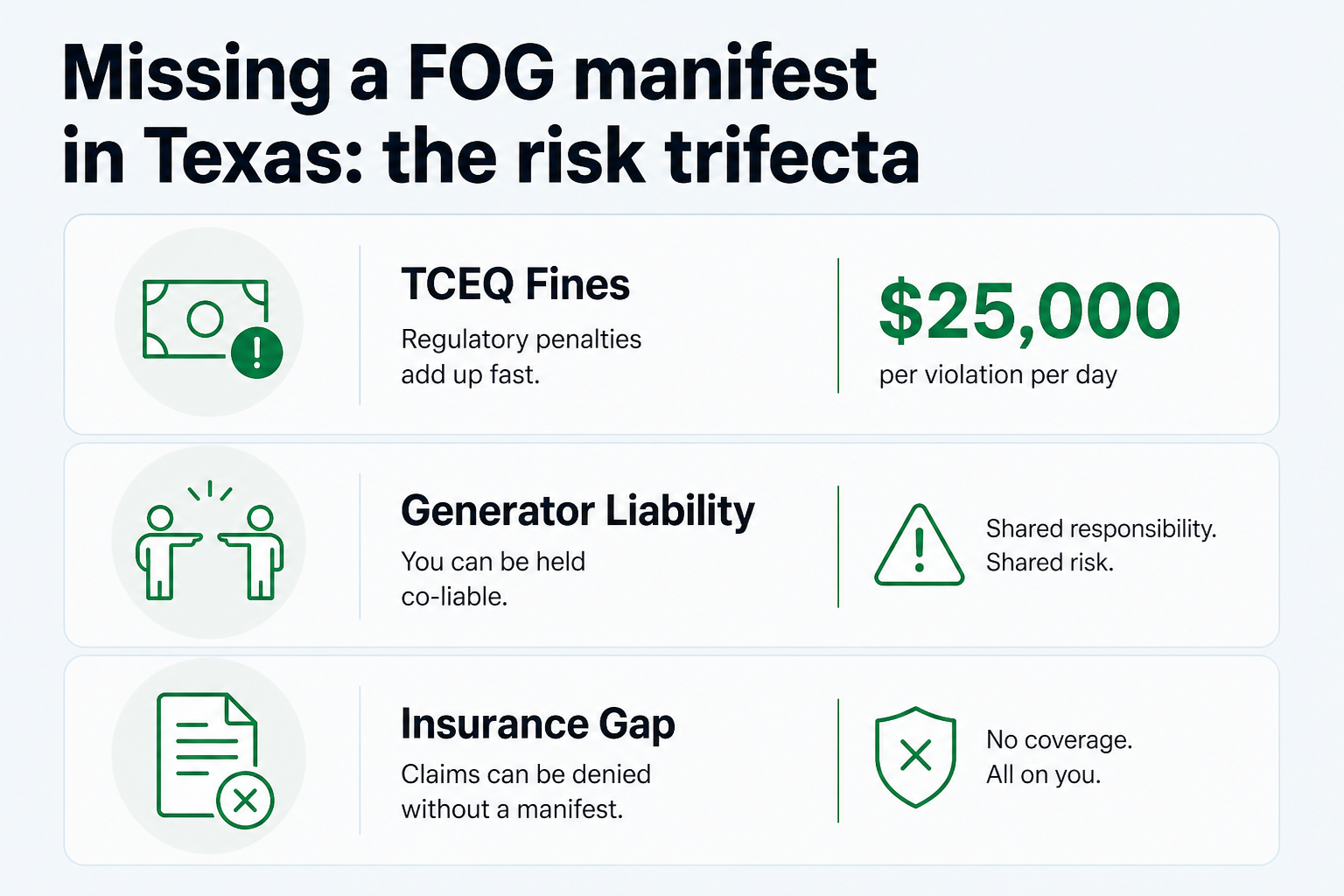
Missing or incomplete records create exposure across three fronts:
Risk area | Who it hits | What it means |
|---|---|---|
Regulatory and enforcement exposure | Hauler, generator | Missing, inaccurate, or poorly retained records can lead to enforcement action under Texas Health and Safety Code Chapter 361. Applicable penalties depend on the specific violation, facts, and enforcement authority involved. |
Documentation gaps for generators | Generator | Generators should retain completed trip-ticket records to document their waste-management practices. Using unregistered transporters or failing to retain records removes that documentation if questions arise. |
Insurance coverage gaps | Both | Many commercial GL policies require proof of proper waste disposal. No manifest documentation means no documentation trail if a coverage question comes up. |
Documentation gaps can create problems during inspections, complaint investigations, disposal-facility disputes, customer questions, or internal reviews - whether or not formal enforcement is actively underway.
What mistakes do Texas FOG haulers make most often?
Using an outdated manifest form. TCEQ updates its requirements periodically. Old forms may be missing required fields - particularly the TCEQ transporter registration number and the receiving facility's permit number. If a field is missing, the manifest is incomplete.
Leaving the TCEQ transporter registration number blank. This is the most common single-field error. The registration number is mandatory. An expired or missing number invalidates the manifest regardless of how complete the rest is.
Incomplete generator information for chains and franchises. When pumping multiple locations under one corporate account, haulers often record the parent company instead of the specific location address. TCEQ requires the address where the waste was actually generated.
Missing the receiving facility acknowledgment. The receiving facility should complete the receiving portion of the trip ticket in accordance with the applicable TCEQ rule, facility procedure, and local program requirements. Haulers should confirm exactly what receiving acknowledgment is required before leaving the disposal site.
Storing paper records with no backup. Years of required records kept only in paper form are one water leak, office fire, or lease move away from disappearing. A digital backup - with records organized by load, date, driver, and generator - makes retrieval during inspections or customer inquiries straightforward rather than a filing-cabinet excavation.
Try ComplyFlo
Texas grease-trap manifest requirements are straightforward once you know the rules. The hard part is executing consistently across hundreds of loads per month - with rotating drivers, multiple jurisdictions, and a documentation system that has to hold up when a customer, disposal facility, or regulator asks a question years later.
ComplyFlo's hauler module helps haulers capture, organize, review, and retrieve trip-ticket and manifest records. Drivers photograph or upload records from the field. ComplyFlo's AI extracts key fields - generator, waste type, gallons, TCEQ registration number, disposal facility, dates - and flags anything that looks incomplete. An authorized company user can review the extracted information, correct or flag missing fields, and preserve the finalized record in the company's workflow. Records are stored securely for the operator's configured retention period, searchable by load, date, driver, generator, or receiving facility.
Reduce paper-file dependence, improve retrieval speed, and create a more consistent record-review workflow across every driver and every jurisdiction you operate in.
The hauler module is currently in beta. Book a demo at complyflowaste.com/haulers to join.
Frequently Asked Questions
Is grease trap waste a hazardous waste in Texas?
No. Grease trap waste (brown grease) is classified as a regulated non-hazardous waste in Texas. It falls under TCEQ's sludge transportation rules at 30 TAC 312, not the hazardous waste rules. That said, 'non-hazardous' doesn't mean unregulated - manifests, TCEQ-registered transporters, and authorized disposal facilities are all still required.
How long must Texas FOG haulers keep manifest records?
Record-retention requirements for grease-trap waste manifests can come from TCEQ rules, local grease-control or pretreatment programs, receiving-facility procedures, permits, customer contracts, and internal company policies. The required period varies by jurisdiction. For example, Dallas requires the completed final liquid-waste manifest record to be retained at the generator's facility for three years. Haulers and generators should confirm the requirements in each operating jurisdiction and apply the longest applicable retention period across all records.
What is a TCEQ sludge transporter registration, and how do I get one?
Any hauler transporting grease trap waste in Texas must hold a TCEQ sludge transporter registration. Apply using Form TCEQ-00481. Registration costs $10 per vehicle sticker, must be renewed every two years, and each registered truck must display the dated TCEQ sticker on the door. Contact TCEQ at streg@tceq.texas.gov or 512-239-6413 for questions.
Can a Texas grease trap hauler mix grease trap waste with septic tank waste?
No. TCEQ guidance RG-389 is clear: haulers cannot mix wastes with different characteristics. Grease trap waste and septic tank waste require separate manifests and separate loads. Most disposal facilities are not authorized to accept mixed waste, so mixing creates both a compliance violation and a rejection risk at the gate.
What happens if a Texas restaurant hires a hauler without a TCEQ registration?
Generators should use only registered transporters and retain completed trip-ticket records. Those records document the generator's waste-management practices if questions arise about collection or disposal. Generators can verify hauler registration status before hiring using TCEQ's Sludge Query System. Missing or inaccurate records can create enforcement, contract, disposal-site, insurance, and customer-liability exposure - the specific consequences depend on the facts and violation involved.
See ComplyFlo in action
Manifests, compliance reporting, and billing in one platform built for waste operations.
Book a demo