Compost
Texas Compost Facility Annual Report: What to Submit to TCEQ by November 10
ComplyFlo · October 25, 2026 · 7 min read
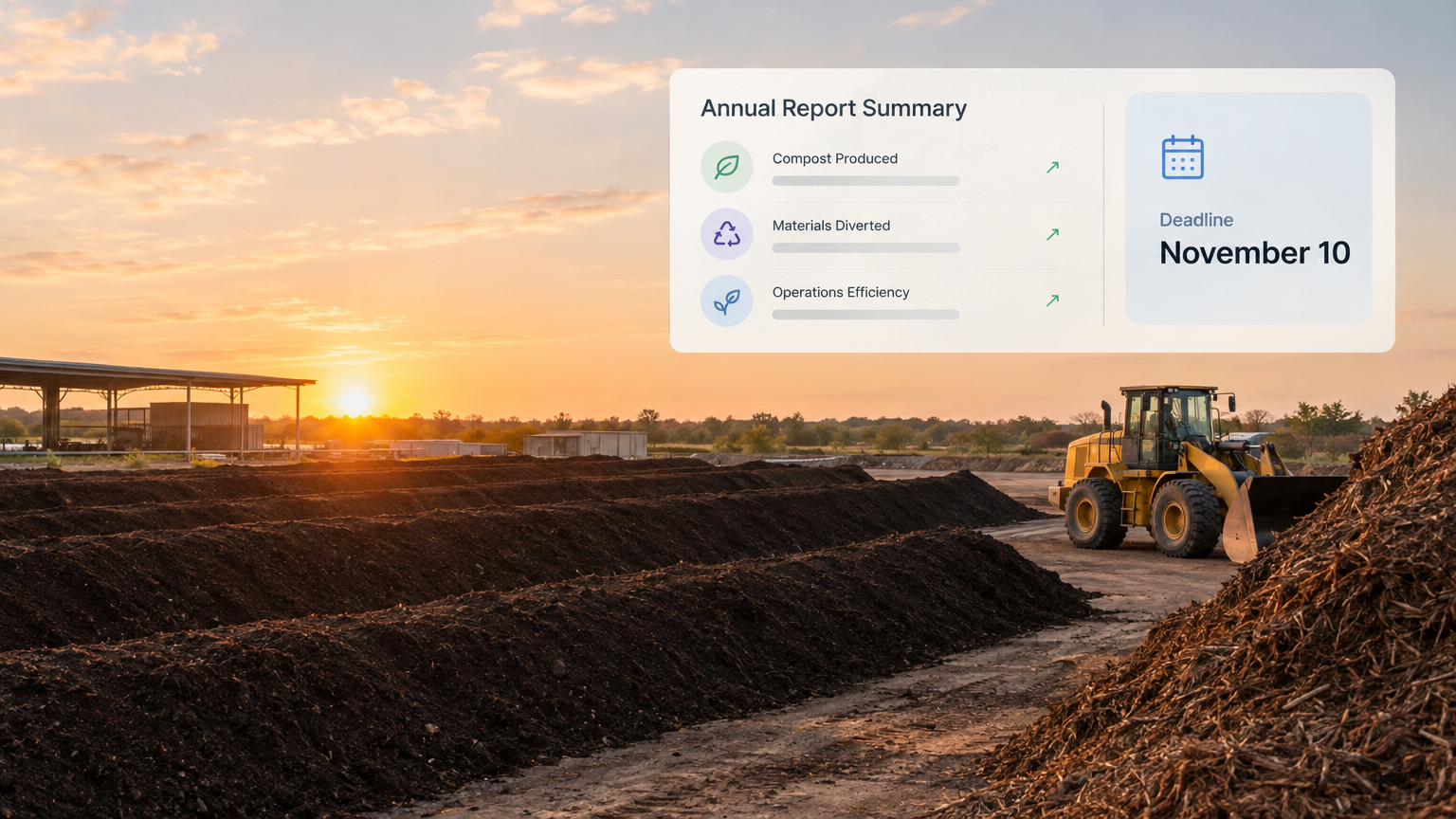
It is late October, and that leaves about two weeks before Texas compost facilities owe TCEQ their annual numbers. If your facility is registered or permitted, your MSW Annual Report is due November 10. This guide covers who files, what goes in the report, which form to use, and how each compost tier differs.
If you are still rebuilding the year from a stack of paper tickets, ComplyFlo tracks intake, production, and outgoing material by tier, so the annual numbers come together from live records instead of a year-end scavenger hunt.
Which Texas compost facilities have to file by November 10?
Registered and permitted compost facilities file the MSW Annual Report, and exempt or notification-tier operations generally do not file this one. TCEQ requires operators of permitted or registered MSW facilities to report the types and amounts of waste processed or disposed, plus remaining disposal capacity, and reports for fiscal year 2026 are due no later than November 10, 2026 (TCEQ).
A compost facility reaches the registration or permit tier based on the materials it accepts under 30 TAC Chapter 332 (TCEQ):
Registration tier generally covers municipal sewage sludge, positively sorted organic materials, disposable diapers, and paper sludges evaluated case by case. Composting municipal sewage sludge mixed with municipal solid waste requires a permit.
Permit tier covers grease trap waste and mixed municipal solid waste that is not positively sorted.
The report follows the Texas state fiscal year, which runs from September 1 through August 31 (TCEQ). The FY2026 report covers September 1, 2025 through August 31, 2026, and is due November 10, 2026.
What does the November 10 compost report actually ask for?
The MSW annual reporting program collects waste-processing and disposal information. For a compost facility, complete the applicable sections of the processing-facility form, and report remaining disposal capacity only where applicable (TCEQ).
For a compost site, plan to assemble:
Incoming feedstock totals by material type and amount, covering September 1 through August 31.
Outgoing finished product totals, reported in the units the current form requires.
Remaining disposal capacity, where the form asks for it.
The source records behind each number, kept so the totals can be traced and checked.
Which form does a compost facility use?
Compost facilities report as processing facilities, so the form is TCEQ-20011b. TCEQ lists TCEQ-20011b as the form for Processing Facilities, covering transfer stations, liquid waste processing, composting, and medical waste processing (TCEQ). The current form is available as the FY 2026 TCEQ-20011b.
Use the submission method specified in TCEQ's current fiscal-year reporting instructions or on the applicable form. Confirm the required signature, attachments, and delivery method before filing, and retain evidence of submission.
Does every compost tier report the same way?
No. The four compost tiers have different requirements, and only the registration and permit tiers file the November 10 MSW Annual Report (TCEQ).
Tier | What it covers | Reporting obligations |
|---|---|---|
Exempt (30 TAC 332.3(d)) | Yard trimmings, clean wood, vegetative material, paper, manure; mulching | No compost notification, registration, or permit under Chapter 332; applicable Chapter 328 recycling storage, reporting, and recordkeeping requirements and other obligations still apply |
Notification (30 TAC 332.3(c)) | Source-separated meat, fish, carcasses, dairy, oils and greases | Operational status reporting through the applicable method, where applicable to the facility's authorization |
Registration (30 TAC 332.3(b)) | Sewage sludge, positively sorted organics, diapers, paper sludges | Final product reports; MSW Annual Report due November 10 |
Permit (30 TAC 332.3(a)) | Grease trap waste, mixed MSW not positively sorted | Final product reports; MSW Annual Report due November 10 |
Two details are easy to miss. First, TCEQ states that for facilities subject to 30 TAC §332.71, registered compost facilities must submit reports semiannually and permitted compost facilities must submit reports monthly (TCEQ). Second, §332.71(a) states that final product derived from municipal sewage sludge at registered facilities is not subject to that section and must instead comply with the applicable Chapter 312 requirements (30 TAC §332.71). Confirm which testing, recordkeeping, and reporting framework applies to your facility.
What does the November 10 filing checklist look like?
Use this preparation checklist alongside the current TCEQ-20011b instructions; it is not a substitute for completing every applicable field.
Confirm your tier and authorization numbers, since only registration and permit facilities file this report.
Pull the whole fiscal year, from September 1 through August 31.
Total incoming feedstock by material type and amount.
Total outgoing finished product in the units the current form requires.
Enter remaining disposal capacity, where the form asks.
Reconcile the numbers so totals match their supporting records.
Use the right form, TCEQ-20011b for processing facilities.
Submit the way TCEQ says, and keep the completed report and evidence of submission.
Review all applicable form sections for additional quantities, destinations, residuals, recovered materials, or other information your facility must report. Reconcile each reported total to its supporting records.
How does manual reporting compare with software?
Manual reporting ties the whole year to paper and a spreadsheet; software helps prepare draft reporting data as the year happens (ComplyFlo).
Step | Manual | With ComplyFlo |
|---|---|---|
Capture intake | Paper tickets, re-keyed later | AI extracts configured fields for operator review against the source image |
Production records | Notebooks and scattered folders | Batches, piles, and readings kept with each load |
Conversions | Done by hand, easy to mistype | Built-in TCEQ conversion factors, with facility-specific compaction settings for outgoing material |
Reporting | Compiled and reconciled from logs and spreadsheets | Draft reporting data prepared from available approved records for review before filing |
Deadlines | Tracked through calendars and staff procedures | Optional email reminders 14 and 3 days ahead |
What happens if you miss November 10?
A required report that is not submitted by its due date can provide grounds for enforcement, including potential permit or registration revocation under 30 TAC §330.675 (30 TAC §330.675). Late payment of applicable fees can separately result in interest charges, and penalties may also apply. TCEQ also uses these annual submissions to produce its statewide Municipal Solid Waste in Texas summary, so incomplete reporting affects the quality of that statewide picture (TCEQ).
Is there any upside to reporting clean numbers?
Yes. Accurate records can also support a composting-refund application for an eligible MSW facility. TCEQ states that an operator may qualify for a refund of up to 20 percent of the solid-waste fees collected by the facility. Eligibility requires a composting plan approved in writing by TCEQ and quarterly reports of composting expenses and volumes of compost produced. Filing the November 10 annual report alone does not establish eligibility (TCEQ).
See ComplyFlo in action
ComplyFlo brings intake, production, billing, and reporting into one connected record for compost operations, with tier-specific reporting tools and built-in TCEQ conversions. Operators remain responsible for verifying conversions, completeness, report requirements, and final submission.
Ready to organize your compost records and TCEQ reports?
Book a free 1-hour demo with a ComplyFlo team member and see it running on your own workflow.
Book a free demoGet TCEQ compliance updates
Deadline reminders, rule changes, and practical guides for Texas waste operators. No spam — unsubscribe anytime.
By subscribing you agree to receive emails from ComplyFlo. See our privacy policy.