Wastewater
TCEQ TPDES Permit Renewal Timeline in Texas: When to Start and What Happens If You Miss the Window
ComplyFlo · October 25, 2026 · 5 min read
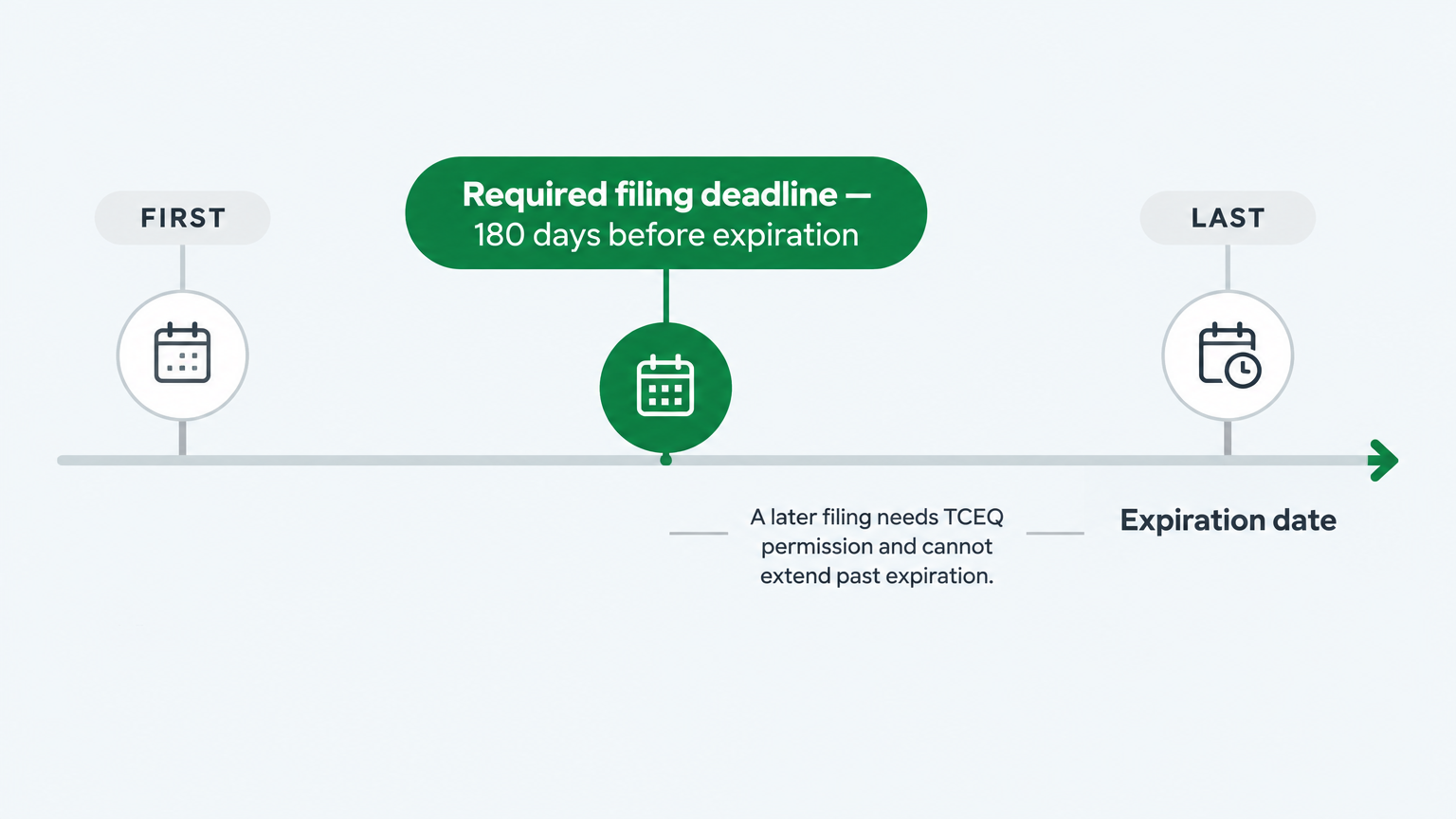
Your individual TPDES permit has a stated expiration date. Submit the renewal application at least 180 days before that date unless TCEQ's executive director grants permission for a later filing. The rule does not allow that permission to extend beyond permit expiration. Treat the 180-day date as the required filing deadline, not the start of a last-minute renewal window.
This guide focuses on individual domestic wastewater TPDES permits. General-permit authorizations and industrial applications may use different forms and procedures.
ComplyFlo tracks the TPDES renewal requirements with lead-time alerts, so the 180-day deadline does not arrive as a surprise.
How long does a TPDES permit last in Texas?
A Texas TPDES permit runs a fixed term of no more than five years (40 CFR §122.46). TCEQ individual permits show a five-year expiration (TCEQ).
When should a Texas plant start its TPDES renewal?
Submit the renewal application at least 180 days before the expiration date, unless TCEQ's executive director grants permission for a later filing (TCEQ). 30 TAC §305.65 sets the same 180-day minimum and does not allow that permission to extend beyond the expiration date.
A filing fewer than 180 days before expiration requires permission for a later date. Do not assume that filing before expiration alone satisfies the application deadline.
Use the current domestic wastewater instructions and complete every applicable form, worksheet, attachment, signature, and fee requirement (TCEQ):
- the Domestic Administrative Report and its checklist,
- the Domestic Technical Report and its worksheets,
- the Core Data Form,
- the Supplemental Permit Information Form, for TPDES applications,
- the Sewage Sludge Technical Report, where the permit covers land application or sludge disposal,
- applicable plain-language summary requirements,
- a Public Involvement Plan for a new or major-amendment application, where required,
- the applicable fees.
If the renewal also changes permit conditions, 30 TAC §305.65(3) treats it as an amendment, not a renewal.
What does the renewal review involve?
It is a two-stage review with two public notices (TCEQ):
- Administrative review checks completeness; a Notice of Deficiency with a due date can lead to the application being returned.
- NORI (Notice of Receipt of Application and Intent to Obtain Permit) is published once the application is administratively complete.
- Technical review leads to a draft permit; missing information can also get the application returned.
- NAPD (Notice of Application and Preliminary Decision) is published, then the public comment period runs.
- Final action follows the applicable review, notice, comment, EPA-review, and hearing procedures.
What happens if you file your renewal in time?
30 TAC §305.65(4) provides for continuation of the existing permit when renewal procedures have been initiated before expiration. Submit on time, obtain permission for any later filing, and respond to deficiencies. You must continue complying with the existing permit's limits and other requirements during the review.
What happens if you miss the window?
Missing the 180-day filing deadline is different from reaching permit expiration without initiating renewal procedures. If you are fewer than 180 days from expiration and have not filed, contact TCEQ immediately about permission for a later filing. That permission cannot extend beyond the existing permit's expiration date. If renewal procedures were properly initiated before expiration, §305.65(4) provides for continuation while TCEQ completes its action.
- Discharging without authorization runs against Texas Water Code §26.121.
- Administrative penalties can reach $25,000 a day for each violation under Texas Water Code §7.052, with civil penalties under §7.102. The amount depends on the provision, the violation, and the circumstances.
- Renewal is not automatic. Section 305.65(5) allows TCEQ to deny renewal on the grounds in §305.66. Separately, if the preceding five years' compliance history raises an issue about the applicant's ability to comply with a material permit term, §305.65(9) requires an opportunity to request a contested case hearing (30 TAC §305.65).
TCEQ calls for new or amended discharge applications at least 330 days before discharge begins, or as soon as possible (TCEQ). That is lead-time guidance, not a guaranteed processing period or permission to discharge while an application is pending.
How does manual tracking compare with a permit dashboard?
Manual tracking relies on calendars and staff procedures; a shared dashboard keeps permit dates and filing milestones visible to the team (ComplyFlo).
| Renewal step | Manual tracking | With ComplyFlo |
|---|---|---|
| Expiration date | Noted in a calendar, or nowhere | Shown on the permit milestones dashboard |
| 180-day filing deadline | Tracked by hand, easy to miss | Lead-time alert before the deadline |
| Application prep | Pulled together at the deadline | Records and reports kept in one place for operator review |
| Renewal versus amendment | Worked out at filing time | Reports organized for review against permit conditions |
| Other permit deadlines | Handled ad hoc | TPDES renewal, DMR, PPR, and sampling dates tracked together |
What should be on a TPDES renewal checklist?
Work it backward from the permit's expiration date (TCEQ):
- Confirm the expiration date on the currently effective permit.
- Mark the required filing deadline: 180 days before expiration, unless TCEQ grants a later date.
- Start the package early: administrative report, technical report, core data form, supplemental form, sludge report where it applies.
- Build in time for a Notice of Deficiency and public comment.
- Retain the submitted application, attachments, submission confirmation, and TCEQ correspondence, including any permission for later filing.
Practical preparation recommendation: For internal planning, begin reviewing the application package well before the 180-day deadline. Allow additional time for engineering work, sampling, amendments, signatures, and missing records.
How does ComplyFlo help you stay ahead of the renewal deadline?
ComplyFlo surfaces the TPDES renewal requirements with lead-time alerts, alongside the next DMR due date, sampling events, and operator CEU deadlines (ComplyFlo). It keeps the records behind a renewal in one place for operator review, and it does not certify or submit on your behalf.
Download the free TPDES Permit Compliance Checklist, which covers permit renewal steps, DMR deadlines, sampling, and SSO reporting.
Frequently Asked Questions
When is a TPDES permit renewal due in Texas?
Submit the renewal at least 180 days before expiration, unless TCEQ's executive director grants permission for a later filing, which cannot extend beyond the expiration date (30 TAC §305.65).
Can I wait until after the expiration date to submit my renewal application?
No. Section 305.65 does not allow the executive director to grant permission to submit the renewal application after the existing permit's expiration date. That is different from TCEQ issuing the renewed permit after the printed expiration date: the existing permit may continue under §305.65(4) while a properly initiated renewal is pending.
What if I file fewer than 180 days before expiration?
A filing inside 180 days needs permission for a later date.
What keeps my permit in effect during the renewal review?
A timely application. Under 30 TAC §305.65(4), the existing permit remains effective when renewal procedures begin before expiration, until commission action is final.
Free checklist
TPDES Permit Compliance Checklist
Review permit-specific DMR submissions, sampling, SSO reporting, renewal milestones, and applicable pretreatment responsibilities.
Ready to move your plant logs and reports off paper?
Book a free 1-hour demo with a ComplyFlo team member and see it running on your own workflow.
Book a free demoGet TCEQ compliance updates
Deadline reminders, rule changes, and practical guides for Texas waste operators. No spam — unsubscribe anytime.
By subscribing you agree to receive emails from ComplyFlo. See our privacy policy.