Compost
TCEQ Compost Facility Requirements Texas: Exempt, Notification, Registration, and Permit Explained
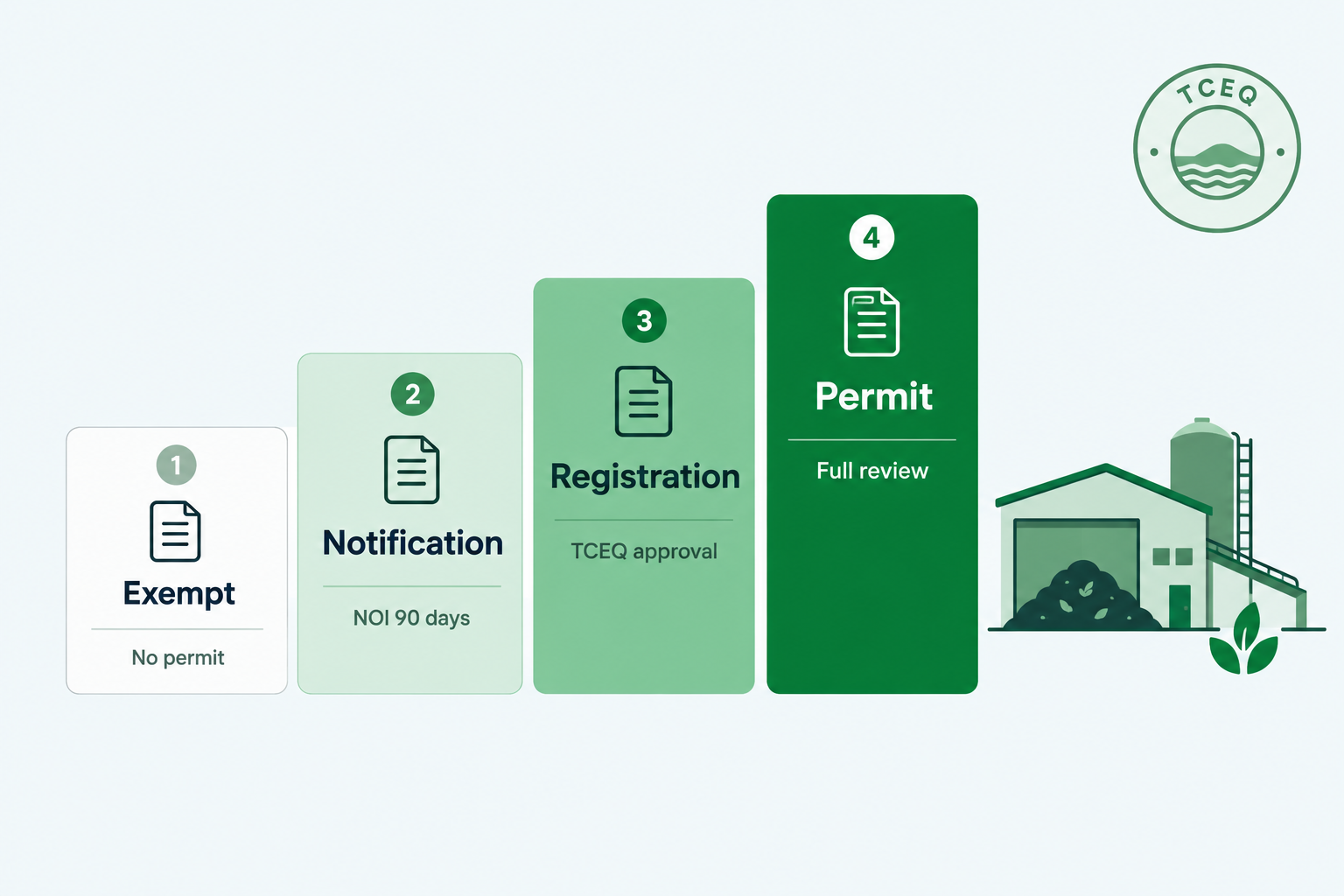
Texas composting activities fall into exempt, notification, registration, and permit tiers under 30 TAC Chapter 332. Classification depends on specific feedstocks and how they are sourced and separated - not facility size.
October 9, 2026 · 6 min read
TL;DR
Texas composting activities fall into exempt, notification, registration, and permit categories under 30 TAC Chapter 332. Classification depends on the specific feedstocks and how they are sourced, separated, and combined - not simply facility size. Composting mixed MSW (unsorted trash) or grease trap waste requires a permit; sewage sludge (biosolids) composted without unsorted trash, organics sorted out of the trash stream, and certain other organics require registration; source-separated meat, fish, dairy, oils, and similar food materials fall under notification requirements. Exempt activities may still have recycling, air, water, storage, and other obligations under Chapter 328 and other programs. Reporting programs must be tracked separately: applicable registered facilities submit semiannual final-product reports, permitted facilities submit monthly final-product reports, and applicable MSW annual reports are due November 10. ComplyFlo supports records, reminders, and report preparation - and can flag materials that may not match your facility's authorized feedstocks for review.
Why does the TCEQ compost classification trip up Texas operators?
Texas has a dedicated plain-language guide to compost authorization on its Composting and Mulching: Am I Regulated? page. Even with that resource available, the classification framework catches operators off guard in practice. The rule under 30 TAC Chapter 332 is feedstock-specific - the same broad category of material (say, organics from food service) can fall into different tiers depending on how it was separated, what it is mixed with, and where it came from.
The four tiers are real and the distinctions between them matter. Here is what each one actually requires.
Which composting activities are exempt from Chapter 332 authorization?
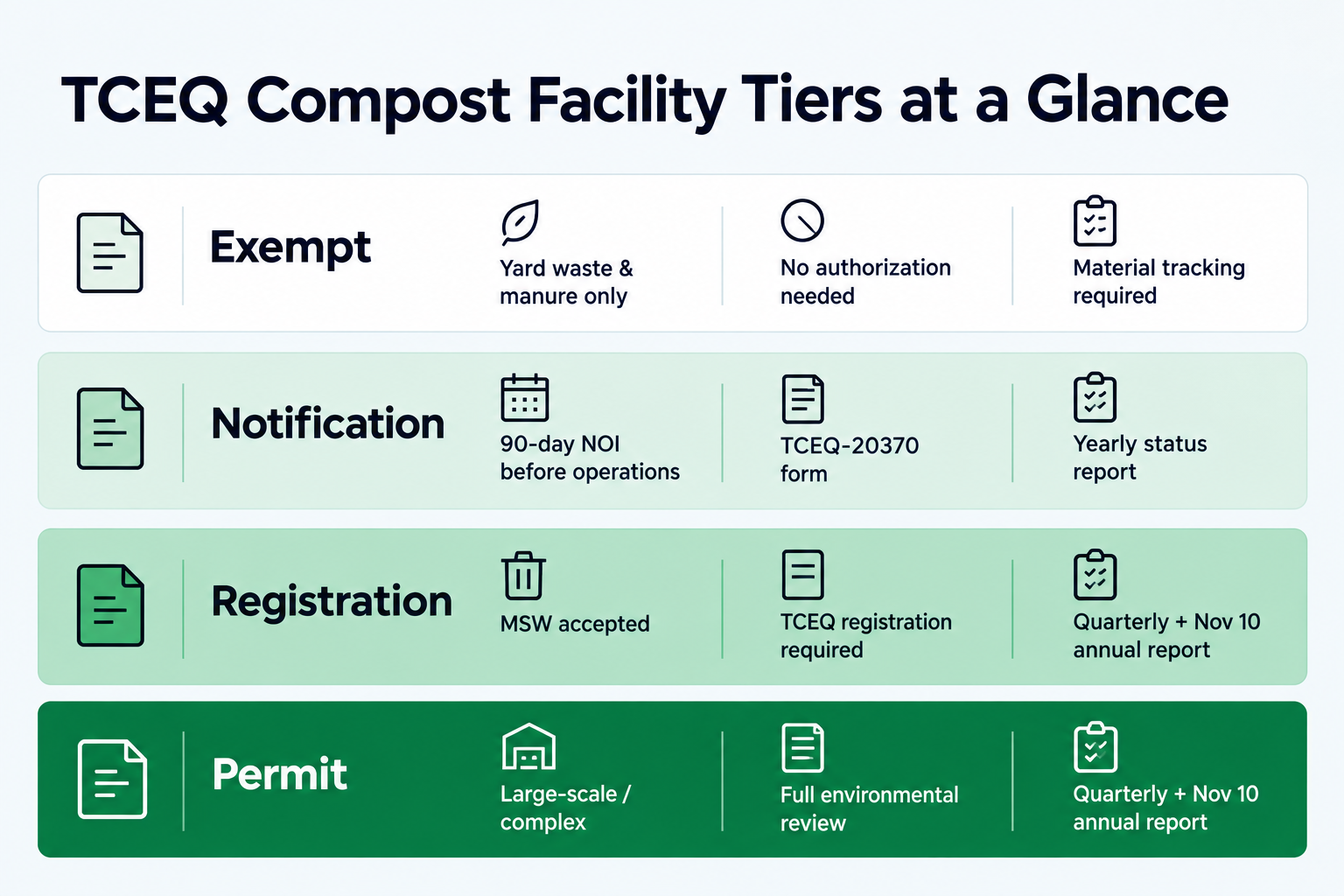
Exempt operations are those involving source-separated yard trimmings, clean wood, vegetative material, paper, and manure - along with specified agricultural activities and mulching. These do not require a compost notification, registration, or permit under Chapter 332.
Exempt status under Chapter 332 does not mean no compliance obligations at all. Two important caveats apply:
Applicable Chapter 328 recycling requirements may still require notification, recordkeeping, storage controls, reporting, or financial assurance, subject to available exclusions.
All composting and mulching operations must follow applicable general requirements, including nuisance, pollution-prevention, and air-quality standards.
Confirm Chapter 328 obligations and any applicable air or water authorizations separately before beginning operations. Exempt status under one program does not establish that no other filings are required.
What does a notification-tier compost facility have to do?
Notification applies to facilities composting source-separated meat, fish, animal carcasses, oils, greases, and dairy materials - including mixtures of these materials with yard trimmings, clean wood, vegetative material, paper, or manure. "Oils and greases" here means source-separated food oils and greases, not grease trap waste; composting grease trap waste requires a permit.
The required form is TCEQ Form 00651, Notice of Intent to Operate a Compost Facility. Under TCEQ's composting guidance, notification must be submitted at least 30 days before beginning construction of the proposed facility. Submit the notification before construction begins. Do not treat it as an after-the-fact filing or wait until startup to address it.
Ongoing obligations for qualifying NOI facilities include:
An annual operational-status report, due December 31 each year, for facilities without a regular reporting requirement under their authorization
Operational records documenting material flow, facility activities, and any changes
Documentation available for audit review
One classification note that catches operators: "food scraps" is not a single regulatory category. Source-separated vegetative material (salad greens, vegetable peels) and source-separated meat or dairy are treated differently under Chapter 332. Identify the actual feedstock and how it was separated before assigning a tier. Do not classify a load as "food scraps" alone - its composition and source determine which rule applies.
What is required for a registered compost facility?
Registration applies to specific categories of materials that go beyond exempt and notification feedstocks but stop short of mixed MSW. The registration tier covers:
Sewage sludge (biosolids) from wastewater treatment plants, as long as it is not composted together with mixed MSW (unsorted household or commercial trash)
Positively sorted organics - organic material pulled out of the regular trash stream after collection
Source-separated organics that are not on the exempt list
Disposable diapers or paper products soiled by human waste
Sludge left over from paper production, if TCEQ approves it as a feedstock
Any of the materials above mixed with exempt or notification feedstocks such as yard trimmings, wood, manure, or food materials
A registered facility must submit a registration application and receive TCEQ approval before beginning operations.
Reporting for applicable registered facilities under 30 TAC §332.71 - Sampling and Analysis Requirements for Final Product:
Final-product reports submitted semiannually, within two months after each reporting period ends
MSW Annual Report due November 10, covering the preceding state fiscal year (September 1 through August 31), for facilities within the MSW annual reporting program
Note: final product derived from municipal sewage sludge at registered facilities is not subject to §332.71 under §332.71(a). Instead, it must comply with the applicable Chapter 312 requirements - including the applicable testing, product standards, recordkeeping, and reporting framework. This is a broader exclusion from §332.71, not merely a reporting-schedule adjustment. Confirm which framework applies to your specific operation before submitting any reports.
Sampling frequency and reporting frequency are separate obligations. Section 332.71 establishes minimum sampling frequencies for facilities subject to its requirements - at least once per 5,000-cubic-yard batch or annually (whichever is more frequent) for registered facilities, and at least once per 3,000-cubic-yard batch or monthly (whichever is more frequent) for permitted facilities, with alternative frequencies available if approved. Use §332.71, any approved alternative frequency, and the facility's applicable authorization and QA/QC plan to establish the sampling calendar.
What does a permitted compost facility require?
Compost yards routinely take municipal solid waste such as yard trimmings and food scraps when it is kept separate from trash. "Mixed" MSW is different: it means the unsorted garbage stream, where plastics, metal, glass, and organics arrive together. A permit is required for any composting of mixed municipal solid waste - including adding any amount of mixed MSW as a feedstock. Composting any amount of grease trap waste (material from restaurant and food-service grease interceptors) also requires a permit. These are not scaled by volume or operational complexity; any mixed-MSW composting activity sits in the permit tier per TCEQ's composting guidance.
The permitting process involves:
A detailed permit application with environmental documentation
Public notice requirements and TCEQ environmental review
TCEQ approval before any operations begin
A unique permit number required for all reports
Reporting for applicable permitted facilities under 30 TAC §332.71:
Final-product reports submitted monthly, within two months after each reporting period ends
MSW Annual Report due November 10, covering the preceding state fiscal year
Permitted facilities also carry the most extensive monitoring, recordkeeping, and any additional permit-condition obligations of any tier.
How do feedstock identity and source determine your tier?
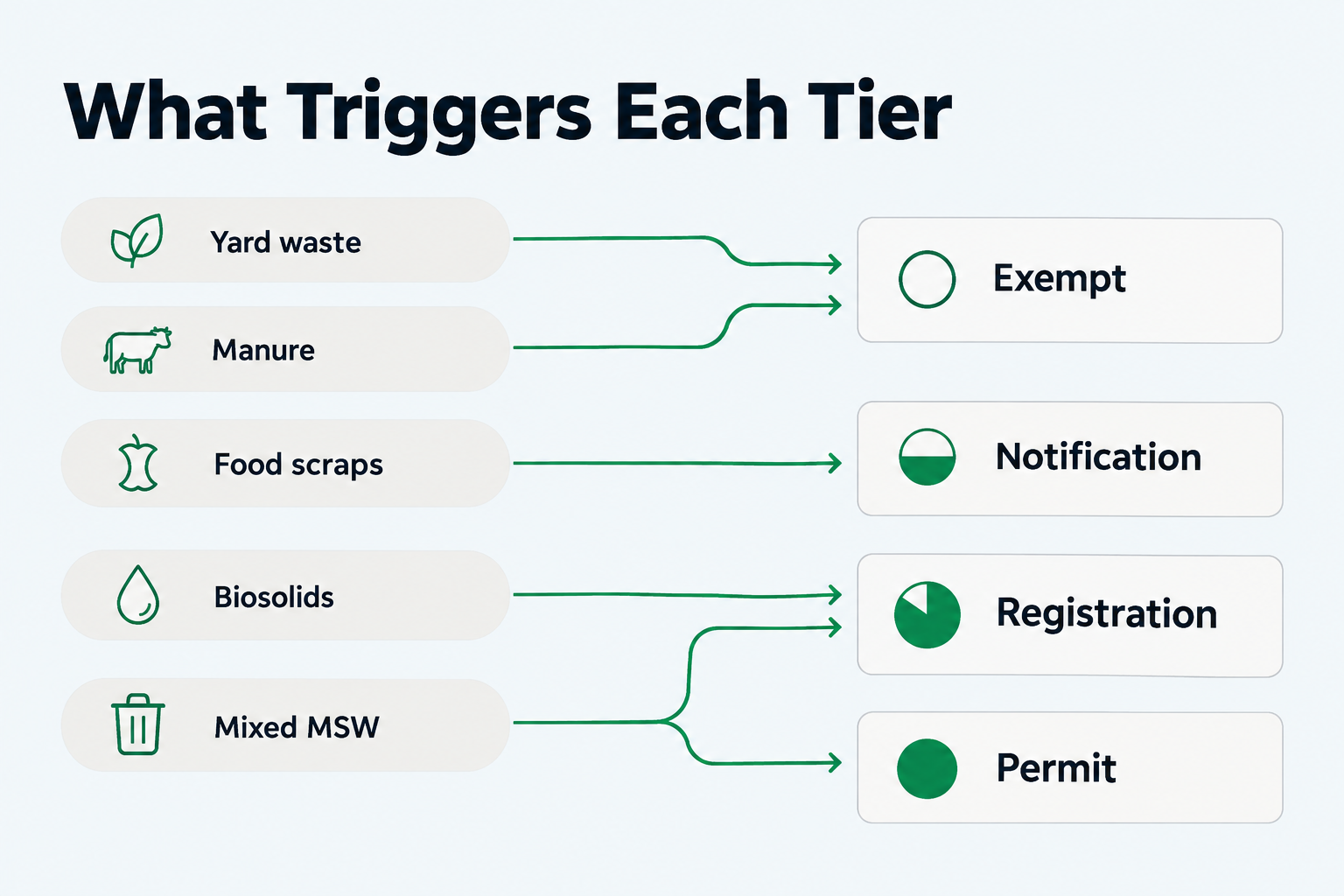
The classification depends on the feedstock's identity, source, separation, and mixture - not on how large the operation is. Here is the correct mapping under 30 TAC Chapter 332:
Tier | Feedstock and activity examples |
|---|---|
Exempt from Chapter 332 authorization | Source-separated yard trimmings, clean wood, vegetative material, paper, and manure; specified agricultural activities and mulching |
Notification | Source-separated meat, fish, animal carcasses, food oils and greases (not grease trap waste), and dairy materials; mixtures of these with exempt feedstocks |
Registration | Sewage sludge (biosolids), when not composted with mixed MSW (unsorted trash); organics sorted out of the trash stream; source-separated organics not on the exempt list; diapers or paper soiled by human waste; TCEQ-approved paper-production sludge; any of these mixed with exempt or notification feedstocks |
Permit | Mixed MSW (unsorted household or commercial trash), including adding any amount as a feedstock; grease trap waste (any amount) |
These examples must still be applied using the definitions and conditions in Chapter 332. A feedstock that looks like a single category can land in different tiers depending on how it was sourced and separated. When in doubt, use TCEQ's Composting and Mulching: Am I Regulated? page as the starting point.
What reporting does each tier require?
Reporting programs under Chapter 332 are separate from each other and have different schedules depending on the facility's authorization and feedstocks. Here is the framework:
Reporting obligation | Applicable schedule |
|---|---|
Chapter 332 final-product report - applicable registered facilities | Semiannual; submit within two months after the period ends |
Chapter 332 final-product report - applicable permitted facilities | Monthly; submit within two months after the period ends |
MSW Annual Report (applicable facilities) | November 10, covering the preceding state fiscal year (Sep 1-Aug 31) |
Operational-status report for qualifying NOI facilities | Annually by December 31 |
Quarterly disposal, fee, or other reports | Where applicable to the facility's specific authorization and reporting program |
The MSW Annual Report and the Chapter 332 final-product report are separate obligations - one does not substitute for the other. Not every registered or permitted facility falls under every program; confirm which apply to your specific authorization.
What obligations exist beyond the Chapter 332 tier?
A compost tier classification is one part of the compliance framework. Depending on the operation, additional requirements may apply independently:
General operating and nuisance requirements apply to all composting and mulching operations
Air-quality authorization may be required separately, depending on the feedstocks and operation size
Water-quality authorization may apply where the operation has potential runoff or discharge
Chapter 328 recycling requirements may impose notification, storage, recordkeeping, reporting, or financial-assurance obligations on otherwise-exempt activities
Financial assurance requirements apply where required by the applicable authorization
Confirm these obligations separately before constructing or expanding the facility. A determination that your activity is exempt under Chapter 332 does not establish that no other filings or authorizations are needed.
How does manual tracking compare to software for compliance?
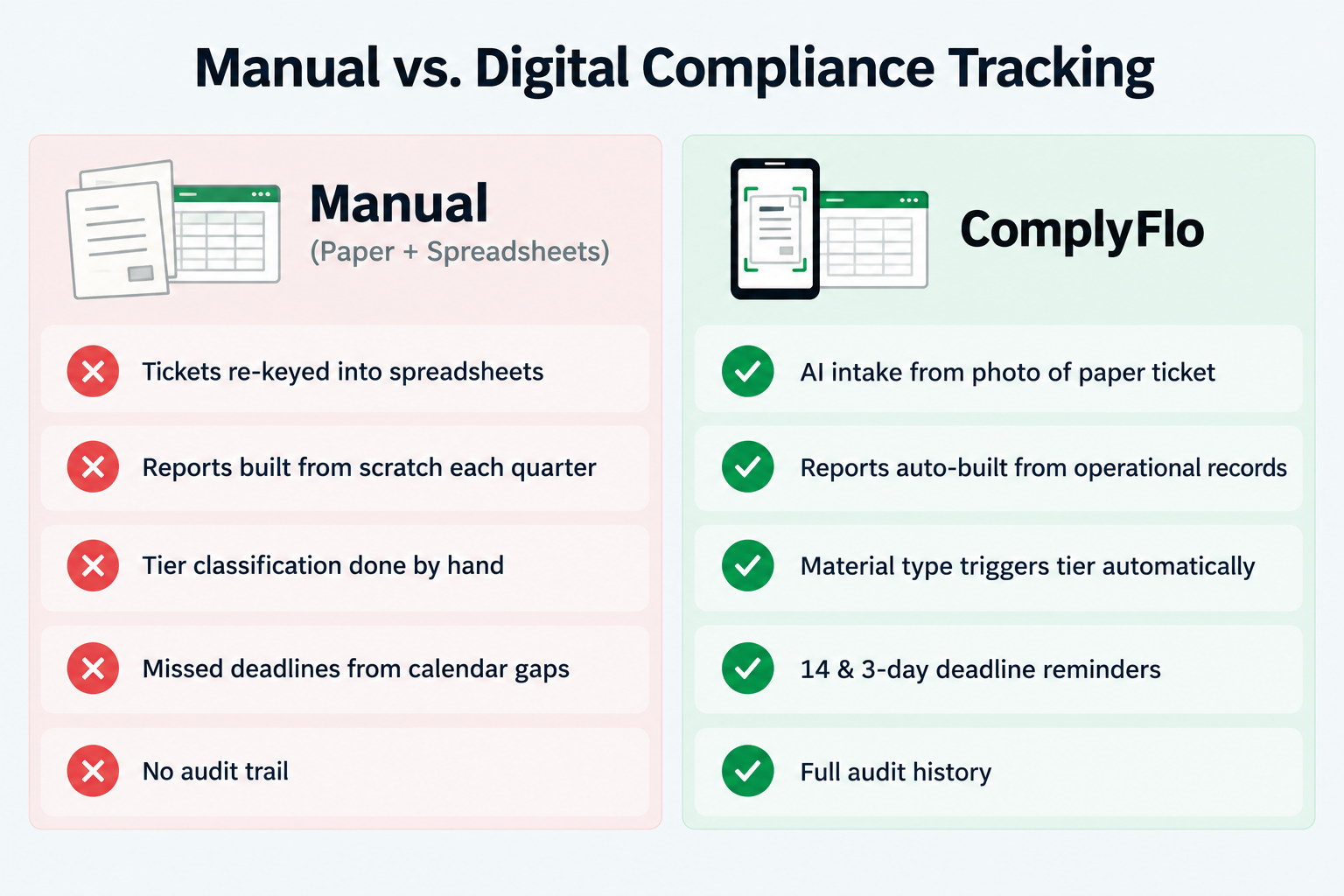
Here is what managing TCEQ compost compliance looks like across both approaches:
Task | Manual (paper + spreadsheets) | ComplyFlo |
|---|---|---|
Intake recording | Paper ticket re-keyed into spreadsheet | Photo of ticket - AI extracts details for operator approval |
Volume estimation | Estimated by eye, separate tipping fee calculation | Dimension-based calculator applied directly to load record |
Feedstock review | Operator compares new material to authorization manually | Material entries can flag a potential mismatch with the facility's configured authorized feedstocks for review |
Final-product and annual reports | Built from scattered records; schedules tracked separately | Reports built from operational logs; deadline reminders for applicable programs |
Deadline tracking | Personal calendar or sticky notes | Email reminders 14 and 3 days before each applicable deadline |
Audit trail | Whatever paper you kept | Full change history with timestamps and operator attribution |
One important note on the feedstock-review row: entering a new material into software does not grant a new authorization. Required authorization - notification, registration, or permit - must exist before the activity proceeds. Software can help flag materials for review; it does not determine or grant regulatory authorization. Before accepting a new feedstock, compare it against the facility's existing authorization and the applicable rules in Chapter 332.
Try ComplyFlo for your compost facility
ComplyFlo is built specifically for Texas compost facilities operating under 30 TAC Chapter 332. It supports intake tracking, production records, lab results, outgoing material documentation, and report preparation for the applicable TCEQ programs - currently in beta.
The platform helps operators track materials against their facility's authorized feedstocks, flag entries that may need review, and prepare the reports that apply to their specific tier and authorization. It does not replace facility-specific regulatory review or grant authorization for activities beyond what TCEQ has approved.
If you're running compost operations in Texas and want to replace scattered paper logs and spreadsheets with a platform built for TCEQ compliance - book a demo.
Frequently Asked Questions
What are the four TCEQ compost facility tiers in Texas?
Texas composting activities fall into four categories under 30 TAC Chapter 332: Exempt (no compost authorization needed for source-separated yard trimmings, clean wood, vegetative material, paper, and manure), Notification (source-separated meat, dairy, oils, and greases), Registration (sewage sludge composted without unsorted trash, organics sorted out of the trash stream, and certain other materials), and Permit (any composting of mixed MSW, meaning unsorted trash, or of grease trap waste). Classification depends on the specific feedstock identity, source, separation, and how materials are combined - not on facility size or volume.
Do exempt compost facilities have any reporting requirements?
Exempt operations do not require a compost notification, registration, or permit under Chapter 332. However, applicable Chapter 328 recycling requirements may still apply, including notification, recordkeeping, storage controls, reporting, or financial assurance obligations. Exempt status under Chapter 332 does not mean no other filings are required. Confirm Chapter 328 obligations and any applicable air-quality, water-quality, and nuisance requirements separately before beginning operations.
When is the TCEQ MSW Annual Report due for compost facilities?
The MSW Annual Report is due November 10 each year, covering the preceding state fiscal year (September 1 through August 31), for applicable permitted or registered MSW facilities. This is a separate obligation from Chapter 332 final-product reporting. Applicable registered facilities submit Chapter 332 final-product reports semiannually (within two months after each period ends). Applicable permitted facilities submit Chapter 332 final-product reports monthly (within two months after each period ends). Qualifying NOI facilities submit an operational-status report annually by December 31.
What feedstocks require a permit rather than registration?
Any composting of mixed municipal solid waste (MSW) - including adding any amount of mixed MSW as a feedstock - requires a permit under TCEQ's composting guidance. Composting any amount of grease trap waste also requires a permit. These activities are not eligible for registration regardless of scale. Before accepting any new feedstock, compare it against the facility's existing authorization and the applicable classification rules in Chapter 332.
How do I file the notification for a notification-tier compost facility?
Notification-tier facilities must file TCEQ Form 00651, Notice of Intent to Operate a Compost Facility, at least 30 days before beginning construction of the proposed facility, per TCEQ's composting guidance. Submit the notification before construction begins. Do not treat it as an after-the-fact filing or wait until startup to address it. Qualifying NOI facilities that have no regular reporting requirement under their authorization also submit an annual operational-status report by December 31 each year. TCEQ's composting forms page is the authoritative source for current forms and filing instructions.
Ready to organize your compost records and TCEQ reports?
Book a free 1-hour demo with a ComplyFlo team member and see it running on your own workflow.
Book a free demoGet TCEQ compliance updates
Deadline reminders, rule changes, and practical guides for Texas waste operators. No spam — unsubscribe anytime.
By subscribing you agree to receive emails from ComplyFlo. See our privacy policy.