Wastewater
RAS Rate Calculation Wastewater: How to Set Return Activated Sludge Flow for Stable MLSS
Learn how to estimate return activated sludge flow, express it as a percentage of influent flow, and interpret the result alongside MLSS, clarifier performance, and your plant's operating strategy.
October 14, 2026 · 5 min read
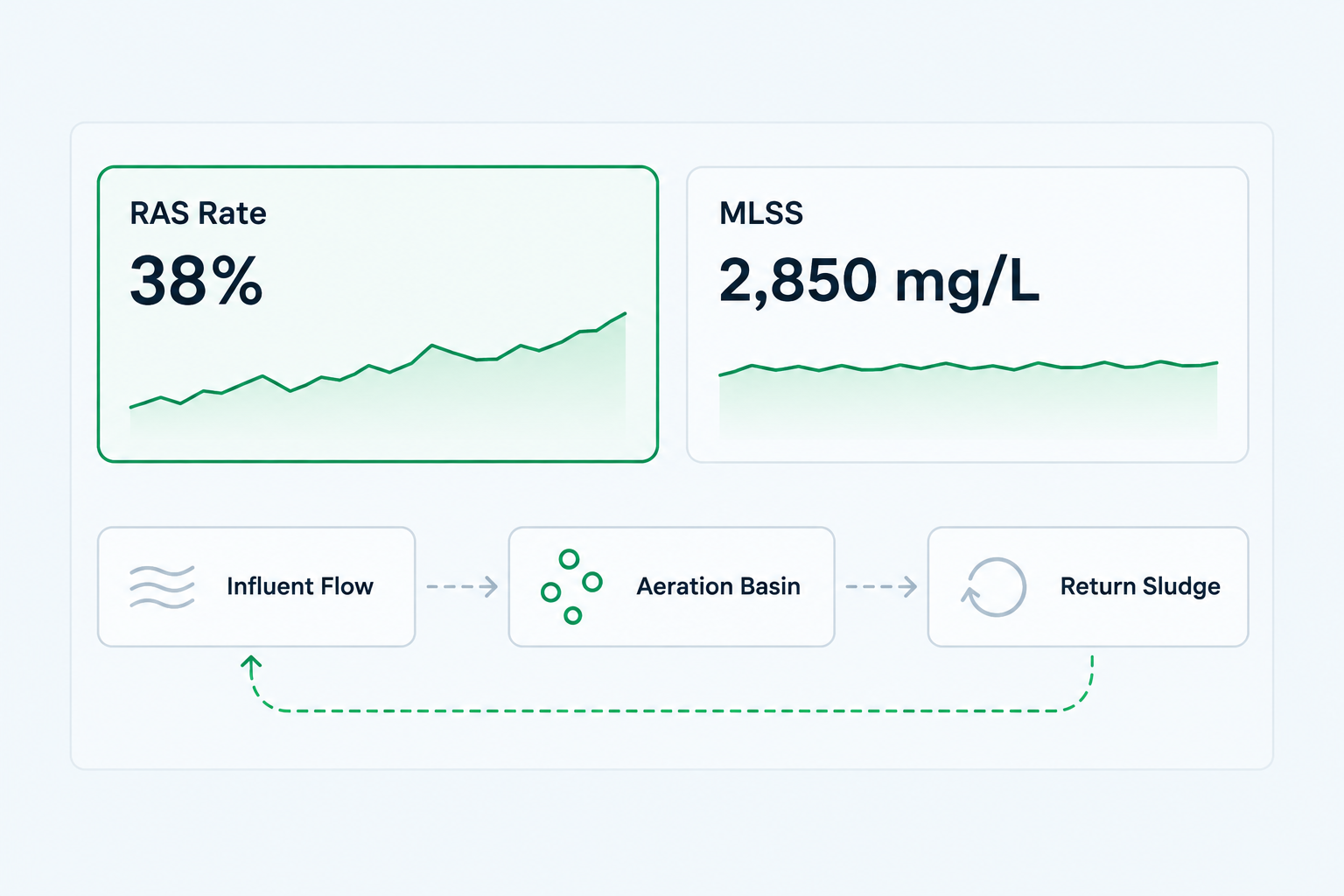
TL;DR
Return activated sludge (RAS) moves settled solids from the secondary clarifier back to the biological treatment process. A simplified steady-state estimate of RAS flow is: Q(RAS) = Q × MLSS ÷ (RAS solids concentration − MLSS) - the result is a flow in the same units as influent flow, not a percentage. Express the return percentage separately as (Q(RAS) ÷ Q) × 100.
Use this estimate alongside clarifier blanket depth, settling performance, solids loading, actual pump output, and your facility's approved operating strategy. Operating decisions remain with qualified personnel. ComplyFlo can help calculate and trend these values when the required inputs are available.
Why does MLSS drift even when the plant looks fine?
MLSS can change because of loading, biomass growth, wasting, effluent solids losses, and movement of solids between the aeration basin and clarifier. Influent-flow changes can also affect detention time and clarifier loading. Review those factors together rather than assuming an MLSS change means the RAS setting is wrong.
This is the core problem with manual RAS management: a return sludge rate that was appropriate at 8:00 AM may no longer be appropriate by noon. Maintain process-control and monitoring records as required by your facility's permit and applicable rules. Internal RAS and MLSS records can support operational review, but only parameters required by the permit belong in the DMR.
What is the RAS rate calculation wastewater operators actually use?
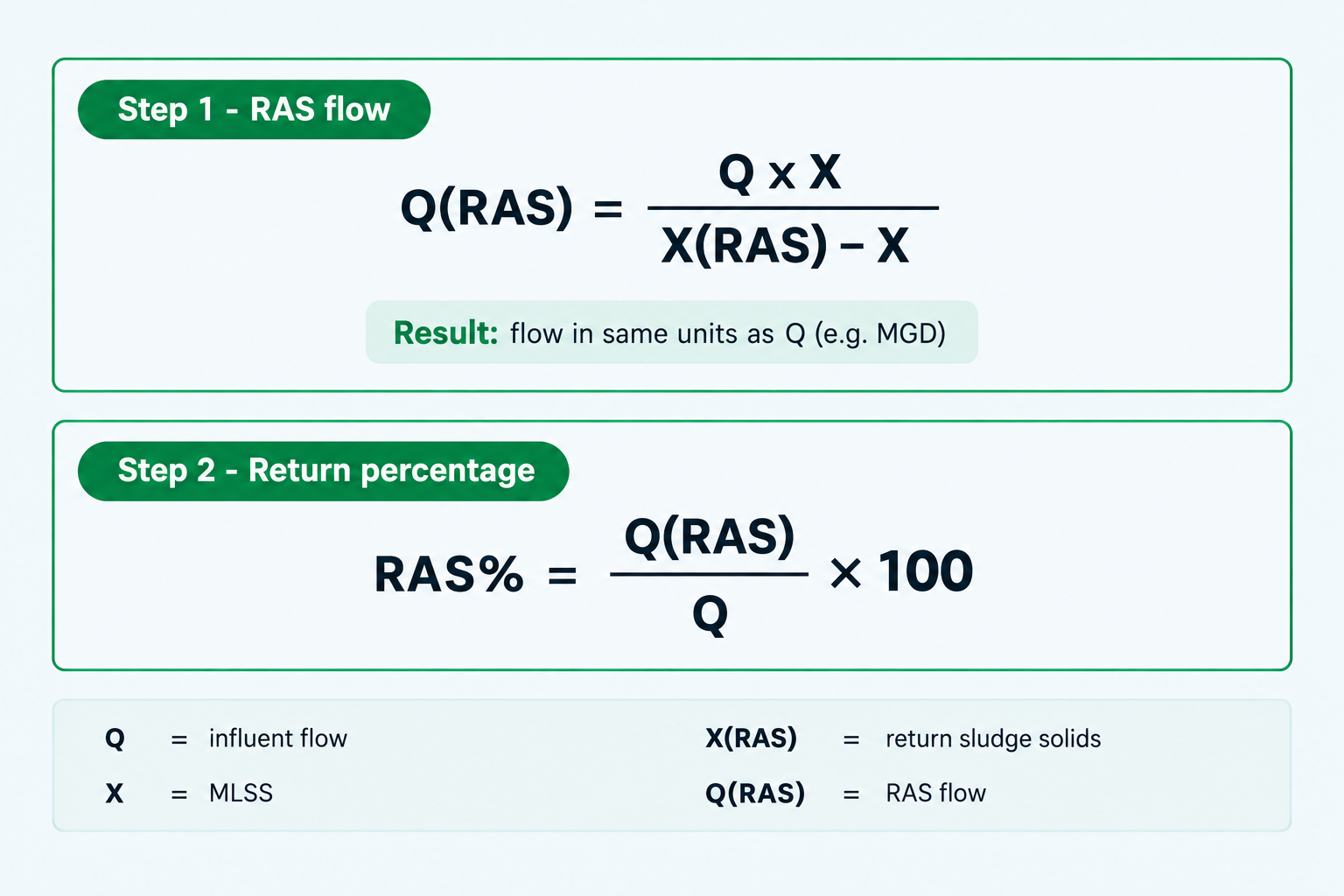
The formula produces two separate results. Calculate them in order:
Step 1 - RAS flow (in MGD): Q(RAS) = Q × X ÷ (X(RAS) − X)
Step 2 - RAS percentage: RAS% = (Q(RAS) ÷ Q) × 100 = (X ÷ (X(RAS) − X)) × 100
Where:
Q = influent flow (MGD)
X = aeration-basin MLSS (mg/L). Conventional activated sludge often operates in the range of 2,000–3,500 mg/L, but the appropriate target is facility-specific - check your permit history and design basis.
X(RAS) = return sludge suspended-solids concentration (mg/L). Reference ranges of roughly 6,000–10,000 mg/L are illustrative; actual values depend on clarifier performance at your plant.
Q(RAS) = calculated RAS flow, in the same units as Q
Note: X(RAS) must exceed X. If the denominator is zero or negative, do not use the formula - review your inputs and process conditions before proceeding.
This equation is a simplified steady-state solids balance. It assumes reasonably stable conditions and generally neglects effluent solids, wasting effects, and changes in solids stored in the clarifier. Actual RAS settings must also consider clarifier blanket depth, settling and thickening performance, solids loading, equipment capacity, and the facility's approved operating procedures.
Worked example:
Q = 2.0 MGD
X (MLSS) = 2,800 mg/L
X(RAS) (return sludge SS) = 8,200 mg/L
Q(RAS) = 2.0 × 2,800 ÷ (8,200 − 2,800) = 5,600 ÷ 5,400 = 1.04 MGD
RAS% = (1.04 ÷ 2.0) × 100 = 52% of influent flow
RAS flow is often expressed as a percentage of influent flow, but the appropriate percentage is plant-specific. Evaluate your RAS percentage against your facility's design, operating history, RAS concentration, settling performance, and clarifier loading rather than treating any fixed number as a universal ceiling.
How do flow changes throw off your return sludge rate?
Flow changes affect detention time, clarifier loading, and the ratio of influent to return flow. The same RAS pump setting that was appropriate during dry weather may not be appropriate during a wet-weather event or a morning peak - and changes to RAS flow also change clarifier loading. Use observations as prompts to review the broader process, not as automatic prescriptions.
Observation | What to investigate |
|---|---|
Influent flow changes significantly | Actual RAS flow, return percentage, clarifier loading, blanket depth, and the plant's flow-following strategy |
MLSS rises | Loading and growth, wasting mass, solids distribution, SRT, and clarifier inventory |
MLSS falls | Wasting mass, effluent solids loss, loading changes, sampling consistency, and solids distribution |
Clarifier blanket rises | Settling and thickening, solids loading, RAS pump performance, withdrawal capacity, and available approved controls |
RAS concentration declines | Return-flow setting, blanket condition, settleability, and sampling reliability |
Make RAS or WAS adjustments only under the facility's approved operating strategy and qualified operator judgment. Do not change wasting solely because influent flow changed.
What is a rising or falling MLSS telling you?
An MLSS trend is a prompt for process review - not a direct readout of what the RAS setting should be. RAS redistributes solids within the activated-sludge system; wasting and effluent losses remove solids from it. MLSS alone cannot distinguish those effects from changes in loading, growth, or other process conditions.
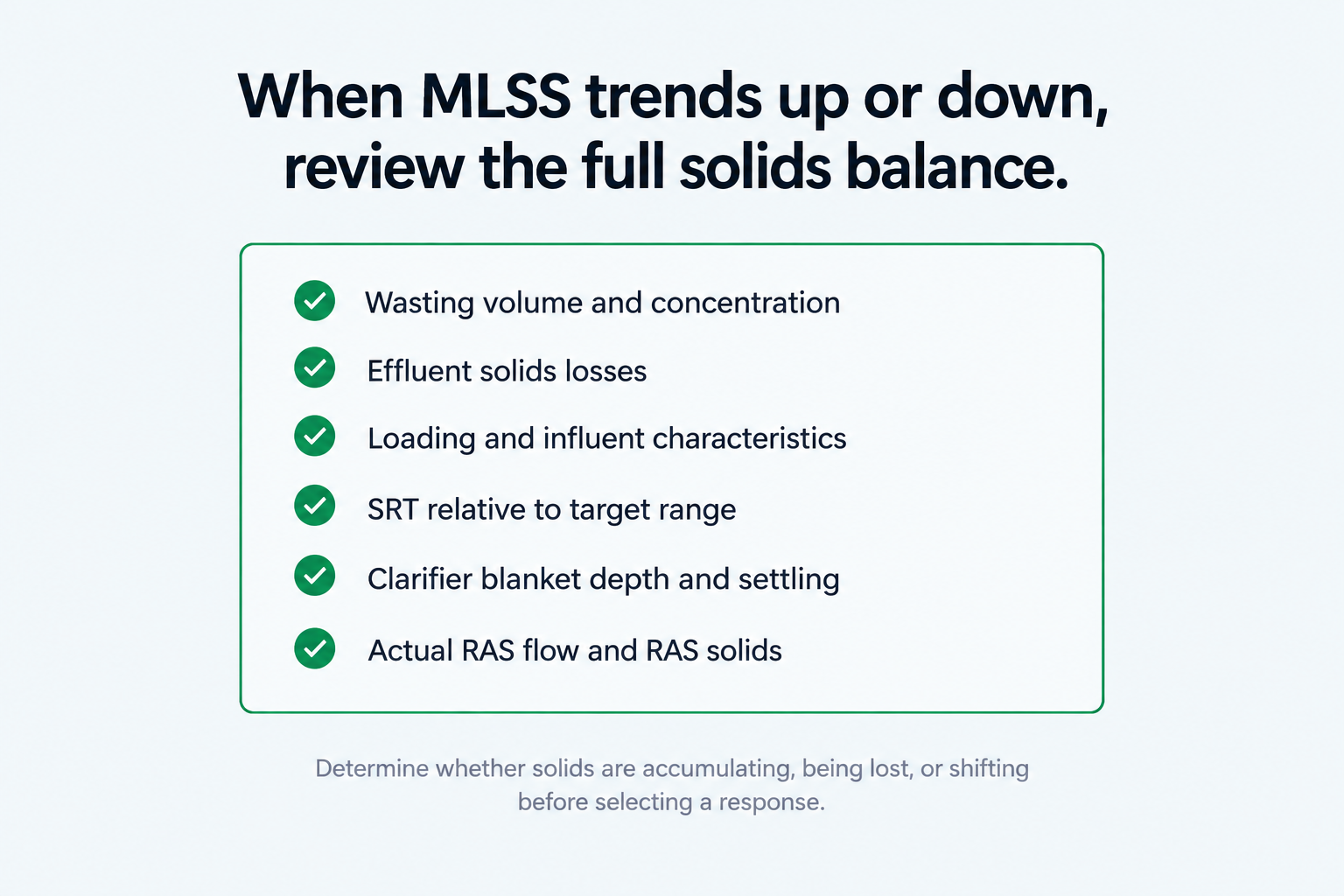
A rising or falling MLSS trend should trigger a review of the overall solids balance. Check:
Wasting volume and concentration
Effluent solids losses
Loading and influent characteristics
SRT and whether it is in the intended range
Clarifier blanket depth and settling behavior
Actual RAS flow and RAS solids concentration
Determine whether solids are accumulating, being lost, or shifting between the aeration basin and clarifier before selecting a response. Do not adjust RAS or wasting based on MLSS trend alone.
Manual vs automated RAS tracking - which holds up under Texas conditions?
Maintaining consistent RAS calculations requires reliable inputs, consistent procedures, and version-controlled formulas. Where those are hard to sustain, a centralized tool can reduce transcription steps and support more consistent recordkeeping.
Task | Manual / spreadsheet | ComplyFlo |
|---|---|---|
RAS calculation | Calculation maintained and reviewed by staff | Calculated when required inputs are available |
MLSS trend visibility | Depends on how records and charts are maintained | Dashboard trend based on available data |
Flow-change review | Staff review updated flow and process observations | Configured alerts when updated inputs meet alert conditions |
Calculation consistency | Depends on formula protection, validation, and version control | Centralized calculation using configured inputs and units |
Operational recordkeeping | Paper or spreadsheet records maintained under facility procedures | Searchable, operator-attributed entries with recorded measurement and entry times, where supported |
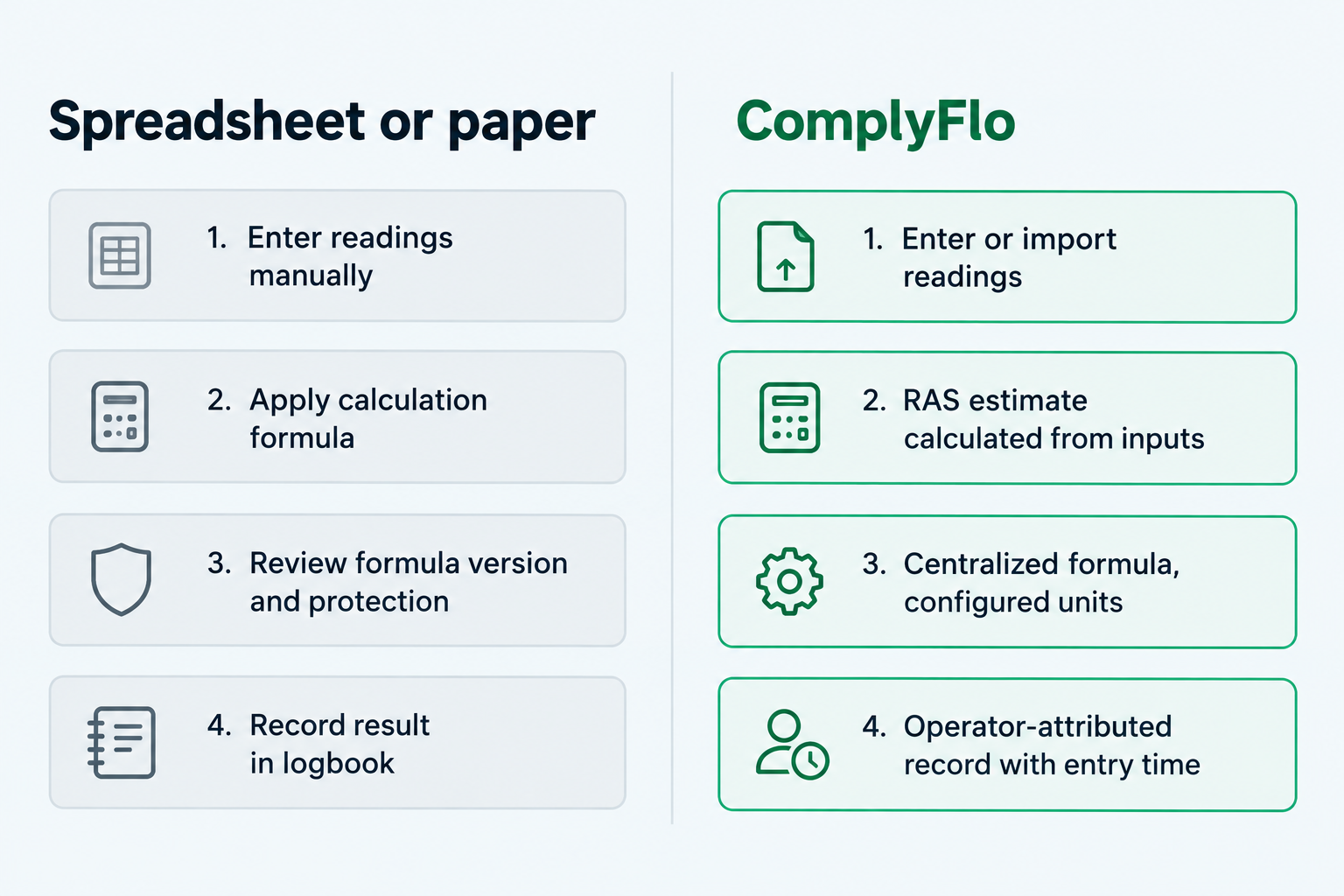
Paper or digital records can support compliance when they satisfy applicable recordkeeping requirements under your facility's TPDES permit and applicable rules. Where permit-monitoring results are first recorded on paper, preparing the DMR may involve additional transcription. Internal RAS and MLSS records should remain available for operational review without being treated as DMR fields unless the permit requires them.
Try ComplyFlo
ComplyFlo is built specifically for Texas wastewater operators who need to move beyond paper logbooks and isolated spreadsheets.
The RAS process calculator computes RAS flow and return percentage from entered or imported readings. It runs alongside SRT, SVI, F/M ratio, and BOD removal efficiency on the same dashboard. Where inputs are configured, the dashboard can flag values against facility-set thresholds. Operating decisions remain with qualified personnel. Book a demo to see the process calculators in your plant's context.
Frequently Asked Questions
What is the RAS rate calculation formula for wastewater operators?
The simplified steady-state formula produces two values. First, RAS flow: Q(RAS) = Q × MLSS ÷ (RAS solids − MLSS). The result is a flow in the same units as influent flow. Then express return percentage as (Q(RAS) ÷ Q) × 100. Using MLSS of 2,800 mg/L, influent flow of 2.0 MGD, and RAS solids of 8,200 mg/L: Q(RAS) = 1.04 MGD; RAS% = 52% of influent flow. ComplyFlo can calculate and trend these values when the required inputs are available. The formula requires RAS solids concentration to exceed MLSS - a zero or negative denominator signals an input or process issue that should be reviewed before proceeding.
What should my MLSS target be in an activated sludge system?
An MLSS range of roughly 2,000–3,500 mg/L is sometimes used as an illustrative reference for conventional activated sludge, but it is not a universal target. Establish your operating range from the facility's design, treatment objectives, operating history, and approved process-control procedures. Meeting an MLSS target does not by itself ensure acceptable effluent TSS; settling, clarifier loading, hydraulics, and other conditions also matter.
How often should I review my RAS rate?
Review your RAS estimate whenever flow changes significantly - after a wet-weather event, during morning peaks, or when MLSS starts trending. But a recalculated estimate is a starting point, not a direct pump-setting instruction. Evaluate it alongside clarifier blanket depth, RAS concentration, settling performance, and your facility's approved operating strategy before making adjustments.
What causes MLSS to rise even when I haven't changed my settings?
MLSS is affected by loading, biomass growth, wasting, effluent solids losses, and the movement of solids between the aeration basin and clarifier. A rising trend warrants a review of the full solids balance - check wasting volume and concentration, effluent solids losses, SRT, clarifier blanket depth, and actual RAS flow and concentration - before attributing the change to any single variable.
Can ComplyFlo calculate my RAS rate?
ComplyFlo's process calculator can calculate RAS flow and return percentage when the required inputs are available - entered manually or imported from a connected data source. The dashboard can display trends and flag values against configured thresholds. Operating decisions remain with qualified personnel. It also supports SRT, SVI, F/M ratio, and other daily process calculations in one place.
Free checklist
TPDES Permit Compliance Checklist
Review permit-specific DMR submissions, sampling, SSO reporting, renewal milestones, and applicable pretreatment responsibilities.
Ready to move your plant logs and reports off paper?
Book a free 1-hour demo with a ComplyFlo team member and see it running on your own workflow.
Book a free demoGet TCEQ compliance updates
Deadline reminders, rule changes, and practical guides for Texas waste operators. No spam — unsubscribe anytime.
By subscribing you agree to receive emails from ComplyFlo. See our privacy policy.