MSW Disposal
How to Digitize Texas Sludge Transporter Trip Tickets: Records, Signatures, and Retention
Texas sludge-transporter trip tickets under 30 TAC 312.145 have specific signature, distribution, and retention requirements. Here is what the rule actually says and how digitizing records can help.
October 9, 2026 · 6 min read
TL;DR
Texas sludge-transporter trip tickets governed by 30 TAC §312.145 have specific information, signature, distribution, and recordkeeping requirements. The rule expressly recognizes certain electronic signatures, requires five-year retention, and assigns the transporter responsibility for returning the completed generator copy within 15 days after the waste is received at the disposal or processing facility. Digitizing records can improve retrieval and reduce transcription, but scanning, AI extraction, and internal approval do not replace required signatures or distribution steps. ComplyFlo helps teams capture, review, organize, and retrieve records - operators remain responsible for applying the requirements for their waste stream and jurisdiction.
Why do paper trip tickets create problems for Texas operators?
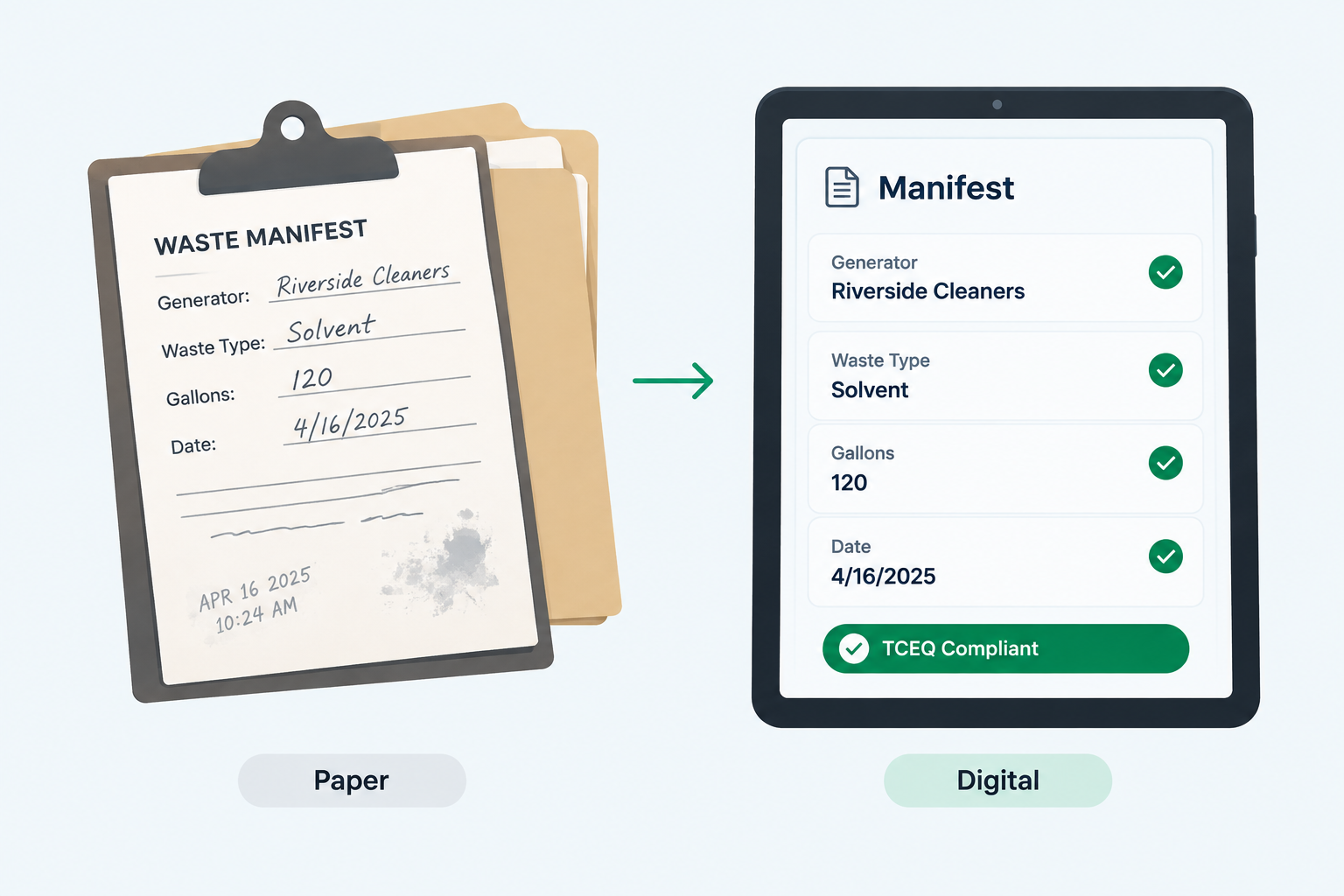
Paper trip tickets create problems the moment they leave the truck. A driver fills out a form by hand at the generator's site. The paper copy goes to the facility. Someone at the office re-keys the data into a spreadsheet - or doesn't. The original gets filed in a cabinet, sometimes misfiled, sometimes lost. When TCEQ asks for a trip ticket from 18 months ago, the search starts.
The problem isn't the paper itself. The problem is what happens to the data on it.
Three record-management failure points show up again and again in Texas sludge and grease-trap operations:
Re-keying errors. Manual transcription can introduce errors, particularly when handwriting is difficult to read or information is entered more than once.
Incomplete fields. Missing transporter registration information is one example of an incomplete required field. Digital tools can help flag gaps before the record is finalized.
Lost records. Five-year retention is a legal requirement under 30 TAC § 312.145. Paper records require procedures to protect against loss, damage, and misfiling throughout the retention period.
A note on scope. This article focuses on trip tickets required under 30 TAC § 312.145 for wastes covered by Texas's sludge-transporter rules - grease traps, grit traps, septic tanks, and related streams. Other waste streams may be subject to different manifest, shipping-document, retention, and electronic-record requirements. Determine the applicable framework before replacing an existing documentation process.
What does 30 TAC 312.145 actually require on every trip ticket?
Every trip ticket must include eight categories of information. A digital implementation must capture all eight - not just the fields that are easy to extract automatically.
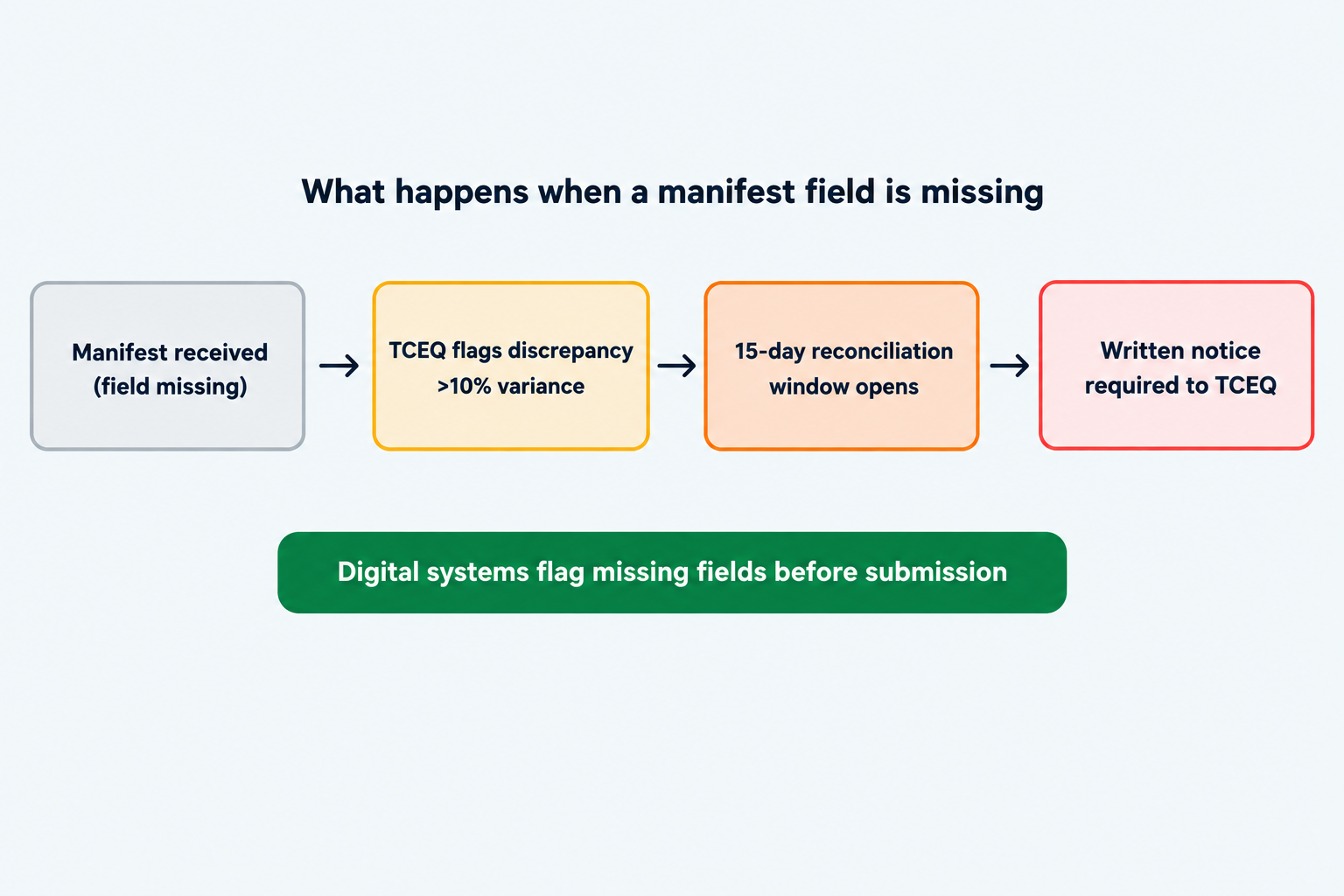
Section 312.145(a) lists the following eight required elements:
Transporter name, address, telephone number, and TCEQ registration number
Generator name, signature or electronic signature, address, telephone number, and collection date
Type and amount of waste collected or transported
Names and signatures of responsible persons collecting, transporting, and depositing the waste
Date and place of deposit
Receiving facility permit or site-registration number, location, and operator
Receiving on-site representative name and signature or electronic signature acknowledging receipt and the amount received
Volume of the grease trap, grit trap, or septic tank
For trip tickets covered by 30 TAC § 312.145, copies must be retained for five years and kept readily available for TCEQ review. The rule specifies a five-part distribution structure, including a generator copy at pickup and a completed copy returned by the transporter within 15 days after facility receipt. Transporters must also submit an annual summary to TCEQ by July 1 for activities during the preceding June 1 through May 31 reporting period.
Can electronic signatures satisfy the Chapter 312 trip-ticket requirements?
For specific parties, yes - expressly. 30 TAC § 312.145 uses the phrase "signature or electronic signature" for the generator and the receiving on-site representative.
Two important distinctions follow from this:
First, scanning a signed paper trip ticket to support record management is different from creating, signing, distributing, and retaining the legally required record electronically. A complete digital workflow must still satisfy all applicable information, signature, distribution, accessibility, and retention requirements.
Second, a receiving facility must notify the appropriate TCEQ regional office within three days if a transporter cannot produce a current registration acknowledgment. That is a separate obligation from the signature and retention rules.
Section 312.145(a) also permits similar documentation with written approval from TCEQ's executive director. If a proposed digital workflow uses substitute documentation rather than the prescribed trip-ticket structure, confirm whether that approval is needed before deployment. Scanning an existing paper record for record-management purposes is a different action and does not automatically implicate this requirement.
The practical question isn't only whether you can use electronic signatures. It's whether your entire workflow - from field capture through distribution and five-year retention - satisfies the rule as a whole.
Hazardous-waste manifests follow a separate regulatory framework and EPA e-Manifest workflow. This article does not describe a replacement for that system.
Paper vs. digital record management: what does the comparison look like?
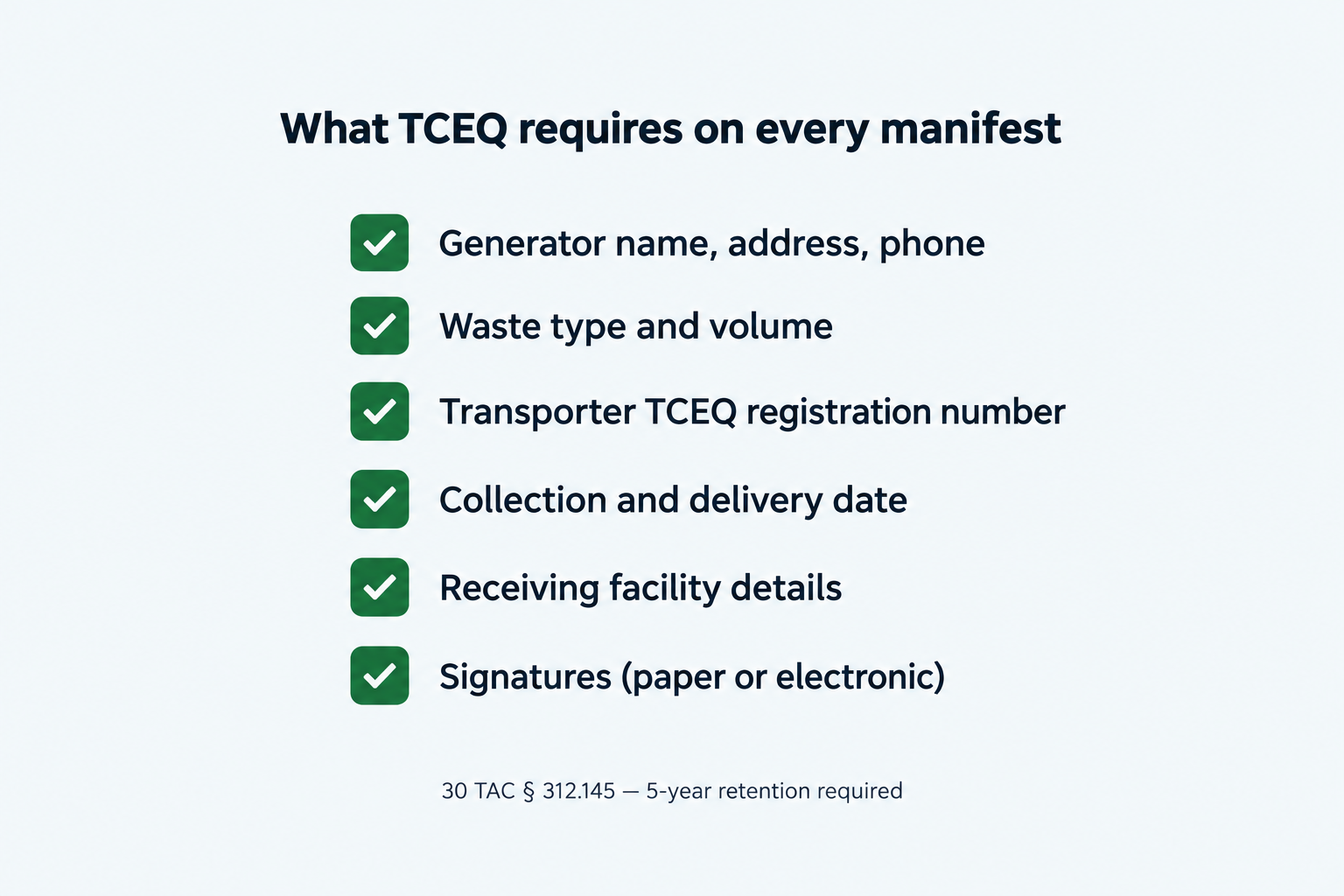
Step | Paper workflow | Digital record management |
|---|---|---|
Field capture | Handwritten on-site | AI extraction from photo |
Data entry | Re-keyed into spreadsheet | Extraction can reduce manual transcription; corrections may be needed |
Field validation | Depends on staff review and procedures | Incomplete fields flagged before record is finalized |
Record storage | Physical cabinet | Searchable digital archive |
Retention tracking | Manual | Retention schedule and deletion controls configured separately |
TCEQ audit retrieval | Search through folders | Instant keyword search |
Generator copies | Pickup copy provided at collection; completed copy returned by transporter within 15 days after facility receipt | Workflow must support both required distribution stages |
The time cost of the paper workflow shows up in two places: the hours spent re-keying and filing, and the hours spent searching when TCEQ requests records. Digital tools address the retrieval and transcription problems. They do not automatically satisfy the distribution or signature obligations in the rule.
How does digitizing trip-ticket records actually work alongside the paper process?
The paper original doesn't disappear in a digital workflow - and it doesn't need to. ComplyFlo supports a photograph-and-extract approach that can work alongside the paper process.
Here's what that workflow looks like in practice:
The operator photographs the paper trip ticket at the gate or point of collection.
ComplyFlo's AI attempts to extract configured fields - generator, waste type, gallons, transporter TCEQ number, driver, manifest number, collection date. Image quality, handwriting, and document format affect extraction accuracy.
Extractions surface in a review queue. The original paper image appears on the left; the extracted fields appear on the right. The authorized user reviews the extracted data against the source record, corrects errors, and approves.
Once finalized in the company's workflow, the record feeds the daily log, compliance reports, and billing simultaneously.
The paper copy is retained at the facility. The digital record supports retrieval and reporting.
The human review step is the important part. The two-checkpoint review process - authorized-user review followed by billing/admin review - is designed to identify mismatches before invoices are issued.
What are significant discrepancies, and how does the 15-day process work?
Significant discrepancies and missing fields are different issues. Section 312.145(c) establishes a specific process for discrepancies between the recorded waste and what the receiving facility actually receives.
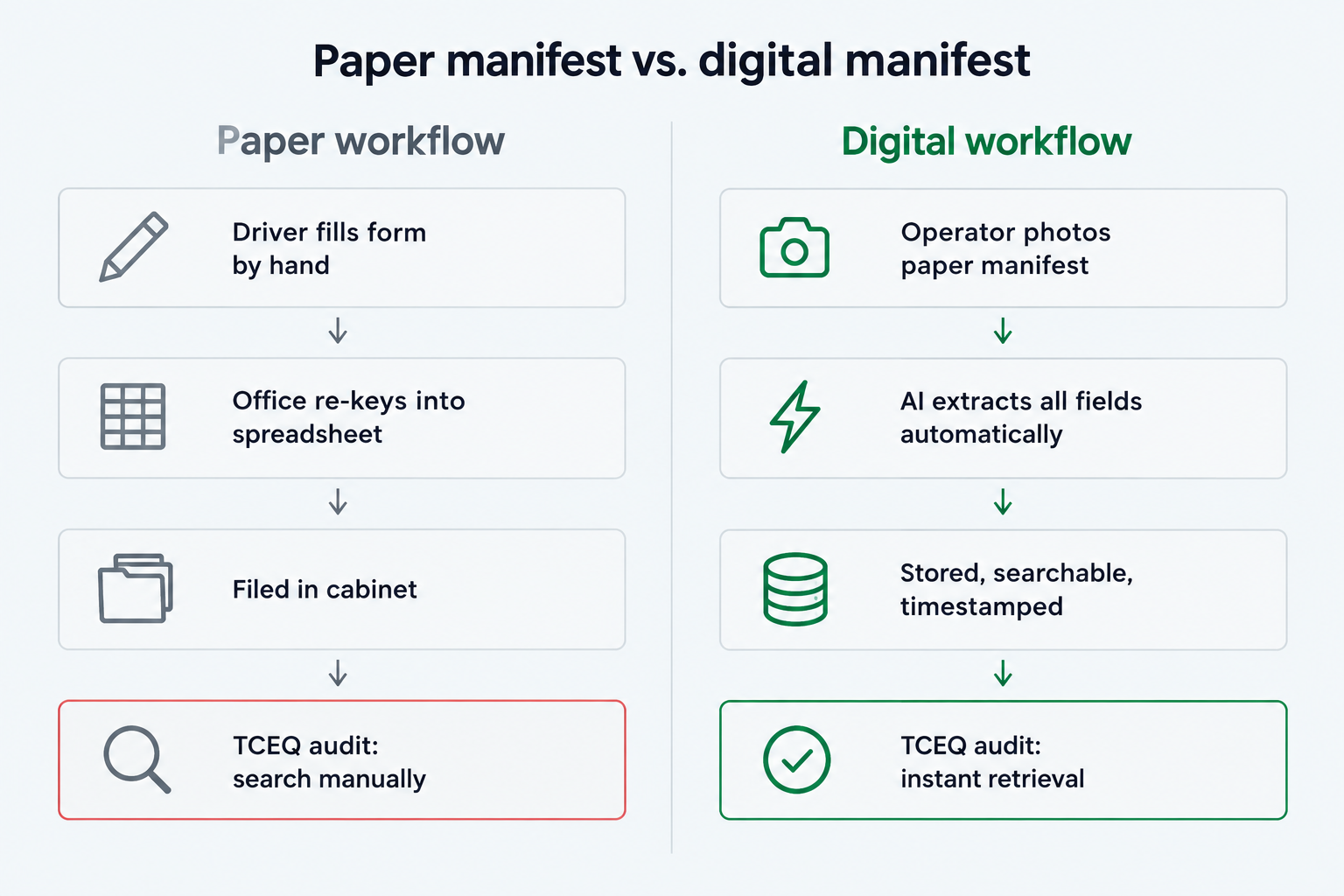
Section 312.145(c) addresses situations where the waste type or quantity received at the facility differs from what is recorded on the trip ticket. Two thresholds define a significant discrepancy:
Greater than 10% by bulk weight, or
Greater than 15% by liquid volume (for liquid waste)
A significant type discrepancy includes obvious differences found by inspection or analysis.
When a significant discrepancy is found, the receiving facility notes it on each copy. The transporter must attempt reconciliation with the generator or the receiving facility. If the discrepancy is not resolved within 15 days after delivery, the transporter must immediately send TCEQ a letter explaining the discrepancy and reconciliation attempts, along with a copy of the trip ticket.
Missing required fields are a separate record-management concern. They should be identified and corrected through the company's own review process. Digital tools that flag incomplete fields before a record is finalized help operators catch those gaps earlier - at the time of entry rather than at audit.
Try ComplyFlo
ComplyFlo is built for Texas waste operators - wastewater treatment plants, haulers, MSW disposal sites, and compost facilities - who want to move away from paper logbooks and spreadsheets. The AI manifest intake attempts to extract required fields from a photo of the paper trip ticket, routes low-confidence extractions to an authorized user for review, and stores finalized records in a searchable archive. One platform covers trip-ticket record management, daily compliance logging, DMR package generation, and integrated billing.
ComplyFlo helps teams capture, review, and retrieve records efficiently. Operators remain responsible for confirming that their workflow satisfies the applicable signature, distribution, and retention requirements for their waste stream.
Book a demo at complyflowaste.com to see the manifest intake workflow in action.
Frequently Asked Questions
Do Texas sludge transporter trip tickets require paper signatures?
Not exclusively. 30 TAC § 312.145 expressly recognizes electronic signatures for the generator and the receiving-facility representative. However, a complete compliant trip ticket must still satisfy all required-field, distribution, and retention provisions. Scanning a paper trip ticket to support record management is different from creating, executing, and distributing a fully electronic trip ticket.
How long must sludge transporter trip tickets be retained in Texas?
Under 30 TAC § 312.145, trip ticket copies must be retained for five years and kept readily available for TCEQ review. The transporter - not the receiving facility - is responsible for returning a completed copy to the generator within 15 days after the waste is received at the disposal or processing facility. ComplyFlo helps teams organize and retrieve those records quickly when needed.
What happens if there is a significant discrepancy on a trip ticket?
Section 312.145(c) establishes a discrepancy process for differences between the waste type or quantity recorded and what the receiving facility actually receives. Discrepancies greater than 10% by bulk weight or 15% by liquid volume are significant quantity discrepancies. Significant type discrepancies include obvious differences found by inspection or analysis. The receiving facility notes the discrepancy on each copy. The transporter must attempt reconciliation within 15 days after delivery; if unresolved, the transporter must immediately send TCEQ a letter with a copy of the trip ticket. Missing fields are a separate record-management concern, not the same as a significant discrepancy under this process.
Can a waste hauler capture trip ticket data digitally at the point of collection?
Yes, with important caveats. 30 TAC § 312.145 recognizes electronic signatures for certain parties, so digital capture at the point of collection is feasible. However, a digital workflow must still satisfy all required-field, signature, distribution, and retention provisions. Photographing an existing paper trip ticket to support record management is a different workflow from creating and executing the legally required record electronically.
What information does 30 TAC 312.145 require on a trip ticket?
Section 312.145(a) lists eight required elements: (1) transporter name, address, phone, and TCEQ registration number; (2) generator name, signature or electronic signature, address, phone, and collection date; (3) type and amount of waste collected or transported; (4) names and signatures of responsible persons collecting, transporting, and depositing the waste; (5) date and place of deposit; (6) receiving facility permit or site-registration number, location, and operator; (7) receiving on-site representative name and signature or electronic signature acknowledging receipt and the amount received; (8) volume of the grease trap, grit trap, or septic tank. ComplyFlo supports operators in capturing and reviewing these fields.
Free checklist
Sludge Transporter Trip Ticket Checklist
Review required fields, signatures, generator copies, five-year retention, annual summaries, and significant-discrepancy procedures.
Ready to replace paper trip tickets?
Book a free 1-hour demo and see how ComplyFlo keeps trip tickets, signatures, and records organized in one place.
Book a free demoGet TCEQ compliance updates
Deadline reminders, rule changes, and practical guides for Texas waste operators. No spam — unsubscribe anytime.
By subscribing you agree to receive emails from ComplyFlo. See our privacy policy.