Wastewater
Chlorine Dose Calculation Wastewater: How to Dial In Disinfection Without Over-Dosing
The chlorine dose calculation wastewater operators rely on is a two-part formula - but getting the dose right means understanding CT value, your permit's TRC limit, and how to trend daily residual readings over time.
October 21, 2026 · 5 min read
TL;DR
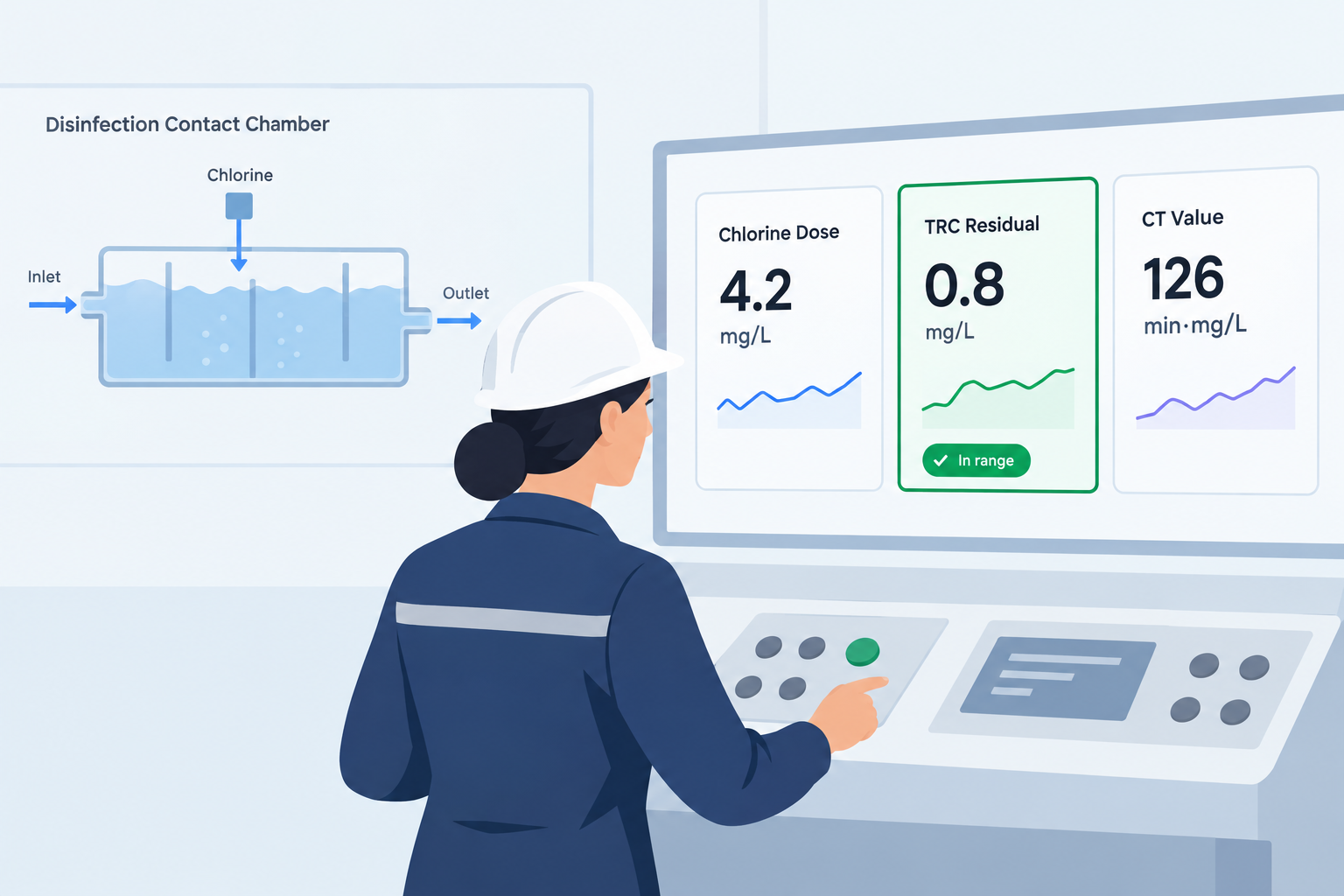
Chlorine disinfection involves related but distinct calculations. A dose estimate uses chlorine demand and a target residual under defined conditions; available-chlorine mass feed is calculated as dose in mg/L x flow in MGD x 8.34. CT is residual concentration multiplied by the applicable contact time, but it does not replace the facility's permit, bacteria limits, or approved design requirements. At plants using dechlorination, monitor disinfection residual and final-effluent residual separately - they are different locations with different objectives. ComplyFlo can support configured calculations, records, and trend review; operating decisions remain with qualified personnel.
Why does getting the chlorine dose wrong matter?
An inappropriate chlorine dose can create disinfection risk, excess chemical cost, or discharge-compliance problems, depending on the facility's operating conditions and dechlorination performance. Under-dosing means the disinfection process may not achieve the bacteria limits, specified residuals, detention time requirements, or other conditions in your TCEQ TPDES permit. Over-dosing means excess total residual chlorine (TRC) may reach the receiving water if dechlorination is insufficient - which is acutely toxic to aquatic life - and drives up dechlorination chemical use regardless.
The dechlorination cost is real but proportional to the residual that actually remains after demand is satisfied - not simply to the applied dose. EPA's Wastewater Technology Fact Sheet: Dechlorination (September 2000) illustrates an SO₂ feed calculation using an assumed 1:1 mass ratio to chlorine residual expressed as Cl₂. This is a calculation assumption, not a universal operating setting; use the facility's validated dosing and control procedures. Applied dose that is consumed by demand does not become residual requiring removal.
The goal is a dose that meets the applicable disinfection requirements - permit limits, bacteria limits, residual and detention time conditions - without generating more residual than necessary before the dechlorination step.
What is the chlorine dose calculation wastewater operators rely on?
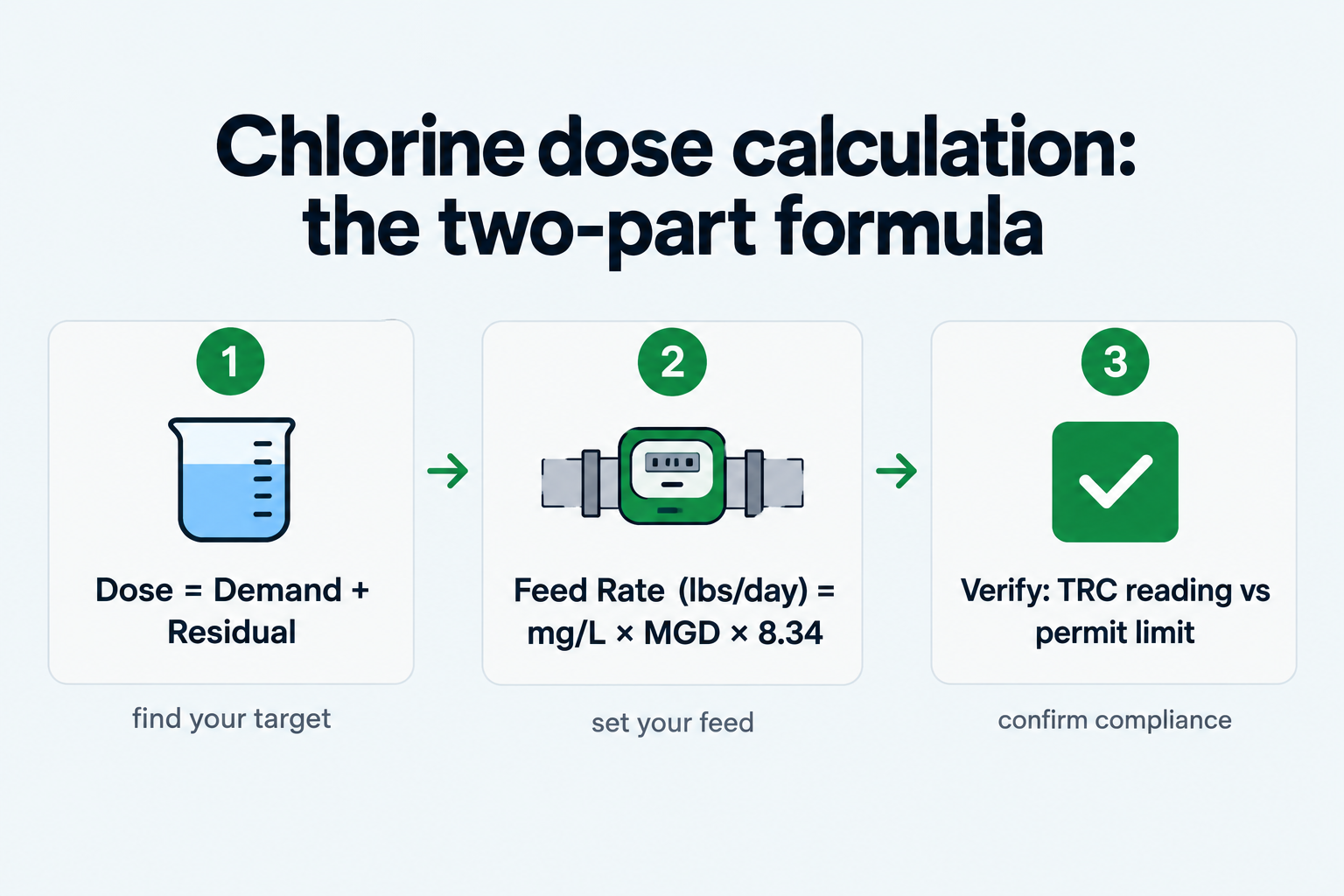
The chlorine dose calculation wastewater operators use has two steps. The first step estimates the target dose in mg/L based on demand and target residual under representative conditions. The second converts that to an available-chlorine mass feed in lbs/day.
Step 1 - Target dose:
Dose (mg/L) = Chlorine Demand (mg/L) + Target Residual (mg/L)
Chlorine demand is the amount of chlorine consumed by reactions with organics, ammonia, and other reducing agents before a residual forms. Demand and residual must be evaluated at a defined contact time and under representative conditions - they are not fixed properties independent of those test conditions. EPA's Wastewater Technology Fact Sheet: Chlorine Disinfection (September 1999) gives a usual applied-chlorine dose range of 5-20 mg/L for secondary wastewater, with actual requirements depending on effluent quality, demand, and the specific disinfection requirements in the permit. Establish a representative demand through the facility's own testing and operating procedures.
Step 2 - Available-chlorine mass feed:
Available-Chlorine Feed (lbs/day) = Dose (mg/L) × Flow (MGD) × 8.34
The 8.34 factor converts MGD and mg/L to pounds per day. So if your plant flows 2.5 MGD and your target dose is 12 mg/L:
12 × 2.5 × 8.34 = 250 lbs/day of available chlorine
This gives the required available-chlorine mass feed. Converting it to a commercial-product quantity or liquid-pump setting requires the product's available-chlorine strength, solution density where applicable, and verified equipment calibration. The dose isn't static - as flow changes through the day, so does the feed rate needed to maintain a consistent mg/L at the contact chamber inlet. Plants with flow-paced chemical feed systems handle this automatically. Plants without them need operators to recalculate and adjust as flow shifts.
What does CT value mean, and how does it relate to your permit?
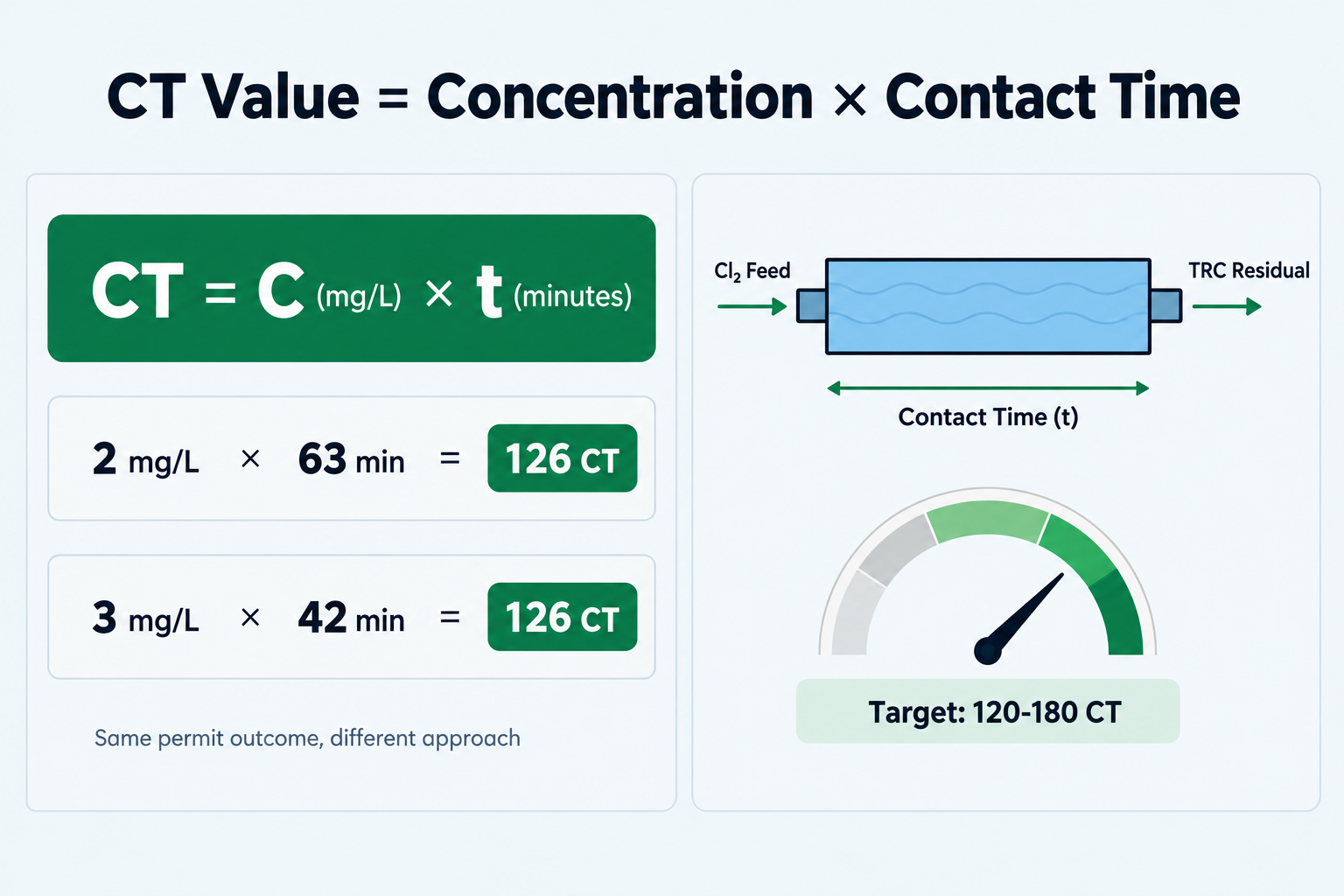
CT is a tool for evaluating or designing disinfection systems. CT is the product of chlorine concentration multiplied by the applicable contact time:
CT = Concentration (mg/L) × Contact Time (minutes)
Some permits and design documents reference CT as part of the disinfection basis. Others specify bacteria limits, minimum chlorine residuals, minimum detention times, or a combination of these - without expressing a CT requirement directly. Disinfection requirements vary by permit; read the facility's actual TPDES permit and approved disinfection design rather than assuming a universal CT requirement applies.
Where CT is used as an operational or design reference, two different concentration-and-time combinations can produce the same numerical CT:
2 mg/L × 63 minutes = 126 CT
3 mg/L × 42 minutes = 126 CT
However, the same numerical CT does not automatically establish equivalent compliance or equivalent disinfection performance. Disinfection depends on wastewater characteristics, chlorine species, temperature, mixing, and contact conditions. A higher residual and shorter contact time may produce the same CT value but are not automatically interchangeable operating conditions. Follow the facility's approved design and permit requirements before changing residual or contact-time targets.
The contact time used in a CT calculation is also worth distinguishing from simple V/Q detention time. Effective contact time depends on the applicable design or evaluation method for the specific facility - not just basin volume divided by flow.
CT is calculated. Residual is measured. Daily TRC readings at the contact chamber tell you whether the chlorination process is performing as expected. If residual is consistently lower than the target, demand may be higher than assumed.
How do you use daily TRC readings to trend dose efficiency?
Residual monitoring at the frequency and locations required by the permit and operating procedures is a key part of disinfection and dechlorination control. At a plant with dechlorination, those locations serve different purposes and should be tracked separately:
Contact-chamber residual - helps assess whether the chlorination process is performing as expected relative to the disinfection basis.
Final-effluent residual - helps assess compliance with the discharge requirement. At many Texas plants, this is the TRC limit in the TPDES permit.
Do not use one location's result as a substitute for the other. EPA's Wastewater Technology Fact Sheet: Dechlorination (September 2000) describes measuring residual after disinfection but before sulfur-dioxide addition for feed-forward control, with downstream measurements for feedback control on the dechlorination side.
A changing trend in either location is an investigation prompt - not a definitive diagnosis. Low or erratic residual can involve feed delivery, chemical strength, mixing, contact time, analyzer or sampling performance, or changes in flow. Rising residual alongside a constant dose suggests demand has decreased, but other explanations should be checked before adjusting feed. The appropriate response depends on the specific location, the magnitude and direction of the change, and the facility's operating procedures.
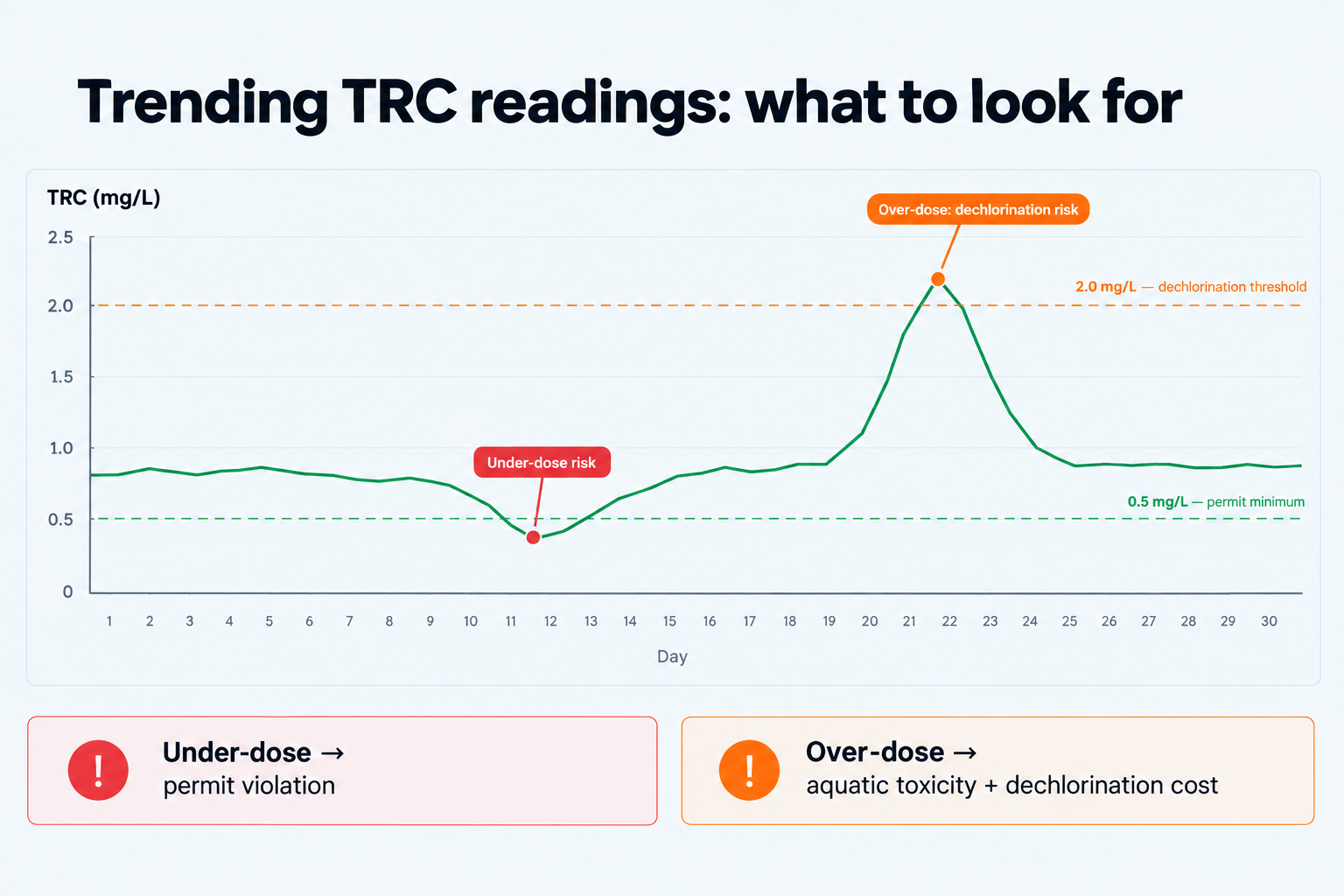
At plants using spreadsheets or paper logbooks, the limitation isn't that the formulas are missing - it's that reviewing trends requires someone to actively look. A dedicated parameter log that flags out-of-range readings and generates 30-day trend charts automatically makes that review a routine part of the day rather than a task that happens when something already looks wrong.
Manual vs digital: what changes when you stop tracking this in a spreadsheet?
Task | Manual (paper / spreadsheet) | Digital (ComplyFlo) |
|---|---|---|
Log daily TRC reading | Paper logbook, re-entered into spreadsheet | Mobile entry, timestamped automatically |
Calculate feed rate | Formula in spreadsheet, manually updated for flow | Calculator applies entered dose and flow to return available-chlorine mass feed |
Track 30-day TRC trend | Build chart manually or scan paper log | 30-day trend chart auto-generated per parameter |
Alert when TRC drifts outside target | Requires active review of log or chart | Out-of-range readings flag in red on dashboard |
Calculate CT for review where applicable | Manual calculation per shift | CT calculated from entered residual and contact time |
Generate DMR data | Compile from spreadsheet tabs | Applicable monitoring data populate a draft report for review; export capabilities depend on the configured reporting workflow |
The difference is in when problems become visible. A log that requires manual trend-building is one where drift is caught when someone looks - which may not be until a compliance event prompts the review. A system that flags out-of-range readings automatically and generates trend charts as readings are entered or imported makes that review a routine part of the day. The timeliness of the information depends on the sampling frequency and data source.
Try ComplyFlo
ComplyFlo is built specifically for Texas wastewater treatment plant operators who need to move past paper logbooks and disconnected spreadsheets. The platform supports separate parameter logging for disinfection-side and final-effluent residuals, calculates available-chlorine mass feed and CT values from entered readings, and flags out-of-range results in red on the dashboard. Daily entries are timestamped, attributed to the operator who entered them, and plotted on a 30-day trend chart. Applicable permit-monitoring results can populate a draft DMR package for authorized review; internal dose, CT, and process-control records remain available as supporting operational information. Operating decisions remain with qualified plant personnel.
ComplyFlo is currently in beta for wastewater treatment plants. Book a demo to see the chlorine dose calculator and TRC trending in action.
Frequently Asked Questions
What is the standard chlorine dose calculation wastewater operators use?
The dose estimate uses: Dose (mg/L) = Chlorine Demand (mg/L) + Target Residual (mg/L). To convert to an available-chlorine mass feed: Available-Chlorine Feed (lbs/day) = Dose (mg/L) x Flow (MGD) x 8.34. Demand and residual must be evaluated under representative conditions. Converting the lbs/day result to a commercial-product quantity or pump setting also requires product strength, density, and equipment calibration. ComplyFlo can calculate available-chlorine mass feed from an entered dose and flow. Where a dose estimate is based on demand plus target residual, the demand and residual inputs must represent defined contact conditions and require operator review.
What does CT value mean in a wastewater permit?
CT is the product of chlorine Concentration (mg/L) x Contact Time (minutes) and is used as a design or operational assessment tool for disinfection systems. Not every TCEQ TPDES permit expresses a CT requirement directly - many instead specify bacteria limits, minimum chlorine residuals, minimum detention times, or a combination. Two different concentration-and-time combinations can produce the same CT value, but they are not automatically interchangeable operating conditions - disinfection performance also depends on wastewater characteristics, chlorine species, temperature, and mixing. Always follow the facility's actual permit and approved design.
What is a typical TRC permit limit for a Texas wastewater plant?
Disinfection and dechlorination requirements vary by permit. TCEQ TPDES examples include requirements such as a minimum specified chlorine residual after a defined detention time for disinfection, and a final-effluent TRC limit - sometimes below 0.1 mg/L - to protect receiving waters. These are specific permit conditions, not universal benchmarks. Read your facility's actual permit for the applicable limits and sampling locations. At plants using dechlorination, the disinfection-side residual and the final-effluent residual are different measurements with different compliance purposes.
What happens when you over-dose chlorine in wastewater treatment?
Excess applied chlorine beyond what demand consumes remains as residual. At plants with dechlorination requirements, higher residual requires more dechlorination chemical. EPA's Wastewater Technology Fact Sheet on Dechlorination (September 2000) illustrates an SO₂ feed calculation using an assumed 1:1 mass ratio to chlorine residual expressed as Cl₂ - a calculation assumption, not a universal operating setting; actual feed depends on the facility's validated dosing and control procedures. If excess TRC reaches the receiving water, it is acutely toxic to aquatic life and may put the facility in permit violation. The goal is the dose that meets the applicable disinfection requirements without generating more residual than the dechlorination system needs to manage.
How can I trend chlorine dose efficiency over time?
Log residual readings at each required location - disinfection-side and final-effluent - at the frequency your permit and operating procedures specify. Track each separately; they have different compliance purposes. A changing trend at either location should prompt review of actual chemical feed, flow, chemical strength, demand, mixing and contact conditions, and instrument performance before a corrective action is selected. ComplyFlo's parameter logging timestamps every residual entry and auto-generates 30-day trend charts, making pattern review part of the normal operating day.
Free checklist
TPDES Permit Compliance Checklist
Review permit-specific DMR submissions, sampling, SSO reporting, renewal milestones, and applicable pretreatment responsibilities.
Ready to move your plant logs and reports off paper?
Book a free 1-hour demo with a ComplyFlo team member and see it running on your own workflow.
Book a free demoGet TCEQ compliance updates
Deadline reminders, rule changes, and practical guides for Texas waste operators. No spam — unsubscribe anytime.
By subscribing you agree to receive emails from ComplyFlo. See our privacy policy.