MSW Disposal
TCEQ MSW Annual Report Due Date: What's Due November 10 and How to File Without Scrambling
The TCEQ MSW annual report due date is November 10 every year. Here's which facilities must file, what data TCEQ requires, and how to avoid the errors that delay acceptance.
October 23, 2026 · 5 min read
TL;DR
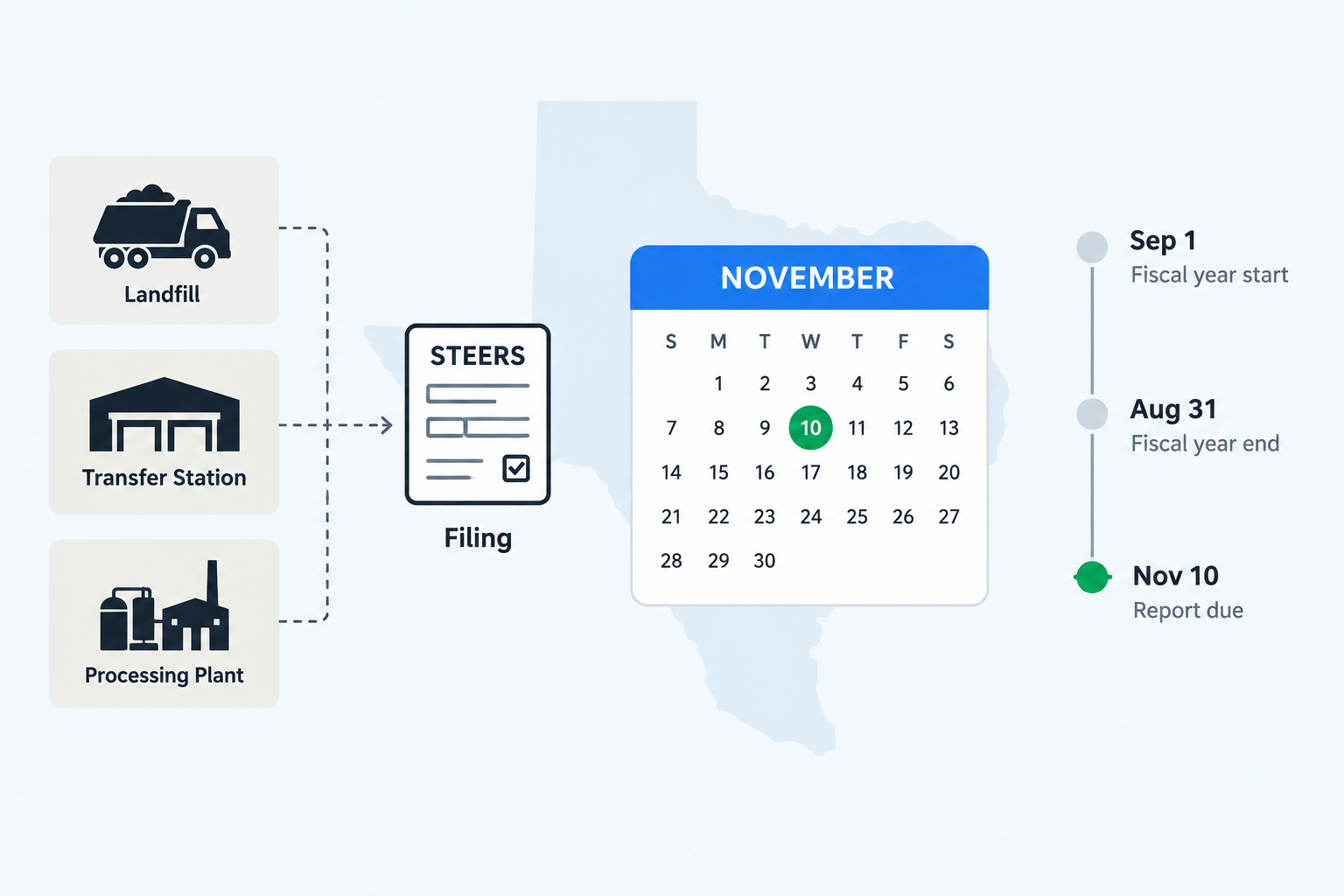
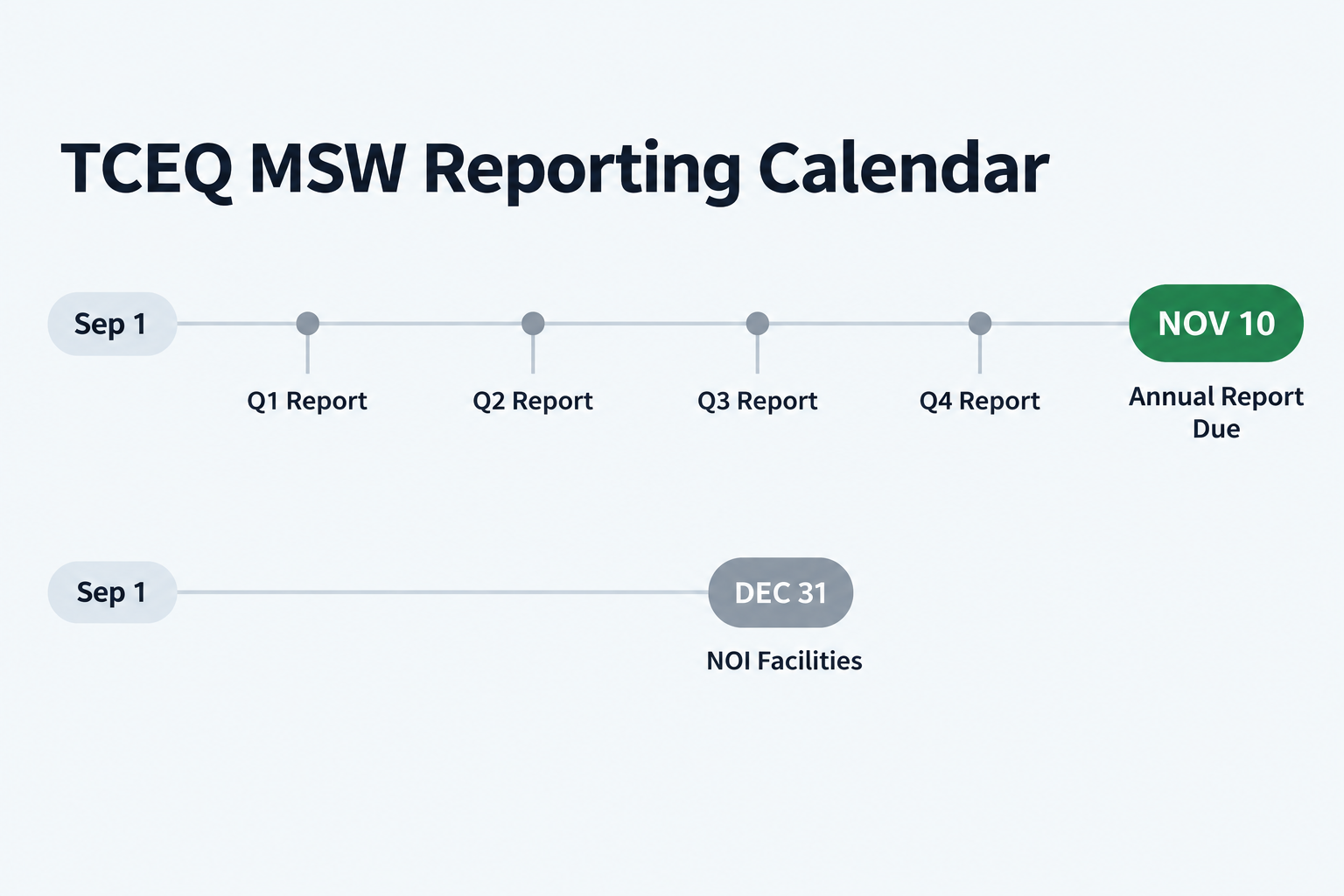
TCEQ's MSW Annual Reporting Program identifies November 10 as the deadline for applicable permitted or registered MSW facilities, covering the preceding September 1 through August 31 fiscal year. Use the current facility-specific form and submission instructions to determine required data, units, and filing method. Quarterly disposal fee reports and the December 31 operational-status report for qualifying temporary or indefinite authorizations are separate programs with different purposes. ComplyFlo can help operators organize records and prepare reporting data for review; operators remain responsible for the applicable requirements and final submission.
Which facilities have to file by November 10?
Operators of permitted or registered MSW facilities subject to TCEQ's MSW Annual Reporting Program must submit the applicable annual report by November 10 following the September 1 through August 31 reporting year. Requirements and report fields depend on facility type.
The facilities covered include Type I and Type IV MSW landfills (including applicable arid-exempt units designated Type IAE and Type IVAE), transfer stations, and processing facilities. Each facility type has its own applicable form; required data fields are not identical across all of them.
It is worth keeping two separate programs distinct. The MSW Annual Reporting Program collects waste types and amounts, processing and disposal activity, facility status, and applicable capacity information. A different obligation - the operational-status report under Texas Water Code § 5.587 - applies only to qualifying temporary or indefinite authorizations that do not already have a regular reporting requirement. That program includes certain NOI-authorized facilities such as low-volume transfer stations, citizen collection stations, and recycling, mulching, and composting operations, and carries a December 31 deadline.
These two reports serve different purposes and are not interchangeable. Determine which obligations apply from the facility's authorization and current TCEQ guidance.
Note also that 30 TAC § 330.675 distinguishes quarterly disposal fee reporting (applicable to disposal facilities and due within 20 days of each fiscal quarter end) from the annual reporting obligation. Not every transfer, processing, or other MSW facility is subject to the same quarterly requirement.
What fiscal year does the annual report cover?
The TCEQ MSW annual report covers the period September 1 through August 31.
TCEQ's current MSW Annual Reporting Program guidance identifies the September 1 through August 31 state fiscal year as the reporting period, with November 10 as the annual report deadline. The same fiscal calendar applies to quarterly disposal fee reports under 30 TAC § 330.675(a)(5), though quarterly and annual obligations are separate - confirm which apply to your facility type.
This matters for preparation. When November 10 arrives, the facility is filing on a fiscal year that ended 71 days earlier. All 12 months of data - September through August - need to be compiled, reconciled, and ready before that deadline.
What data does TCEQ expect in the report?
Use the current form for the facility type as the controlling data checklist. The applicable form - not a universal regulatory list - determines exactly which fields apply to a given facility.
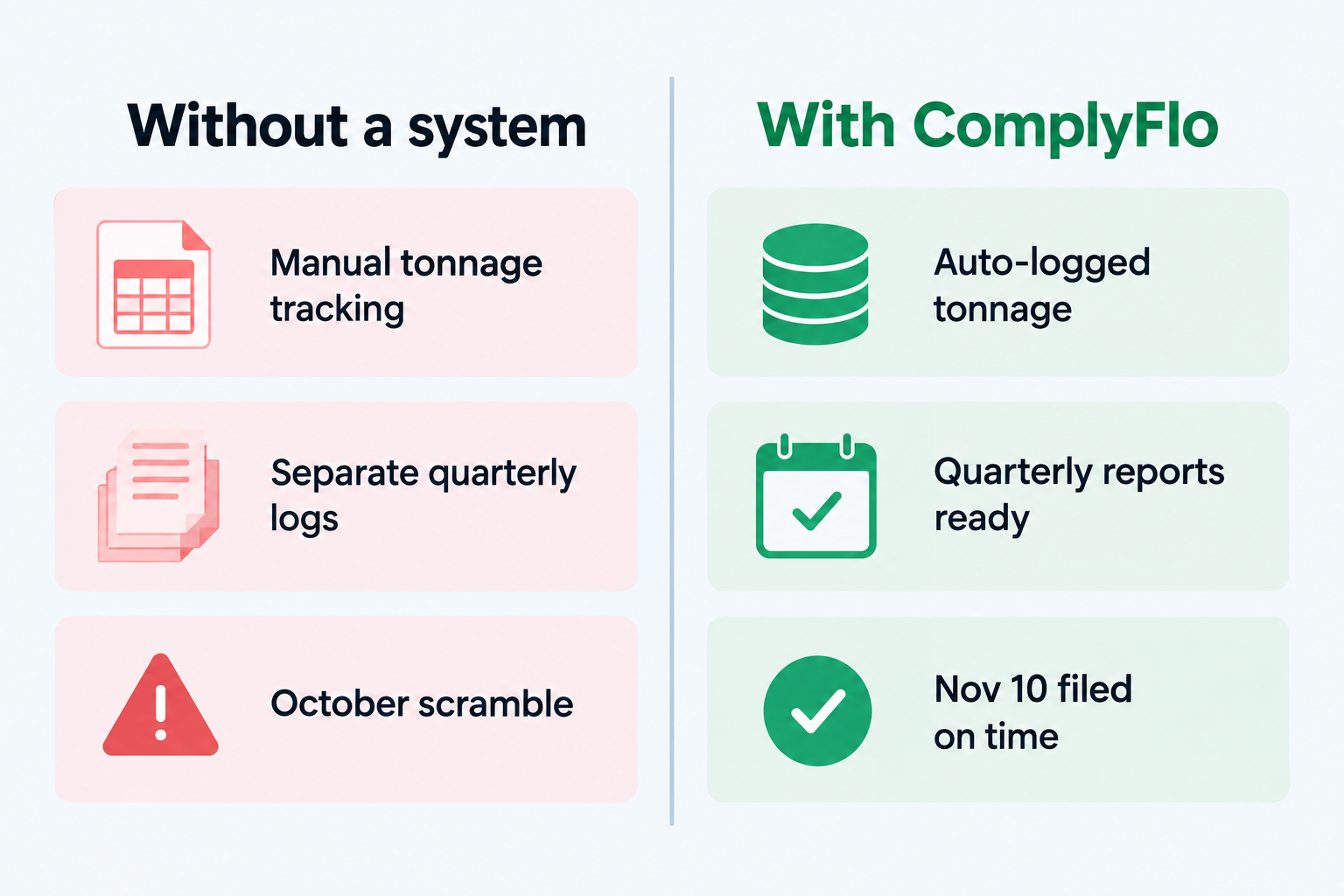
Per 30 TAC § 330.675(a)(1)(C), the report must contain information requested on the form, including waste received for processing or disposal and other information the executive director may request. Depending on facility type and the applicable form, this commonly includes:
Waste received by category - waste types and amounts, typically including MSW, construction and demolition debris, industrial non-hazardous waste, and yard waste
Processing, disposal, or recovery activity - how received material was handled
Facility identification and operational status - operator name, address, phone number, permit or registration number, and active/closed status
Remaining disposal capacity where applicable - relevant to landfills; not necessarily required for every transfer or processing facility
Identify each facility by its permit or registration number and follow the applicable form's instructions for separate facility reporting. Operators with multiple sites should confirm reporting requirements rather than assuming one combined submission is acceptable.
For quantities, 30 TAC § 330.675(a)(2) allows reporting in short tons or in cubic yards as received, with specified conversion factors and distinctions for compacted versus uncompacted waste. Report in the units required by the applicable current form. If converting from volume to weight, preserve the original measured units and document the conversion basis - including whether the waste arrived compacted or uncompacted.
Why starting in October leaves limited time
The report covers 12 months of waste intake data. That data does not assemble itself.
Starting in October leaves a limited preparation window. Facilities with incomplete or fragmented records may need substantial time to reconcile data before November 10. By October 1 there are only 40 days until the deadline. That window has to cover data gathering, reconciliation of quantities using the form's accounting instructions, verification of the authorized submission method, and the actual filing.
How much time is actually needed depends on record quality and facility complexity. A facility that has been logging manifests and waste types throughout the fiscal year can compile the report from records that already exist. A facility reconstructing a full year of tonnage from paper records faces a much larger task.
Preparation time also depends on the specific form requirements. Different facility types may have different data fields, unit requirements, and submission workflows. Confirming those details before the filing window closes is part of the preparation.
Errors to check for before filing
Filing problems can create delays that consume the remaining window before November 10. Some issues to review before submitting:
Quantity reconciliation. Reconcile quantities using the definitions and accounting instructions in the applicable form, including inventory changes or other categories where required. Investigate unexplained differences and avoid double-counting material. Processing facilities may have inventory changes or other accounting categories that affect how quantities balance across the form.
Missing waste type detail. Many forms require waste received to be broken down by category rather than reported as a single total. Check the applicable form for which waste streams must be reported separately.
Incomplete facility identification. Each facility with a unique permit or registration number typically requires its own separate report. Operators covering multiple sites should confirm whether combined or separate reporting applies.
Wrong form or submission method. Use the current reporting-year form and confirm the authorized submission method from TCEQ's current program instructions before filing. STEERS is TCEQ's electronic reporting platform; verify whether it is the required submission channel for the annual waste and activity report for your facility type and the current reporting year.
Account access. If electronic filing is required, verify account access and permissions before the final days of the filing window.
Manual tracking versus a system built for it
Approach | Data at filing time | Reconciliation effort |
|---|---|---|
Paper records and spreadsheets | Depends on how consistently records and totals are maintained | May require cross-checking across separate sources |
Centralized platform | Records and totals organized throughout the year, where configured | Still requires review, reconciliation, and correction of input errors |
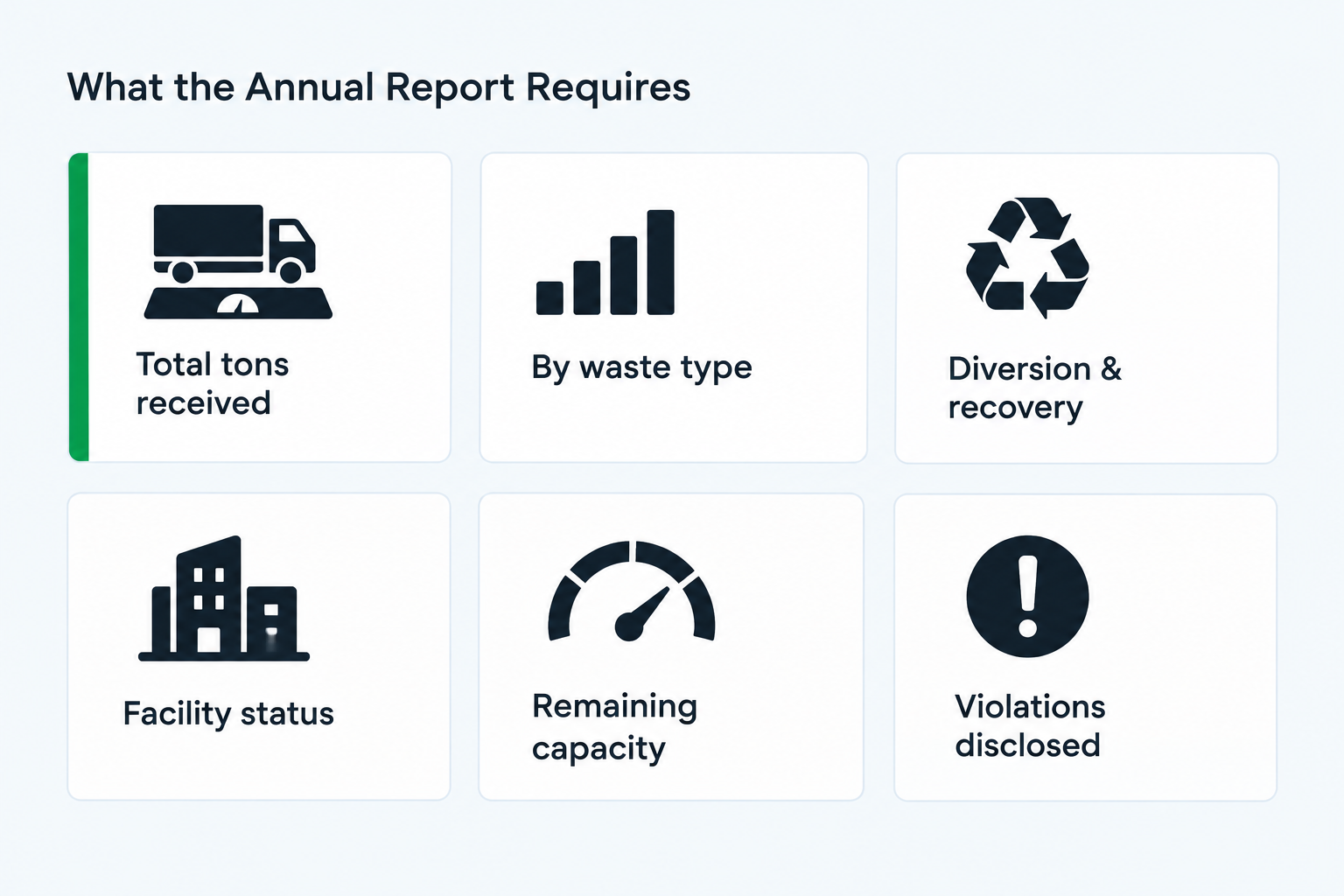
ComplyFlo captures waste intake data from digital manifests throughout the fiscal year. Each load is logged with waste type, volume or weight, and source at the time of receipt - not reconstructed later. When the annual report window opens, the records needed to prepare the filing are already organized rather than scattered across paper logs and spreadsheets. Operators still verify and confirm the data against the applicable form requirements before submitting to TCEQ.
Try ComplyFlo
ComplyFlo is built for Texas waste facility operators who need organized records ahead of TCEQ compliance deadlines - including the November 10 MSW annual report. The platform digitizes manifest intake with AI field extraction, logs waste type and quantity at the time of receipt, and keeps data organized throughout the fiscal year rather than requiring reconstruction at filing time. Operators use ComplyFlo to prepare and review data before submitting to TCEQ through the applicable current-year process. If your facility is still pulling together a year of waste records in October, book a demo to see how continuous tracking changes the preparation window.
Frequently Asked Questions
What is the TCEQ MSW annual report due date?
The TCEQ MSW annual report due date is November 10 each year for operators of permitted or registered MSW facilities subject to TCEQ's MSW Annual Reporting Program. The report covers the TCEQ fiscal year running September 1 through August 31. Use the current reporting-year form and submission instructions for your facility type to confirm the authorized filing method. A separate December 31 operational-status deadline applies to qualifying temporary or indefinite authorizations without a regular reporting requirement, including specified NOI facilities, under Texas Water Code § 5.587.
Which MSW facilities are required to file by November 10?
Operators of permitted or registered MSW facilities subject to TCEQ's MSW Annual Reporting Program must file by November 10. This includes Type I and Type IV MSW landfills (including applicable arid-exempt facilities), transfer stations, and processing facilities - though required data fields vary by facility type. Verify your obligations using the current TCEQ reporting-year instructions for your specific authorization. Separately, qualifying temporary or indefinite authorizations without a regular reporting requirement - including specified NOI facilities such as low-volume transfer stations, citizen collection stations, and recycling, mulching, and composting operations - face a December 31 operational-status deadline under Texas Water Code § 5.587.
What happens if an MSW facility misses the November 10 TCEQ deadline?
Missing a required TCEQ MSW report can have serious consequences. Under 30 TAC § 330.675, failure to submit a required report by the due date is grounds for TCEQ to revoke a permit or registration. Under Texas Water Code § 7.051, TCEQ may also assess administrative penalties. For disposal facilities subject to quarterly fee reporting, late payment of associated fees can separately result in interest charges. These are distinct consequences tied to different provisions - confirm which apply to your facility type and authorization.
What data does TCEQ require in the MSW annual report?
Required data varies by facility type - use the current TCEQ form for your facility as the controlling checklist. Depending on the form, information may include: waste received by category; processing, disposal, or recovery activity; facility identification and operational status; and remaining disposal capacity where applicable. Report quantities in the units required by the current form. 30 TAC § 330.675 provides for short tons or qualifying volume-based reporting with specified conversion factors - preserve original measured units and document any conversion basis.
How do I determine the correct way to submit the TCEQ MSW annual report?
Use the current TCEQ reporting-year instructions for your facility type to determine the authorized submission method and form. STEERS (https://www3.tceq.texas.gov/steers/) is TCEQ's electronic reporting platform and is explicitly required for the separate operational-status report for qualifying temporary and indefinite authorizations. For the MSW annual waste and activity report, confirm the authorized method from TCEQ's current program guidance before filing. ComplyFlo can help operators organize waste intake records and prepare reporting data for review; operators remain responsible for the applicable requirements and final submission.
Free checklist
Sludge Transporter Trip Ticket Checklist
Review required fields, signatures, generator copies, five-year retention, annual summaries, and significant-discrepancy procedures.
Ready to replace paper trip tickets and manifests?
Book a free 1-hour demo with a ComplyFlo team member and see it running on your own workflow.
Book a free demoGet TCEQ compliance updates
Deadline reminders, rule changes, and practical guides for Texas waste operators. No spam — unsubscribe anytime.
By subscribing you agree to receive emails from ComplyFlo. See our privacy policy.